 how-to guide
Troubleshoot Tankless Water Heater Error Codes: Step-by-Step Guide
Table of Contents
- Understanding Tankless Water Heater Error Codes
- Ignition Failure and Flame Loss Error Codes
- Venting and Air Supply Issues Explained
- Water Flow and Pressure Error Codes
- Overheating and Temperature Sensor Faults
- Rinnai Tankless Error Codes and Brand-Specific Troubleshooting
- Navien Tankless Error Codes and Reset Procedures
- Preventative Maintenance and Descaling for Error Prevention
- Frequently Asked Questions
Troubleshoot Tankless Water Heater Error Codes: Step-by-Step Guide
Last Updated: July 23, 2026
When your tankless water heater displays an error code, it's sending a specific diagnostic message about what's gone wrong. Learning to troubleshoot these codes can save you hundreds of dollars in service calls and help you determine whether you're facing a quick fix or a job requiring professional attention. At Home Tech, we've spent over a decade diagnosing tankless systems across the Phoenix metro area.
Understanding Tankless Water Heater Error Codes
Your tankless water heater's control board monitors dozens of sensors and safety mechanisms. When something falls outside normal operating parameters, the system shuts down and displays a code to protect the unit from damage.
Error codes serve as a diagnostic language between your system and you. Different manufacturers use slightly different numbering systems, Rinnai uses two-digit codes like 11 or 12, while Navien uses codes like E003 or E012, but they all follow the same logic: identify the problem area and trigger a shutdown until conditions normalize. The system shuts down instead of continuing to operate because a tankless water heater that can't ignite properly, can't vent exhaust safely, or can't sense flame presence becomes a hazard.
Why Error Codes Matter and What They Tell You
Understanding error codes transforms you from someone waiting helplessly for a technician to someone who can diagnose half the problem before the appointment. When you call a service provider and can say, "My Rinnai is throwing code 12," they immediately know you're dealing with a flame loss issue, not a venting blockage.
Error codes also help you avoid unnecessary panic. Some codes indicate routine maintenance issues, like scale buildup from hard water, while others signal component failures requiring replacement.
Safety Precautions Before DIY Troubleshooting
Before you touch anything on your tankless water heater, understand that these units operate at high temperatures, high gas pressures, and involve electrical components. Never attempt to troubleshoot while the unit is actively heating water or while gas is flowing to the burner. Always turn off the gas supply at the isolation valve before opening any panels or accessing internal components. If you smell gas at any point, stop immediately, leave the area, and call your gas company's emergency line.
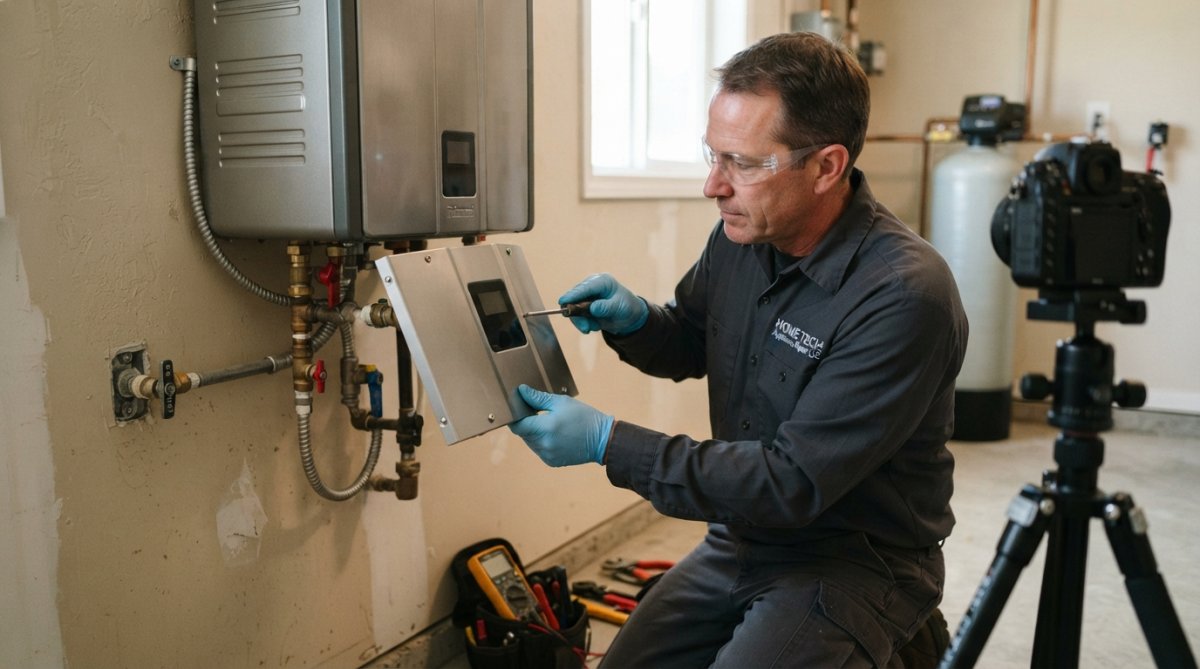
The control board operates on 120V AC power. If you need to access the circuit board or wiring harness, turn off power at the breaker first. Water temperature inside a tankless unit can exceed 140°F even after shutdown. Allow the system to cool for at least 30 minutes before opening panels. If your unit is still under warranty, opening panels or attempting internal repairs may void the warranty. For most homeowners, the safest approach is to perform basic external checks, filter cleaning, vent inspection, gas valve inspection, and call a professional for anything requiring opening the sealed combustion chamber.
Ignition Failure and Flame Loss Error Codes
The ignition system is where all tankless heating begins. If your unit can't ignite the gas, you get no hot water and an error code on the display.
Recognizing Ignition Failure (Code 11, E003)
Code 11 on Rinnai units and E003 on Navien systems both indicate the same problem: the system attempted to ignite but failed. Start by checking the simplest possibility: is gas actually reaching the unit? Verify that the gas isolation valve (the ball valve on the inlet line) is fully open. It should be aligned with the direction of the gas line; if it's perpendicular, it's closed.
Next, listen carefully when the unit attempts to ignite. You should hear a distinct clicking sound from inside the unit, that's the igniter sparking. If you hear nothing, the igniter has likely failed and needs replacement. If you hear clicking but no gas smell, the gas valve may not be opening. If you hear clicking and smell gas but no ignition, the igniter may be too weak to light the gas, or the spark gap may be misaligned. The igniter is a replaceable component costing $50-$150 depending on your unit's model, but it requires opening the sealed section of the unit, making this a job for a licensed technician in most cases.
Diagnosing Flame Loss (Code 12, E012)
Code 12 (Rinnai) or E012 (Navien) means the unit successfully ignited and established a flame, but then the flame went out. This code typically appears after the unit has been heating for a few seconds or longer.
Flame loss during operation is often caused by a dirty or failed flame sensor. The flame sensor sits near the burner and continuously verifies that a flame is present. If it gets covered with carbon buildup or mineral deposits, it can't "see" the flame even though one is burning.
The flame sensor is accessible on many units without opening the sealed combustion chamber completely. It's a thin rod sitting perpendicular to the burner. You can carefully remove it (with the gas off and the unit cooled), wipe it clean with a soft cloth or fine steel wool, and reinstall it. This simple cleaning fixes flame loss codes in roughly 40% of cases where the sensor is the culprit. If cleaning doesn't resolve it, the sensor likely needs replacement, costing $40-$100.
Venting and Air Supply Issues Explained
Your tankless water heater needs two things to operate safely: a source of combustion air and a path for exhaust gases to exit your home. When either is blocked or restricted, error codes appear and the system shuts down.
Clearing Exhaust Blockage (Code 10, E010, E030, 90)
Code 10 (Rinnai), E010 (Navien), E030 (Noritz), or 90 (Rheem) all indicate a venting or exhaust problem. The system detects that exhaust gases aren't flowing out properly.
Start by inspecting the vent termination outside your home. Look at where the vent pipe exits the wall or roof. Is it clear of obstructions? Is there any visible ice, lint, or debris blocking the opening? If you can safely access it, clear away any visible blockage.
Next, check the vent pipe routing inside your home if visible. Is the pipe kinked or crushed anywhere? Does it slope downward toward the outside (typically a 1/4-inch drop per foot of horizontal run)? Improper slope traps condensate inside the pipe, which can freeze or clog the vent. If the vent appears clear and properly installed, the issue may be with combustion air supply. Tankless units need fresh air to feed the burner. Check whether your unit has a dedicated fresh air intake pipe. If not, ensure the room where it's installed has adequate ventilation.
Water Flow and Pressure Error Codes
Your tankless water heater needs minimum water flow to activate the heating cycle. If flow is too low or water pressure is too weak, the system won't ignite and you'll see a flow-related error code.
Addressing Low Water Flow (Code 18, 31, 65, E011, E039)
Code 18 (Rinnai), 31 (Takagi), 65 (Bosch), E011 (Navien), or E039 (Noritz) all indicate insufficient water flow. Low water flow codes are often caused by a clogged inlet filter. Your tankless water heater has a small screen filter on the cold water inlet line. Over time, especially in areas with hard water or older homes with corroded pipes, this filter clogs.
Clearing this filter is straightforward. Turn off the water supply to the unit at the isolation valve. Locate the inlet filter, typically a small cartridge screwed into the inlet port. Unscrew it counterclockwise and remove it. Rinse it thoroughly under clean running water or soak it in white vinegar for 30 minutes to dissolve mineral deposits. Screw it back in and turn the water supply back on.
If cleaning the filter doesn't restore flow, check your incoming water pressure using a water pressure gauge (available at any hardware store for $10-$20). Most tankless units require at least 20 PSI. If pressure is lower, the issue is with your home's water supply, not the water heater. Another possibility is mineral scale buildup inside the heat exchanger itself, which requires professional descaling.
Inlet Filter and Supply Line Checks
The inlet filter should be inspected and cleaned annually, or more frequently if you have hard water or sediment issues. To check your water supply lines for leaks or restrictions, look at the pipes between your home's main shutoff and the water heater inlet. Are there any visible leaks, corrosion, or crushed sections? Kinked or partially crushed supply lines can restrict flow significantly.
| Issue | Cause | Solution | Difficulty |
|---|---|---|---|
| Flow code appears | Clogged inlet filter | Remove and clean filter cartridge | Easy |
| Flow code persists | Mineral scale buildup | Schedule professional descaling | Professional |
| Low water pressure | Corroded supply lines | Replace damaged pipe section | Professional |
| Intermittent flow codes | Hard water deposits | Install water softener | Professional |
Overheating and Temperature Sensor Faults
When your tankless water heater gets too hot, it shuts down to protect itself. Overheating codes indicate that water temperature has exceeded safe limits or that the system can't regulate temperature properly.
Recognizing Over Temperature Warnings (Code 16, E016, E002, 13, 991)
Code 16 (Rinnai), E016 (Navien), E002 (Noritz), 13 (Takagi), or 991 (Rheem) all signal overheating. The water temperature inside the heat exchanger has climbed above the safe operating limit, typically around 185°F for most units.
Overheating codes most commonly appear when hot water demand drops suddenly while the burner is still firing at high output. When you cut off hot water demand, the water inside the heat exchanger has nowhere to go, so it stays in the exchanger and keeps heating. Temperature spikes, the sensor detects it, and the system shuts down. In most cases, you simply wait a minute for the unit to cool, then try using hot water again at a lower temperature setting. The code clears on its own.
However, if overheating codes appear repeatedly or during normal operation, something is wrong with temperature regulation. The most common cause is a failed thermistor, the temperature sensor that measures water temperature. Another cause is a malfunctioning gas valve that won't shut off completely.
Rinnai Tankless Error Codes and Brand-Specific Troubleshooting
Rinnai is one of the most popular tankless brands in North America, and their error code system is straightforward once you understand the basic categories.
Common Rinnai Error Codes and What They Mean
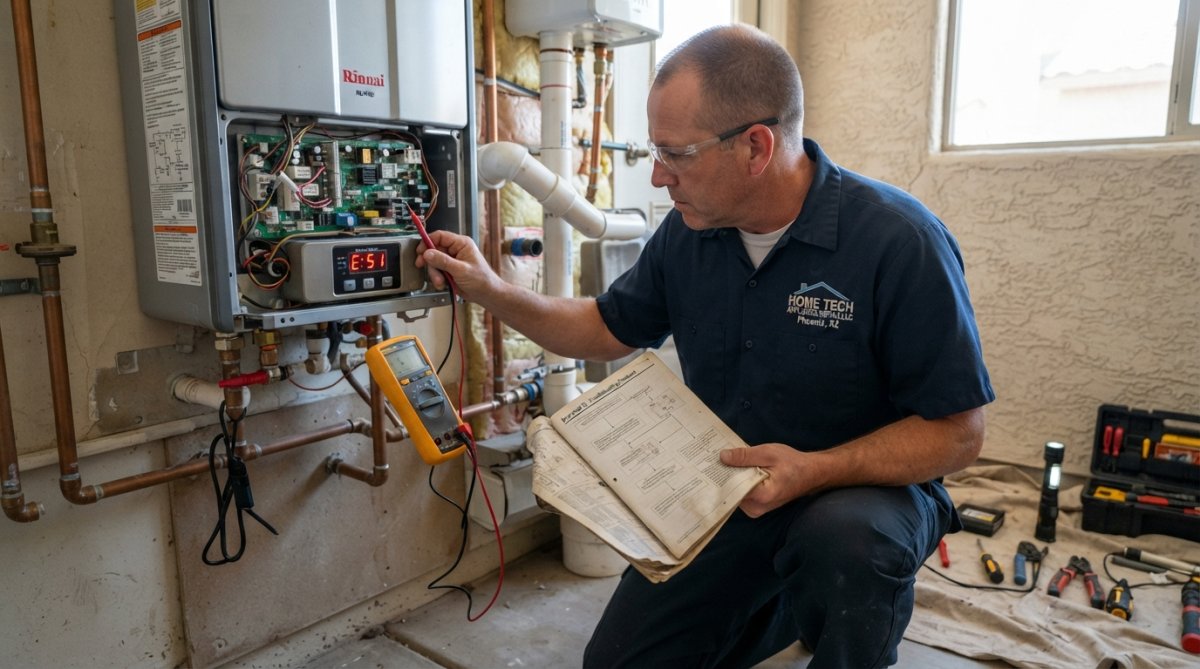
Rinnai uses two-digit codes. The first digit often indicates the category (ignition, flame, venting, flow, temperature), and the second digit provides more specificity:
Code 11, Ignition failure. The system tried to ignite but failed. Check gas supply, igniter condition, and gas pressure.
Code 12, Flame loss. The unit ignited but lost flame during operation. Check the flame sensor for carbon buildup and clean it.
Code 10, Venting error. Exhaust isn't flowing properly. Check the vent pipe for blockages, ice, or improper slope.
Code 16, Overheating. Water temperature exceeded safe limits. Usually clears on its own; if repeated, check the thermistor.
Code 18, Low water flow. Insufficient water flowing through the heat exchanger. Clean the inlet filter and check water pressure.
Code 25, Flame sensor malfunction. The flame sensor itself is faulty or not communicating with the control board.
For Rinnai units, the first troubleshooting step after checking gas supply and water flow is always to look at the flame sensor (for flame loss codes) or the inlet filter (for flow codes). These two components account for the majority of Rinnai error codes that homeowners encounter. Rinnai units also have a reset function. If you've cleared the underlying problem, you can often reset the unit by turning off power at the breaker for 30 seconds, then turning it back on.
Navien Tankless Error Codes and Reset Procedures
Navien uses a different coding system with letter-number combinations like E001, E003, E012. The letter "E" stands for "error," and the number indicates the specific fault.
Identifying Navien-Specific Fault Codes
E001, Ignition failure. The igniter won't produce spark or gas won't reach the burner. Check gas supply and igniter.
E003, Ignition failure (alternative). Similar to E001; appears in different models or at different stages of ignition sequence.
E012, Flame loss. Flame was established but then extinguished. Clean the flame sensor.
E011, Water flow error. Insufficient water flow detected. Clean the inlet filter and check water pressure.
E002, Overheating. Water temperature exceeded safe limits. Usually clears after cooling; if persistent, check thermistor.
E010, Venting error. Exhaust isn't flowing properly. Check vent pipe for blockages and proper slope.
E036, Thermal fuse tripped. A safety fuse inside the unit has blown due to excessive heat. This indicates a serious overheating condition.
Navien units can be reset by pressing and holding the power button on the control panel for 5-10 seconds. If that doesn't work, turn off power at the breaker for 30 seconds and turn it back on. If you've resolved the underlying issue and the error code persists even after reset, the control board may need reprogramming or replacement.
Navien tankless water heater official support documentation
Preventative Maintenance and Descaling for Error Prevention
The best way to avoid error codes is to prevent the conditions that trigger them. Regular maintenance on a tankless water heater is far less expensive than emergency repairs.
Annual Descaling Schedule and Scale Buildup Prevention
Mineral scale is the silent killer of tankless water heaters. Hard water contains dissolved minerals, primarily calcium and magnesium, that precipitate out when water is heated. These minerals stick to the inside of the heat exchanger, building up layer by layer. As scale thickness increases, it insulates the water from the heating surface, reduces water flow, and eventually triggers low flow codes or overheating codes.
Descaling means flushing a food-grade acid solution (usually white vinegar or a commercial descaling agent) through the heat exchanger to dissolve mineral deposits. The frequency depends on your water hardness. If you have soft water (less than 60 mg/L of dissolved minerals), descaling once every 2-3 years is sufficient. If you have moderately hard water (60-120 mg/L), annual descaling is recommended. If you have very hard water (over 120 mg/L), descaling twice per year may be necessary.
You can determine your water hardness by getting a water test from your local health department or by purchasing an inexpensive water hardness test kit from a hardware store. Professional descaling costs between $150-$300 depending on your location and the severity of scale buildup. A more cost-effective long-term solution in hard water areas is installing a whole-home water softener, which removes minerals before they reach your water heater.
Water Hardness Levels and Maintenance Frequency
| Water Hardness | Level | Descaling Frequency | Additional Measures |
|---|---|---|---|
| 0-60 mg/L | Soft | Every 2-3 years | Standard maintenance only |
| 60-120 mg/L | Moderate | Annually | Consider water softener |
| 120-180 mg/L | Hard | 1-2 times per year | Water softener recommended |
| Over 180 mg/L | Very Hard | 2-4 times per year | Water softener strongly recommended |
Beyond descaling, regular maintenance includes annual filter cleaning, gas valve inspection, vent inspection, electrical connection checks, and burner inspection. Most manufacturers recommend having a professional service your tankless water heater annually or every two years. During a service visit, a technician will descale the system, inspect all components, test gas pressure and water flow, clean the burner, and verify that all safety systems are functioning.
American Water Works Association guidelines on water softening and mineral content
When your tankless water heater throws an error code, you now have a clear path forward. Start with simple checks, gas supply, inlet filter, vent termination, before assuming you need a major repair. Many codes clear once the underlying issue is addressed. However, if codes persist after you've verified gas supply, water flow, and venting are all normal, professional diagnosis becomes necessary. At Home Tech, we handle all major tankless brands including Rinnai, Navien, Noritz, Rheem, Takagi, Bosch, and AO Smith. Our EPA 608-certified technicians can diagnose error codes, perform descaling, replace failed sensors, and get your system running again with same-day or next-day service across the Phoenix area. Call (602) 486-1901 or visit hometechappliancerepair.com to book your appointment, we offer no hidden fees and a 100% satisfaction guarantee on every repair.
Frequently Asked Questions
What are the most common tankless water heater error codes and what do they mean?
The most frequent error codes relate to ignition failure (Code 11, E003), flame loss (Code 12, E012), venting issues (Code 10, E010, E030, 90), water flow problems (Code 18, 31, 65, E011, E039), and overheating (Code 16, E016, E002, 13, 991). Ignition codes indicate the burner won't light; flame codes mean the flame is unstable or lost. Venting codes suggest exhaust blockage or air supply issues. Water flow codes point to low pressure, mineral deposits, or inlet filter clogs. Overheating codes warn of excessive temperature or thermistor faults. Each code helps pinpoint the system area causing the shutdown.
How do I reset my tankless water heater after an error code appears?
Most tankless water heater reset procedures involve turning off the circuit breaker for 30 seconds, then turning it back on. Some units have a dedicated reset button on the control board or digital display, check your manual for the exact location. For gas units, you may also need to shut off the gas supply valve briefly. After power restoration, the system will run a self-diagnostic. If the error code returns immediately, the underlying issue (ignition failure, venting blockage, sensor fault, or water pressure problem) requires professional attention rather than a simple reset.
What preventative maintenance helps avoid tankless water heater error codes?
Annual descaling is the single most important maintenance task, especially in areas with hard water or high mineral content. Scale buildup inside the heat exchanger triggers overheating codes and reduces efficiency. Additionally, inspect inlet filters quarterly and replace them if clogged. Check venting and air supply lines for debris or blockages that could cause combustion or exhaust errors. For units in very hard water regions, descaling every 6 months may be necessary. Flushing the system with a descaling solution removes mineral deposits and extends the lifespan while preventing sensor faults and flow-related error codes.
When should I call a professional plumber instead of troubleshooting myself?
Call a professional immediately if you encounter sensor faults (Codes 70-75, 760, E007, E008, E036, 741, 76, 79), control board errors, or codes that persist after a reset. If ignition or flame codes don't resolve after checking gas supply and connections, a professional should inspect the igniter and flame sensor. Any error involving the wiring harness, thermistor, or internal circuit board requires expert diagnosis. Additionally, if water pressure codes don't clear after cleaning the inlet filter, or if venting codes suggest ductwork damage, professional service prevents safety hazards and ensures proper repair. Home Tech's experienced technicians can diagnose and repair all major brands, Rinnai, Navien, Noritz, Rheem, Takagi, Bosch, and AO Smith, with same-day availability in the Phoenix metro area.