 comparison
Repair vs Replace Commercial Oven: A 2026 Decision Guide
Table of Contents
- When to Repair vs Replace a Commercial Oven: The Core Decision Framework
- The 50% Rule and Repair Threshold
- Commercial Oven Lifespan: What You Can Expect
- Signs of Commercial Oven Failure: When Repair Becomes Risky
- Commercial Oven Repair Cost vs Replacement Cost: The Financial Analysis
- Commercial Kitchen Equipment Maintenance: Extending Your Oven's Life
- Downtime Cost Calculation: The Hidden Factor in Repair vs Replace Decisions
- Energy Efficiency and Utility Savings: Long-Term ROI of Replacement
- Financing and Leasing Options for Commercial Oven Replacement
- Frequently Asked Questions
Last Updated: July 29, 2026
When to Repair vs Replace a Commercial Oven: The Core Decision Framework
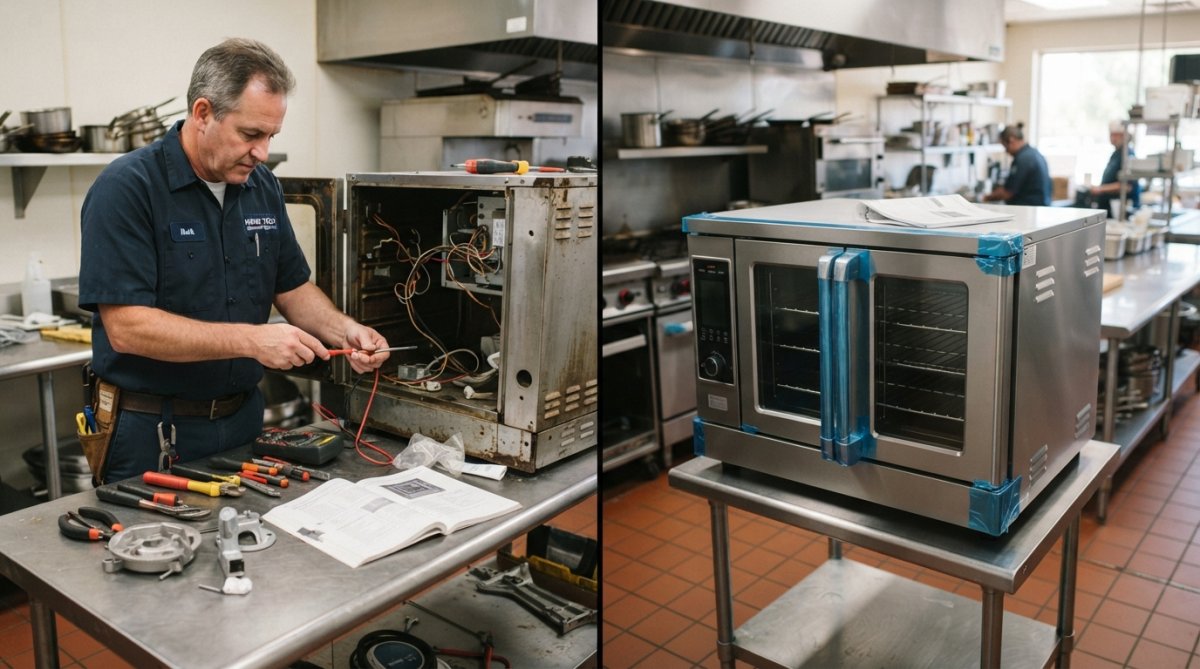
A repair vs replace commercial oven decision impacts both immediate operations and long-term budgets. The core decision comes down to three factors: equipment age, repair cost relative to replacement, and operational impact of failure.
Most commercial ovens have a service life of 10-15 years, though well-maintained units often reach 20 years. When your oven fails, you're weighing immediate repair cost against remaining useful life, breakdown frequency, and hidden downtime costs.
| Decision Factor | Repair Makes Sense | Replace Makes Sense |
|---|---|---|
| Equipment age | Under 7 years | Over 12 years |
| Repair cost | Under 50% of replacement | Over 50% of replacement |
| Failure frequency | First or second failure | Multiple failures per year |
| Remaining lifespan | 5+ years expected | Less than 3 years expected |
| Energy efficiency | Current standards | Significantly below current standards |
| Safety compliance | Meets all OSHA requirements | Failing compliance checks |
The 50% Rule and Repair Threshold
The 50% rule states that if repair cost exceeds 50% of replacement cost, you should replace rather than repair. This threshold signals deeper problems likely coming down the pipeline.
However, this rule has nuances. A 2-year-old oven with a $4,500 repair on a $9,000 replacement might still be worth fixing. A 14-year-old oven with the same repair cost is almost certainly a replacement candidate. If you're looking at your third major repair in three years, the 50% rule shifts lower, you might replace at 40% or even 35% of replacement cost, because the pattern of failures indicates unreliability.
Commercial Oven Lifespan: What You Can Expect
Equipment age is the foundation of any repair vs replace decision. Most commercial gas and electric ovens are engineered for 10-15 years of continuous operation under normal conditions. However, most commercial kitchens don't operate under "normal" conditions. A busy restaurant oven runs 50+ hours per week, while a catering operation's backup oven might sit idle for months then get hammered during event season.
Service Life by Equipment Type
Different oven types have different failure patterns. A combi oven, which combines convection, steam, and direct heat, is mechanically more complex than a basic convection oven. Gas ovens typically last slightly longer than electric models in heavy-use environments because they have fewer electrical components.
Thermostat drift becomes a serious issue around year 8-10 for most commercial ovens. The temperature sensor gradually loses accuracy, requiring larger adjustments to maintain consistent heat. Once you're replacing thermostats every 18-24 months, replacement should be seriously considered.
Depreciation and Replacement Cycles
Commercial kitchen equipment depreciates rapidly in the first 5 years, then more slowly afterward. A $10,000 oven might be worth $6,000 after 5 years, but still worth $3,500 after 10 years. If you're considering replacing a 12-year-old oven, the residual value is so low that replacement makes sense even if the immediate repair cost is modest.
Signs of Commercial Oven Failure: When Repair Becomes Risky
Some failures indicate that the oven is approaching the end of its useful life. Temperature inconsistency is often the first sign of trouble. If one corner runs 25 degrees hotter than another, or if the oven takes significantly longer to preheat, you're likely dealing with thermostat drift or a failing heating element.
Fan motor failure in convection ovens creates cascading problems. The oven can't circulate heat evenly, so baked goods cook unevenly. A fan motor replacement is relatively inexpensive, usually under $1,000, but it signals that the oven's electrical components are aging.
Ignition issues on gas ovens range from annoying to dangerous. A pilot light that won't stay lit, burners that take multiple attempts to ignite, or a burner that goes out mid-cycle all point to problems in the ignition system.
Common Oven Failure Symptoms and Troubleshooting
Door seal failure is common on ovens over 8 years old. The gasket hardens, shrinks, or tears, allowing heat to escape. Door gasket replacement is one of the cheapest repairs, often under $300, but it reminds you that other seals and gaskets are aging too.
Rust or corrosion inside the oven chamber indicates moisture problems or salt spray exposure. Deep corrosion means structural integrity is compromised. If you're seeing rust, the oven is approaching the end of its service life.
Unusual sounds, grinding, squealing, or rattling, often indicate bearing failure or loose components. A squealing sound usually points to a fan bearing that's failing.
Safety and OSHA Compliance Concerns
Commercial ovens must be maintained in safe working condition. An oven failing to maintain consistent temperature might create food safety risks by not reaching temperatures needed to kill pathogens. An oven with a broken door seal might create burn hazards for staff.
Commercial Oven Repair Cost vs Replacement Cost: The Financial Analysis
The raw numbers matter, but they're incomplete without context. A $3,000 repair sounds expensive until you compare it to a $9,000 replacement. But that same $3,000 repair looks different if you've already spent $5,000 on repairs in the past two years, or if your oven is 13 years old and likely to need another major repair within 12 months.
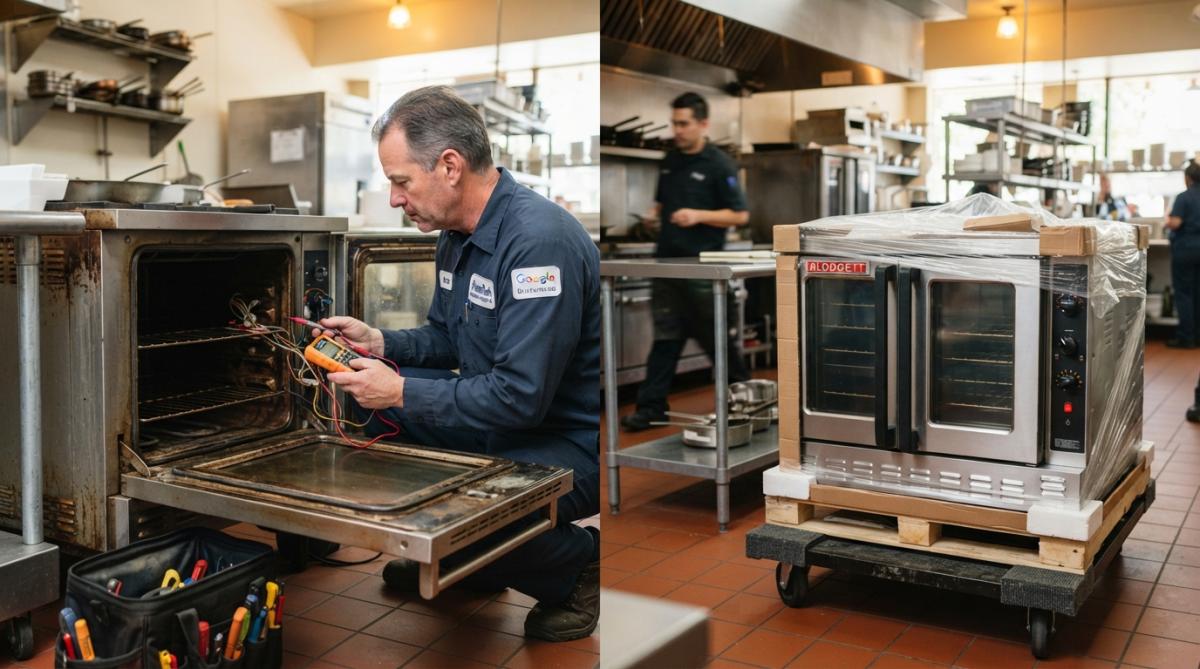
Repair costs for commercial ovens vary widely. A thermostat replacement might run $400-800. A fan motor replacement might be $800-1,500. A heating element replacement might be $600-1,200. A complete control board replacement might be $2,000-4,000. These are parts costs plus labor, and labor on commercial equipment is expensive because technicians need specialized training.
Replacement costs depend on the oven type and capacity. A basic convection oven might run $6,000-10,000. A combi oven might run $12,000-20,000. A deck oven for a bakery might run $8,000-15,000. Installation can add $1,000-3,000.
Labor Costs and OEM Parts Pricing
Labor is where repair costs become unpredictable. A simple thermostat replacement might take 2-3 hours. A complex control system repair might take 8-10 hours, spread across multiple visits. Many commercial appliance repair companies charge $150-250 per hour for labor, with minimum service call charges of $100-150.
OEM parts are significantly more expensive than aftermarket alternatives, but they're more reliable. Using aftermarket parts can save 20-30% on parts costs, but you're accepting higher risk of premature failure. Parts availability affects repair timelines and costs. Common components like thermostats and door gaskets are usually in stock at parts distributors. Specialty components for older ovens might need to be ordered, adding days to your repair timeline.
Capital Expenditure vs Operating Expense
A repair is an operating expense, hitting your P&L in the month you do it. A replacement is a capital expenditure, potentially depreciated over several years, affecting your tax situation differently.
From a cash flow perspective, a $3,000 repair is easier to absorb than a $10,000 replacement. But from a total cost of ownership perspective, the $10,000 replacement might be cheaper if it eliminates $2,000-3,000 in annual repair costs over the next 5 years.
Commercial Kitchen Equipment Maintenance: Extending Your Oven's Life
Preventative maintenance is the single biggest factor in extending oven lifespan and reducing repair costs. An oven receiving regular maintenance might last 18-20 years. The same oven without maintenance might fail at year 10.
Preventative maintenance includes quarterly cleaning of the interior and exterior, annual inspection of door seals and gaskets, regular checking of thermostat accuracy, and monitoring of fan motors and heating elements for wear. A $300 gasket replacement during preventative maintenance prevents the $1,500 repair that happens when the broken gasket allows heat to escape and the heating element burns out trying to compensate.
Preventative Maintenance Programs and Service Records
A preventative maintenance program should include quarterly visual inspections, annual professional servicing, and detailed record-keeping. Many commercial appliance repair companies offer maintenance plans that include scheduled inspections and priority service calls, typically costing $500-1,500 per year.
Service records are critical because they tell the real story of your oven's condition. If records show you've replaced the thermostat twice in two years, the control system is aging faster than expected. Documentation also protects you during disputes. If you need to file a warranty claim or prove that equipment failure was due to a manufacturing defect rather than maintenance neglect, your service records are your evidence.
Warranty Expiration and Repair Strategy
Most commercial ovens come with a 1-year parts and labor warranty, sometimes extended to 2-3 years with additional cost. Once warranty expires, all repair costs are yours. Some operators extend warranties on critical equipment, paying an additional $500-1,000 for extended coverage. This makes sense if your equipment is in the 5-8 year age range and you expect it to last another 5-10 years.
Downtime Cost Calculation: The Hidden Factor in Repair vs Replace Decisions
The most overlooked cost in repair vs replace decisions is the cost of equipment downtime. A $3,000 repair taking your oven offline for 3 days might actually cost $5,000-8,000 when you factor in lost revenue.
Downtime cost depends on your operation. A high-volume restaurant might lose $1,000-2,000 per day in revenue when an oven is down. A catering company might lose $500-1,000 per day. A small café might lose $200-500 per day. If a repair takes 3 days and costs $3,000, your total cost is $3,000 plus 3 days of lost revenue. If a replacement takes 10 days for delivery and installation but eliminates $2,000-3,000 in annual repair costs, you might break even in the first year.
Quantifying Equipment Downtime Impact on Kitchen Productivity
Calculate your daily downtime cost by dividing your average daily revenue by the number of ovens you operate. If you operate 2 ovens and lose one for a day, you're operating at 50% capacity. Emergency repairs often cost more than scheduled repairs because they happen outside normal business hours.
Energy Efficiency and Utility Savings: Long-Term ROI of Replacement
Older ovens are significantly less efficient than modern units. An oven from 2010 might use 20-30% more energy than a 2026 model with the same capacity. Over 5 years, that efficiency difference translates to thousands of dollars in additional utility costs.
A commercial oven typically costs $500-1,500 per year to operate in utilities. A modern, energy-efficient oven might cost $400-1,000 per year. The difference, $100-500 per year, compounds over time. If you're replacing an oven that will last 10 more years, cumulative energy savings might be $1,500-5,000.
Thermostat Drift and Operational Efficiency Decline
Thermostat drift, where the temperature sensor gradually loses accuracy, creates hidden efficiency losses. An oven with a 10-degree thermostat drift doesn't just cook unevenly. It also runs hotter than needed to compensate, wasting energy. Modern ovens have better temperature stability and more sophisticated control systems. A 2026 oven with digital temperature control and multiple sensors maintains temperature within 5 degrees.
Financing and Leasing Options for Commercial Oven Replacement
The cost of replacement doesn't have to come from cash on hand. Many operators finance equipment purchases, spreading the cost over 3-5 years. Others lease equipment, treating it as an operating expense rather than a capital purchase.
Financing typically involves equipment loans at interest rates ranging from 6-12%. A $10,000 oven financed over 5 years at 8% interest costs about $230 per month. Leasing is another option for operators who want to avoid large capital expenditures. A commercial oven lease might cost $300-500 per month for a 3-5 year term. At the end of the lease, you return the equipment and lease a new unit.
Capital Lease vs Operating Lease Strategies
A capital lease is essentially a financing arrangement where you pay for the equipment over time and own it at the end. An operating lease is a pure rental where you never own the equipment. Capital leases make sense if you want to build equity in your equipment and plan to use it long-term. Operating leases make sense if you want predictable monthly costs, minimal maintenance responsibility, and the flexibility to upgrade to newer equipment at the end of the lease term.
Making the repair vs replace decision for commercial kitchen equipment requires weighing immediate costs against long-term operational needs. The 50% rule provides a starting point, but the real answer depends on your oven's age, maintenance history, and how much longer you need it to last.
If your commercial oven is showing signs of age and you're facing repeated repairs, Home Tech can help you diagnose the problem and determine whether repair or replacement makes sense. With over 10 years of experience serving Phoenix-area restaurants and food service operations, we understand the operational impact of equipment downtime and the financial pressures of replacement decisions. Our EPA 608-certified technicians can assess your equipment's condition, provide honest repair estimates, and help you understand your long-term options. Call (602) 486-1901 or visit hometechappliancerepair.com to schedule a diagnostic appointment and get clarity on your next steps.
Frequently Asked Questions
What is the 50% rule for commercial oven repair vs replacement?
The 50% rule is a common decision threshold: if the repair cost exceeds 50% of the replacement cost for a new oven, replacement is typically more economical. However, this rule should be combined with other factors like equipment age, remaining service life, and downtime costs. A technician's diagnosis and your maintenance history are essential to making an informed decision beyond this simple metric.
How long does a commercial oven typically last?
Commercial oven lifespan typically ranges from 10 to 15 years with proper preventative maintenance, though some well-maintained units can exceed 20 years. Convection ovens and combi ovens may have slightly different service lives depending on usage intensity and maintenance. Regular service records, timely repairs, and preventative maintenance programs significantly extend operational life and help justify repair decisions over replacement.
What are the most common signs a commercial oven needs repair or replacement?
Common failure symptoms include uneven heating, thermostat drift (temperature fluctuations), fan motor failure, ignition issues, and visible rust or corrosion. Safety concerns, such as gas leaks, electrical hazards, or inability to maintain food safety temperatures, demand immediate attention and may indicate replacement is necessary. A professional technician diagnosis is critical to determine whether repair or replacement is the safer, more cost-effective choice.
How do I calculate the true cost of equipment downtime in my kitchen?
Downtime cost includes lost revenue from reduced service capacity, food waste, labor costs for staff reassignment, and potential customer dissatisfaction. Calculate your average hourly revenue during peak service times, then multiply by expected repair duration. For emergency repairs, same-day service response can minimize this cost. When comparing repair vs replace, factor downtime duration into your decision, replacement may have longer lead times but eliminates future downtime risk.
Does replacing an old commercial oven with a newer model save money on energy bills?
Modern commercial ovens are significantly more energy-efficient than older models, often reducing utility costs by 15-30% depending on equipment age and type. Older ovens experience thermostat drift and fan motor inefficiency, wasting energy. Over the 10-15 year service life of a new oven, energy savings can offset replacement costs. Calculate your current utility expenses and compare them against projected savings with newer equipment to determine long-term ROI.