 comparison
Professional Dryer Repair vs DIY: Which Costs Less?
Last Updated: November 3, 2026
Quick Summary
The average dryer repair cost runs from $50 to $800, with most common repairs landing between $100 and $300, while Thumbtack puts the national average near $203. DIY saves the most on cheap, well-diagnosed faults like fuses and belts, but a wrong guess usually costs more than one professional diagnostic.
- A thermal fuse costs $10 to $25 in parts, versus $100 to $200 for a professional repair.
- Two wrong parts usually cost more than one professional diagnostic, which flips the DIY math.
- If the repair bill approaches half the price of a new dryer, replacement is worth considering.
- Most clothes dryers are expected to last around a decade with normal use.
- A thermal fuse that blows twice means the vent is restricted, so clear the duct before replacing it.
Table of Contents
- Professional vs DIY Dryer Repair: The Cost Comparison at a Glance
- What the Average Dryer Repair Cost Looks Like in Practice
- Dryer Repair Cost for a Heating Element: Parts, Labor, and DIY Savings
- Using a Dryer Repair Cost Calculator to Compare Your Options
- Dryer Repair vs Replacement Cost: When Repair Stops Making Sense
- DIY Skill, Tools, and Time: The Costs You Don't See on the Parts Receipt
- Which Dryer Repairs Are Safe to Do Yourself and Which Need a Professional
- Booking a Dryer Repair You Can Trust
- Frequently Asked Questions
Professional vs DIY Dryer Repair: The Cost Comparison at a Glance
A dryer that won't heat or spin leaves you with a decision: pay a pro or open the cabinet yourself. The honest answer is that the cost of professional dryer repair vs DIY depends less on the part price and more on whether you diagnose the fault correctly the first time.
The short version: DIY wins on simple, well-diagnosed faults where the part is cheap and the job is safe. Professional repair wins whenever gas, 240-volt wiring, or an uncertain diagnosis is involved, because a wrong guess costs more than the service call.
| Factor | DIY Repair | Professional Repair |
|---|---|---|
| Upfront parts spending | Lower | Included in the bill |
| Diagnostic risk | You absorb it | Technician absorbs it |
| Tools needed | Multimeter, screwdrivers, nut drivers | Technician brings them |
| Time investment | Your afternoon | Same-day or next-day visit |
| Safety exposure | High on gas and 240V work | Handled by trained techs |
| Warranty on the fix | None | Backed by the repair company |
| Best for | Belts, fuses, lint clogs | Heating elements, motors, gas valves |
What the Average Dryer Repair Cost Looks Like in Practice
Published cost guides put the average dryer repair cost in the low hundreds of dollars, with a range that stretches from very cheap fixes to bills that approach the price of a new machine. ConsumerAffairs dryer repair cost guide reports a typical range of $50 to $800, with many common repairs landing between $100 and $300. Thumbtack's dryer repair cost estimates lists a national range of roughly $127 to $324 and an average near $203.
Those figures cover labor and parts together. A service call or diagnostic fee gets a technician to your door, labor covers time on the machine, and parts are the heating element, thermal fuse, belt, or whatever failed.
What most guides miss is that the published average hides the variance. A thermal fuse replacement and a motor replacement both count as "a dryer repair" but sit at opposite ends of that range. Knowing which fault you have matters more than knowing the average.
Dryer Repair Cost for a Heating Element: Parts, Labor, and DIY Savings
The heating element is the most common reason a dryer runs but produces no heat, and it is where the DIY-versus-professional gap is widest.
Here is the honest breakdown for an electric dryer, using a mid-range element as the example.
A DIY heating element swap removes the service call and labor line entirely.
Watch out: the element and thermal fuse fail with the same symptom, no heat.
Where DIY stops making sense: on a gas dryer, the igniter and gas valve sit next to the burner assembly, a fuel system we do not recommend homeowners open.
Angi's dryer repair cost guide notes that small DIY repairs can cost as little as $10 in parts, which is accurate for a fuse or a belt.
| Fault | Typical part cost (DIY) | Typical professional total | DIY difficulty |
|---|---|---|---|
| Thermal fuse | $10 to $25 | $100 to $200 | Beginner |
| Drive belt | $10 to $30 | $120 to $220 | Beginner to moderate |
| Heating element (electric) | $25 to $60 | $200 to $375 | Moderate |
| Drum roller or idler | $15 to $40 | $180 to $300 | Moderate |
| Motor | $80 to $200 | $300 to $500+ | Advanced |
| Gas valve or igniter | Not recommended | $200 to $400 | Professional only |
Using a Dryer Repair Cost Calculator to Compare Your Options
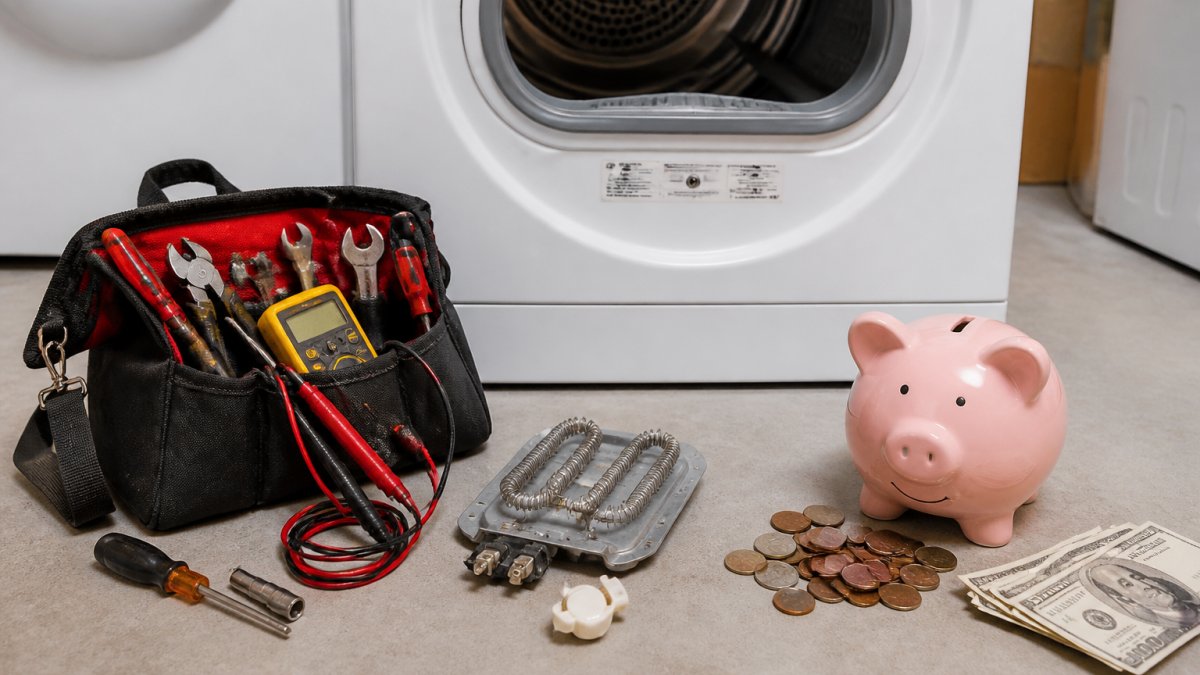
You can compare the cost of a DIY repair with a professional quote by adding up the part price, your estimated time, and the risk of a wrong diagnosis. You don't need software, you need four numbers.
Run it like this:
- Part price. Look up your exact model number and the suspected part.
- Your time, valued honestly. Two hours of your Saturday has a real cost, especially if the job stretches to four.
- Tool gap. If you need to buy a multimeter or a nut driver set, add it.
- Wrong-guess risk. If you are not certain of the diagnosis, add the price of the second part you will buy after the first one does not fix it.
Most homeowners skip step four, and it flips the math. Two wrong parts usually cost more than one professional diagnostic, the single biggest reason a DIY repair that looked cheap ends up costing more than the service call.
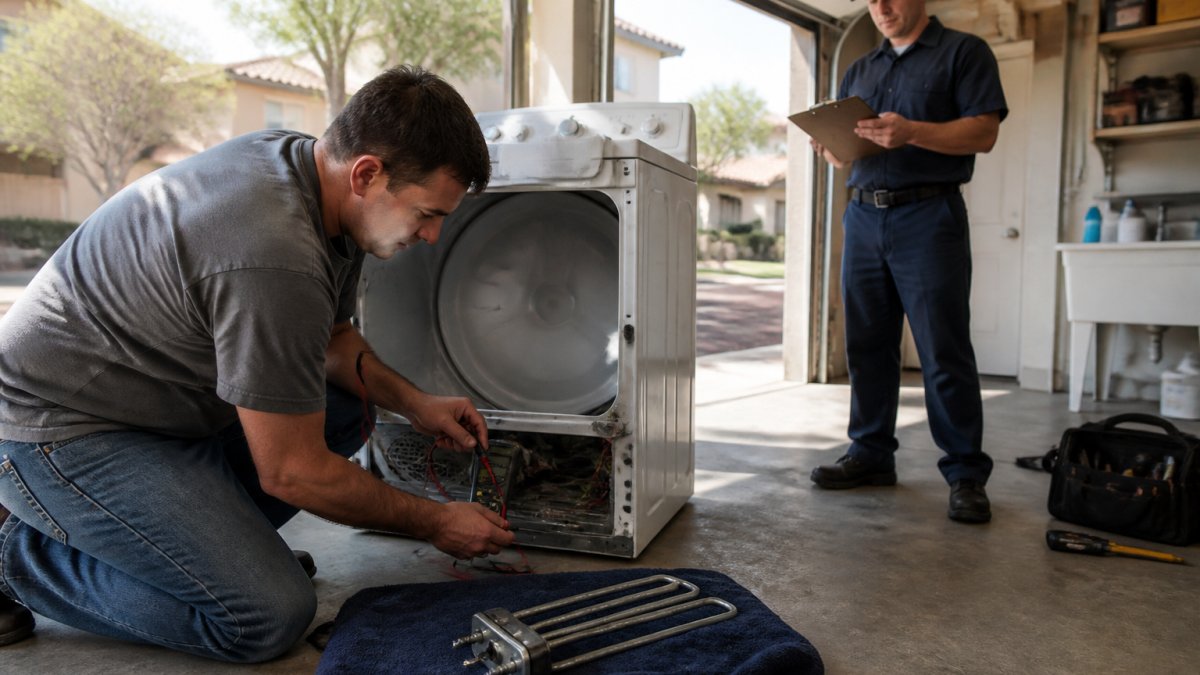
Dryer Repair vs Replacement Cost: When Repair Stops Making Sense
The dryer repair vs replacement decision often comes down to one rule: if the repair bill approaches half the price of a new dryer, replacement is worth considering.
Dryer age matters here. A ten-year-old dryer that needs a motor is a different proposition than a four-year-old dryer with the same fault. Consumer Reports' repair-or-replace guidance makes the point that costlier dryers can justify repair for longer, since the replacement price is higher.
Two more factors push toward replacement:
- Energy efficiency. An aging dryer that runs long cycles is costing you on every load.
- Repeat failures. Two major repairs in a year usually signals the machine is near the end.
If your dryer is young, mid-priced, and this is its first major fault, repair is almost always the cost-effective call. If it is old, cheap, and failing repeatedly, put the money toward a new machine.
DIY Skill, Tools, and Time: The Costs You Don't See on the Parts Receipt
The parts receipt is the smallest line in a DIY repair. The hidden costs are skill, tools, and time, what most cost comparisons leave out.
Skill. Replacing a drive belt or a thermal fuse is generally considered a beginner job. Diagnosing an intermittent no-heat fault with a multimeter is not.
Tools. A basic appliance kit is an inexpensive purchase, but a multimeter you trust is the real purchase. Without one, you are swapping parts blindly.
Time. A belt replacement is quicker for an experienced person than for a first-timer, who should allow extra time, plus a trip for the part.
None of these are reasons to avoid DIY. They are reasons to count them honestly before you decide the part price is the whole cost.
Which Dryer Repairs Are Safe to Do Yourself and Which Need a Professional
Safe DIY repairs have a cheap part, a clear symptom, and no fuel or high-voltage exposure. Professional repairs are everything else. That test holds on almost every dryer fault; use the symptom-to-fault guide below and be honest about your confidence level.
| Symptom | Most likely fault | DIY confidence | Verdict |
|---|---|---|---|
| Runs but no heat (electric) | Thermal fuse, high-limit thermostat, or element | Medium | Test the fuse first; element is a moderate DIY job |
| Runs but no heat (gas) | Igniter, gas valve, or flame sensor | Low | Professional only |
| Drum does not turn, motor hums | Belt, idler, or seized roller | Medium | Belt is DIY-friendly; seized roller is moderate |
| Drum turns freely by hand but no spin | Belt or door switch | High | Safe to try yourself |
| Dryer shuts off mid-cycle | Overheating from restricted vent, or a failing fuse | Medium | Clear the vent before replacing anything |
| Burning smell | Lint buildup, failing element, or wiring | Low | Stop using it and call a professional |
| Trips the breaker | Element short, wiring fault, or motor | Low | Professional only; 240V hazard |
| Will not start at all | Door switch, start switch, or thermal fuse | High | Safe to test and replace switches |
Safe to try yourself:
- Replacing a thermal fuse after confirming the vent is clear
- Replacing a drive belt on a machine that spins freely by hand
- Clearing a clogged lint screen housing or vent duct
- Replacing a door switch or a start switch
Call a professional:
- Heating element replacement on an electric dryer if you are not comfortable working around 240 volts (Home Tech's technicians can handle this)
- Anything inside a gas dryer, including the igniter and gas valve
- Motor or drum roller replacement
- Sealed-system or control board faults
- Any repair where you are not sure of the diagnosis
The safety reasons are not abstract. A gas dryer connects to a fuel line, and a poorly seated connection is a fire and carbon-monoxide risk.
Watch out: a thermal fuse that blows twice is telling you the vent is restricted. Replacing the fuse without clearing the duct just buys you another failure.
If you have decided to call a pro, Home Tech's professional washer and dryer repair services cover the faults that are not safe to attempt at home.
Booking a Dryer Repair You Can Trust
The cost question has an answer, and it is not the same for every dryer. Simple, well-diagnosed faults with cheap parts are worth doing yourself. Gas work, 240-volt components, motor jobs, and any fault you cannot pin down are worth paying a pro to get right the first time.
At Home Tech, we are a family-owned, Google Guaranteed company with over 10 years serving the Phoenix metro. We offer same-day and next-day appointments, no hidden fees, and a 100% satisfaction guarantee on every repair. Our technicians service all major brands, including GE, Whirlpool, LG, Samsung, and Maytag, and they clean up after themselves before they leave.
You can book dryer repair in Phoenix, review our dryer repair service, or check our dryer repair for West Phoenix communities. Call (602) 486-1901 and get your dryer back to work.
Frequently Asked Questions
How much does it cost to have someone service your dryer?
Professional dryer repair cost typically includes a service call or diagnostic fee plus parts and labor. Published cost guides vary widely, and current pricing depends on the fault, the part required, and local labor rates. Your actual bill depends on the fault, the part required, and local labor rates, so ask for an upfront estimate before work begins.
What is the 50/50 rule for appliance repair?
The 50% rule says you should replace an appliance when the repair estimate exceeds half the price of a new one. If a new dryer costs $700 and the repair quote is $400, replacement usually makes more financial sense, especially on an older machine. Apply the rule alongside dryer age and expected lifespan: a 12-year-old dryer facing a $300 repair is a weaker candidate for fixing than a 4-year-old model with the same bill.
What's the most expensive thing to fix on a dryer?
Motor and drum-related failures tend to be the costliest repairs because they involve major disassembly and higher-priced parts. Heating element, thermal fuse, drive belt, and drum roller replacements are usually more affordable. A dryer repair cost calculator can help you weigh a major repair against replacement, but get a professional diagnosis first, since symptoms like no heat or a drum that won't turn can come from several different components.
How much can you save by repairing a dryer yourself?
DIY savings come mostly from skipping labor and service call fees, since you still pay for parts. Some smaller DIY repairs have low part costs. The catch is misdiagnosis: buying the wrong part or replacing a component that wasn't the cause adds cost and time. For simple jobs like a thermal fuse or drive belt on a model you can safely unplug and open, DIY can be cost-effective. For gas dryers or sealed components, professional repair is the safer choice.
A dryer that keeps failing is a decision you should not have to make alone. Home Tech brings same-day appointments, upfront pricing with no hidden fees, and a 100% satisfaction guarantee on every repair. Get started with Home Tech and put the guesswork, and the extra parts bill, behind you.