 comparison
Tankless vs Traditional Water Heater: Which Saves More Money?
Last Updated: October 26, 2026
Quick Summary
Tankless vs traditional water heater involves different trade-offs: tankless systems use less energy and last 15 to 20 years but cost more upfront and require regular descaling, while traditional tanks cost less initially and last 8 to 12 years with simpler maintenance. Tankless systems typically break even within 5 to 10 years for moderate to high hot-water households.
- Tankless systems eliminate standby heat loss by heating water on-demand, while traditional tanks maintain temperature continuously 24/7.
- Tankless installation requires gas line upgrades, new venting, or electrical circuit additions, significantly raising upfront costs compared to tank replacement.
- Tankless units need descaling every 1 to 2 years in hard-water areas to maintain efficiency and prevent system shutdowns.
- Traditional tanks deliver hot water at full plumbing flow rates until empty, while tankless systems are limited to 4 to 8 GPM.
- Choose tankless for smaller households planning to stay 10+ years; choose traditional tanks for larger families, tight budgets, or homes selling within 5 years.
Table of Contents
- How Tankless and Traditional Water Heaters Work
- Tankless vs Tank Water Heater Cost: Upfront and Long-Term
- Energy Efficiency and Monthly Operating Costs
- Tankless Water Heater Flow Rate and Household Demand
- Tankless Water Heater Lifespan and Replacement Frequency
- Tankless Water Heater Maintenance vs Traditional Tank Care
- Installation Requirements, Fuel Type, and Retrofit Considerations
- Which System Is Right for Your Home?
- Frequently Asked Questions
How Tankless and Traditional Water Heaters Work
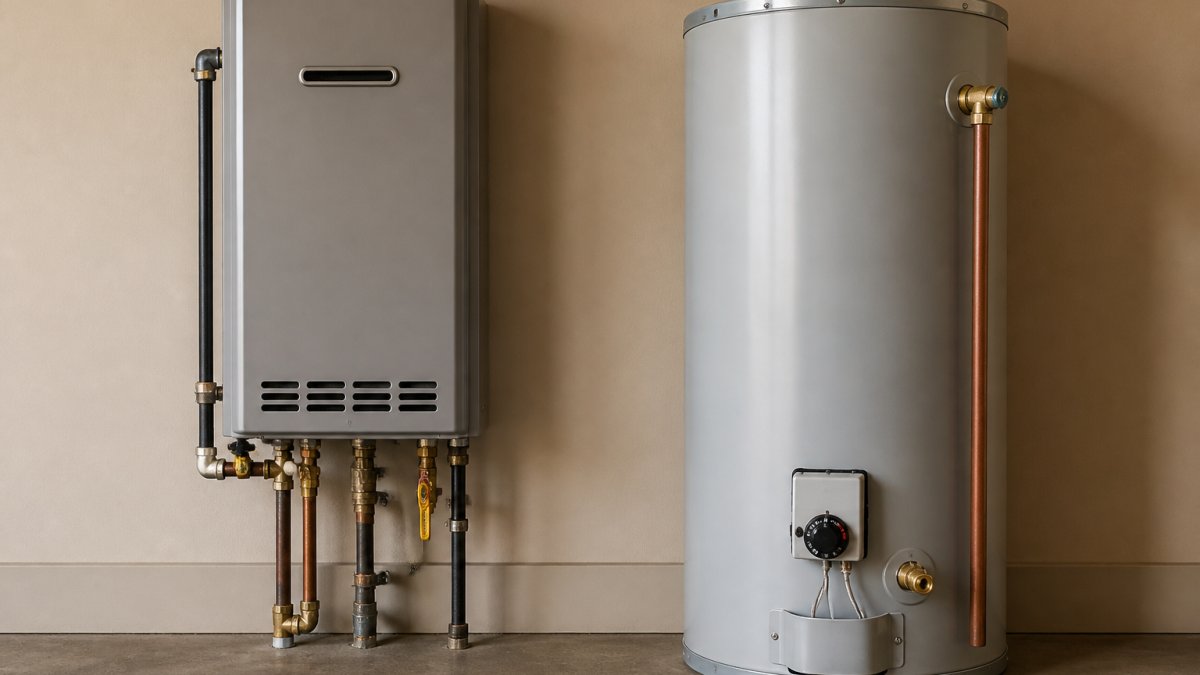
When comparing tankless vs traditional water heater options, your choice shapes your home's comfort and utility bills for years. Understanding how each operates is the first step toward the right decision.
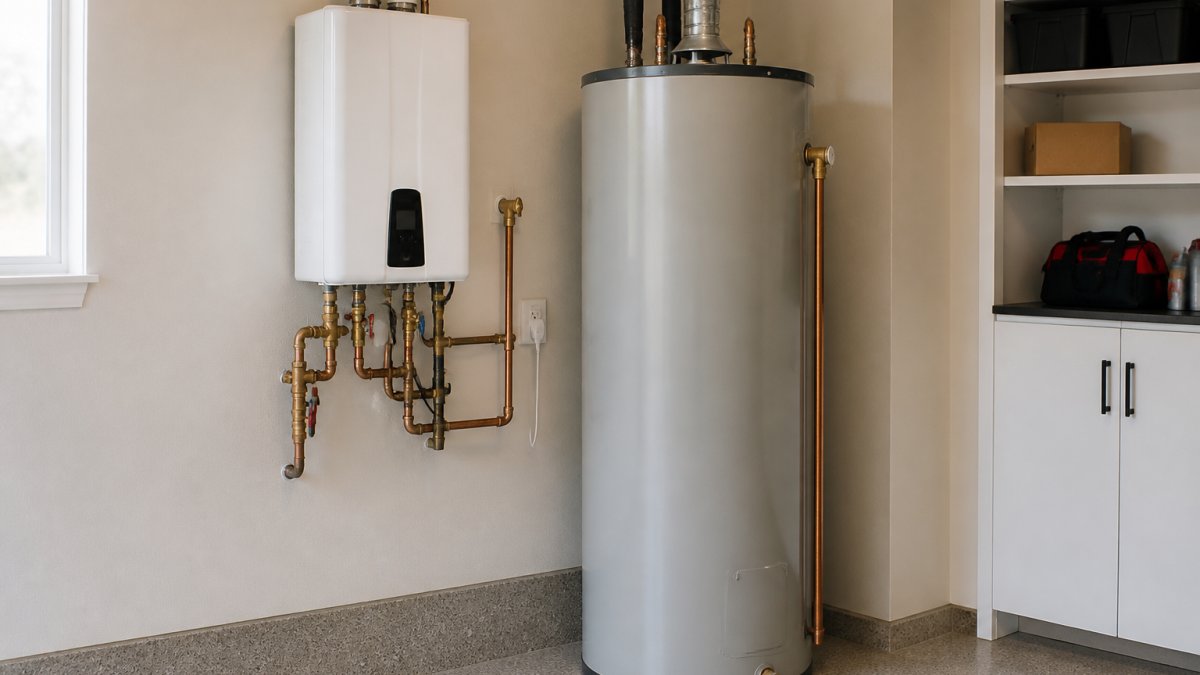
Tankless Systems: On-Demand Heating
A tankless water heater heats water directly as it flows through the unit, with no storage tank. When you turn on a hot-water tap, cold water passes through a heat exchanger, either a gas burner or electric heating element, that raises the temperature instantly. Shut off the tap and heating stops. This on-demand approach eliminates standby heat loss, the energy wasted when a full tank maintains temperature around the clock.
Tankless systems come in two fuel types: natural gas and electric. Gas-fired models deliver faster heating and higher flow rates, while electric units are simpler to install but may struggle with simultaneous hot-water demand in larger homes. Both require proper venting and electrical connections.
Traditional Tank-Style Systems: Storage and Standby
A traditional tank-style water heater stores 40 to 80 gallons of preheated water in an insulated cylinder. When you open a hot-water tap, heated water flows to your fixtures, and the heating element or burner reheats the remaining water, keeping the tank at your set temperature 24/7, whether you're home or away.
The trade-off: a tank guarantees hot water at any flow rate your plumbing can deliver, but it consumes energy continuously to maintain temperature. The larger the tank and the longer between uses, the more energy is wasted to standby heat loss.
Tankless vs Tank Water Heater Cost: Upfront and Long-Term
Cost is often the deciding factor, and the comparison is more nuanced than "which one costs less today." Weigh purchase price, installation complexity, and long-term operating expenses.
Upfront cost heavily favors traditional tanks. A tank-style water heater costs less to buy and considerably less to install; a licensed technician can often swap one in a few hours with minimal plumbing and venting changes.
Long-term operating costs tell a different story. A tankless water heater uses energy only when hot water is actually being used, while a traditional tank maintains temperature continuously.
Payback depends on local energy rates, household size, and usage patterns. Many homeowners break even within 5 to 10 years. If you plan to stay long enough to capture those savings, tankless makes financial sense; if you're selling within a few years, the upfront cost may not justify it.
Rheem's water-heater cost comparison provides a breakdown of typical purchase and installation expenses for both types.
Discover efficient gas vs electric water heater installed in West PHX with Home Tech Appliance Repair. Get premium, quality, and reliable installation services.(page:1)
Energy Efficiency and Monthly Operating Costs
Energy efficiency is where tankless systems claim their strongest advantage. A tankless water heater eliminates standby heat loss entirely, with no tank losing heat through its walls every minute. This translates to lower monthly energy bills for most households.
The efficiency gain depends on how much hot water your home uses. A family of four showering daily and running the dishwasher and laundry will see noticeable savings; a single person with minimal demand may see only modest reductions.
Traditional tanks operate at a steady baseline efficiency loss. Even the most insulated tank loses heat continuously, especially in older models or when located in an unheated garage or basement. High-efficiency tank models reduce this loss but cannot eliminate it.
One practical consideration: tankless systems require descaling (removing mineral buildup from the heat exchanger) every 1 to 2 years, depending on water hardness. This maintenance preserves efficiency and prevents reduced flow or system shutdowns. A traditional tank may need sediment flushing less frequently, though both systems benefit from annual maintenance.
Eccotemp's efficiency comparison guide outlines how energy consumption differs between the two types.
Tankless Water Heater Flow Rate and Household Demand
Flow rate is where many homeowners discover tankless systems have real constraints. A tankless water heater is rated in gallons per minute (GPM), typically 4 to 8 GPM for residential models, meaning it heats that amount continuously. Sounds generous until you run two showers while someone starts the dishwasher.
A traditional tank delivers hot water at whatever flow rate your home's plumbing supplies, often 5 to 10 GPM depending on your fixtures, but only until the tank empties. A 50-gallon tank might supply 10 minutes of hot water at full flow before running cold. A tankless system never runs out of hot water, but it may reduce the flow temperature if demand exceeds its GPM rating.
Household size and simultaneous demand matter enormously. A single person or couple rarely hits the GPM ceiling. A family of four with multiple bathrooms may need a higher-capacity tankless model or two units in parallel, adding cost and complexity. Traditional tanks sidestep this: they hold enough hot water for typical demand patterns.
Water temperature also affects perceived flow. In winter, when groundwater is cold, a tankless unit works harder and may deliver slightly lower flow as it struggles to maintain temperature. In summer, the same unit feels more responsive.
Tankless Water Heater Lifespan and Replacement Frequency
Tankless systems generally outlast traditional tanks. A quality tankless water heater often lasts 15 to 20 years with proper maintenance, while a traditional tank typically lasts 8 to 12 years before corrosion or sediment forces replacement. This advantage is real but comes with caveats.
Tankless lifespan depends heavily on water quality and maintenance. Hard water accelerates scale buildup inside the heat exchanger; regular descaling extends life, neglecting it shortens it dramatically.
When a tankless system fails, repair costs can be steep. A failed heat exchanger or control board often costs several hundred dollars, plus a licensed technician. A traditional tank failure is simpler: the tank corrodes through, leaks, and you replace the whole unit. Parts are cheaper and installation is straightforward.
Replacement cost matters too. A new traditional tank is significantly less expensive than a new tankless system, even before labor.
Tankless systems typically outlast traditional tanks, but the difference in lifespan and replacement costs tells a more complex story.
| System | Typical Lifespan | Key Factor | Replacement Cost |
|---|---|---|---|
| Tankless | 15 to 20 years | Water quality and descaling | Higher |
| Traditional Tank | 8 to 12 years | Corrosion and sediment | Lower |
Tankless Water Heater Maintenance vs Traditional Tank Care
Maintenance requirements differ significantly, affecting long-term ownership costs and hassle.
Tankless systems require annual or biannual descaling, a chemical flush that removes mineral deposits from the heat exchanger. In hard-water areas, this may be necessary every year. Descaling takes 1 to 2 hours and typically costs professional service fees.
Electronic components also need attention. Tankless units have circuit boards, sensors, and flow meters that can fail. Most failures are repairable but require a licensed technician. Many modern systems have built-in diagnostics that alert you before problems become catastrophic.
Traditional tanks require less frequent maintenance. Annual sediment flushing, draining a few gallons from the drain valve to remove accumulated minerals, keeps the system efficient and extends life.
The anode rod in a traditional tank sacrifices itself to prevent rust, extending tank life. Replacing it every 3 to 5 years is ideal but often skipped.
For most people, traditional tank maintenance is simpler and cheaper. For those willing to stay on top of descaling and diagnostics, tankless systems reward that diligence with years of additional service.
Installation Requirements, Fuel Type, and Retrofit Considerations
Installation complexity and cost often decide between tankless and traditional systems, particularly for retrofits replacing an existing heater.
Traditional tank installation is straightforward. A licensed plumber disconnects the old tank, connects the new one to existing water lines, and reconnects the gas or electric supply. Most installations take 2 to 4 hours.
Tankless installation is more demanding. The system requires adequate gas line capacity or electrical service. Gas units may need a larger gas line than the old tank, requiring trenching or wall modifications.
Retrofits complicate matters.
Fuel type also influences the decision. Natural gas tankless units are more powerful and efficient than electric models but require adequate gas supply.
Our EPA 608-certified technicians assess your existing infrastructure and recommend the most cost-effective approach, whether that's upgrading to tankless or optimizing a traditional tank system for your home's actual needs.
This Old House's tankless installation guide details common retrofit challenges and cost factors.
Which System Is Right for Your Home?
Deciding between tankless vs traditional water heater depends on household size, hot-water usage, budget, and long-term plans.
A middle ground exists: high-efficiency traditional tanks with better insulation and faster recovery. These bridge low upfront cost and reasonable operating efficiency, though they don't match tankless energy savings.
Hot water heater not working in Glendale? Discover quick fixes and reliable, affordable, and professional hot water heater services in Glendale from Home Tech Appliance Repair to restore your comfort.(page:2)
Discover the best tankless water heater brands in Gilbert, Arizona. Home Tech Appliance Repair offers premium options with expert installation and service.(page:3)
The decision between a tankless water heater and a traditional tank system isn't about which is objectively "better", it's about which fits your household, your budget, and your priorities. Home Tech can help you evaluate both options for your specific situation.
Frequently Asked Questions
What are the main pros and cons of a tankless water heater?
Tankless systems provide continuous hot water on demand, take up less space, and eliminate standby heat loss, which can reduce energy consumption. Drawbacks include higher upfront installation costs, potential flow-rate limitations when multiple fixtures run simultaneously, and the need for regular descaling maintenance in areas with hard water. Traditional tanks cost less initially but waste energy maintaining hot water in the storage tank even when no one is using it.
How much longer does a tankless water heater last compared to a traditional tank?
Tankless water heaters typically last 15-20 years or longer, while traditional tank-style water heaters usually last 8-12 years. This longer lifespan can offset the higher upfront purchase and installation cost over time, though actual longevity depends on water quality, maintenance frequency, and usage patterns. Hard water requires more frequent descaling on tankless systems to maintain efficiency.
Do tankless water heaters actually save money on energy bills?
Tankless systems can reduce monthly energy bills by 24-34% compared to traditional tanks because they eliminate standby heat loss. However, total savings depend on your household's hot-water usage, fuel type, incoming water temperature, and local energy rates. Homes that use less hot water may see smaller savings, while high-demand households often see the biggest reductions in operating costs.
What is the tankless water heater flow rate, and how does it affect my home?
Flow rate is measured in gallons per minute (GPM) and determines how much hot water a tankless system can deliver at once. Most residential tankless heaters produce 4-8 GPM. If multiple fixtures run simultaneously (shower plus washing machine), flow may drop below your needs. Traditional tanks store hot water, so they handle peak demand better. Sizing a tankless system correctly for your household's simultaneous demand is critical.
What tankless water heater maintenance is required, and how often?
Tankless systems require annual descaling to remove mineral buildup, especially in hard-water areas, which can reduce efficiency and lifespan. You should also flush the system and inspect connections yearly. Traditional tanks need occasional sediment flushing but generally require less frequent maintenance. Neglecting descaling on a tankless unit can void warranties and cause performance problems, so preventive maintenance is essential.