 comparison
Repair or Replace Refrigerator: A 2026 Decision Guide
Table of Contents
- Repair or Replace Refrigerator: The Core Decision Framework
- Average Refrigerator Lifespan: What You Need to Know
- Cost of Refrigerator Repair vs. Replacement: A Practical Breakdown
- Common Refrigerator Problems and Solutions
- DIY Troubleshooting vs. Professional Repair: Making the Right Choice
- Energy Efficiency and Environmental Impact: The Hidden ROI of Replacement
- Warranty Status, Home Warranty, and Financial Protection
- Your Repair or Replace Refrigerator Decision: Final Checklist
- Conclusion
- Frequently Asked Questions
Repair or Replace Refrigerator: A 2026 Decision Guide
Last Updated: July 9, 2026
Repair or Replace Refrigerator: The Core Decision Framework
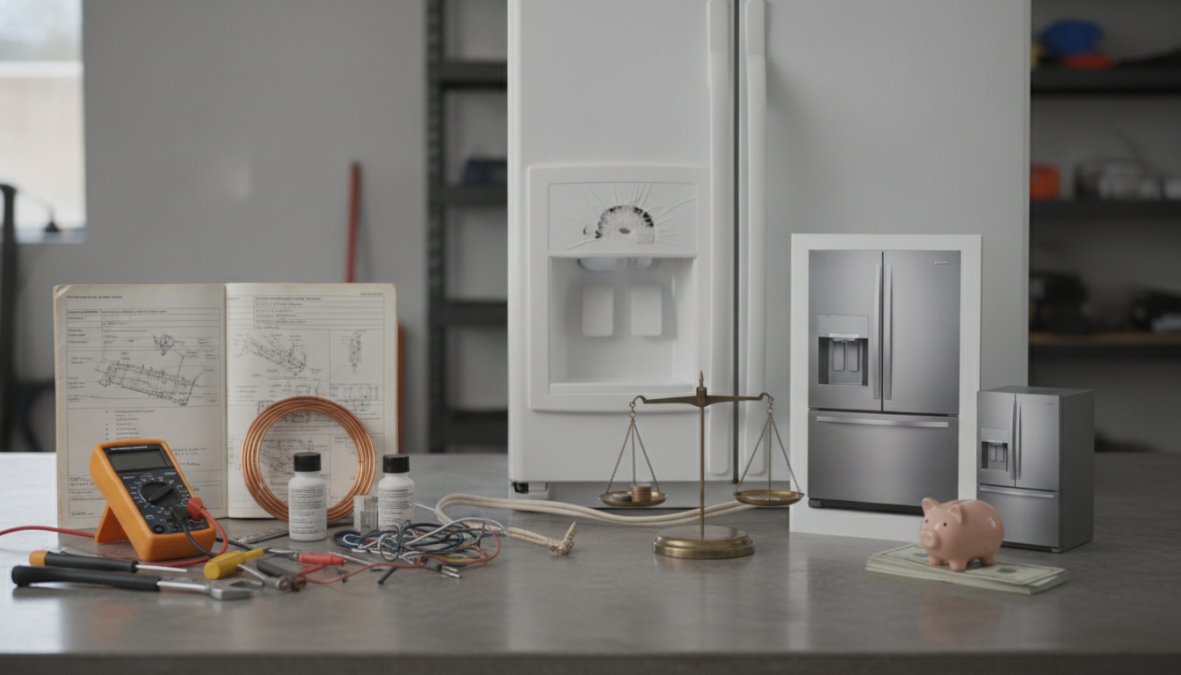
When your refrigerator fails, the decision between repair and replacement is urgent and costly. The real decision hinges on your refrigerator's age, the type of failure, warranty status, energy efficiency, and repair history.
The 50% Rule and When It Applies
The 50% rule states: if repair costs exceed 50% of replacement cost, replace the unit. However, this oversimplifies the decision. A new refrigerator costs $500 to $3,000+ depending on size and features, while a compressor replacement costs significantly less, but a sealed-system failure combined with other aging components might push repair costs higher.
What matters most is understanding whether you're repairing a young appliance with one isolated problem or an aging unit nearing end-of-life.
Key Factors Beyond Cost
Appliance age and lifespan expectations directly impact your choice. A refrigerator that's 3-5 years old and experiencing its first major failure is typically worth repairing. One that's 12+ years old is approaching its expected lifespan, making replacement the smarter investment.
Frequency of prior repairs signals reliability. If you've called a technician twice in two years, a third repair indicates accelerating failure rates and suggests more repairs are coming.
Energy efficiency improvements matter significantly. Older refrigerators consume 40-50% more electricity than modern Energy Star models. If your unit is 10+ years old, a new refrigerator could reduce annual energy costs by $100-$200 or more, offsetting replacement costs faster than expected.
Warranty coverage affects your financial exposure. If your refrigerator is still under warranty, repair costs are minimal or free. Once warranty expires, you're paying full service fees plus parts.
Average Refrigerator Lifespan: What You Need to Know
Most refrigerators last between 10-18 years, with the median lifespan around 12-14 years. A refrigerator that's 8 years old with a failed compressor might have 4-6 years of life ahead if repaired. One that's 14 years old with the same failure has perhaps 2-3 years remaining. Spending $800 on a repair for a refrigerator that will likely fail again in 18 months is wasteful. Spending $800 to fix a unit that will reliably run for another 5 years makes sense.
Brand Reliability Variations
Not all refrigerators are created equal. Research from Consumer Reports appliance reliability data shows meaningful differences in compressor failure rates and sealed-system longevity across major manufacturers. If your refrigerator is a brand known for longevity and you're at year 9-10, repair becomes more attractive. If it's a brand with known durability issues and you're at year 8, replacement might be smarter despite lower repair costs.
Signs Your Refrigerator Is Failing
Compressor failure is the most expensive repair and often the tipping point for replacement decisions. Repair costs typically range from $400-$1,000. A compressor failure on a unit over 10 years old usually means replacement is better.
Condenser coils and evaporator fan problems are often fixable and relatively affordable at $150-$400. These repairs almost always make sense.
Thermostat and temperature control failures cost $100-$300 to fix. If this is your refrigerator's only problem, repair is the clear choice.
Refrigerant leaks in sealed systems cost $300-$600 to detect, seal, and recharge. If your unit is already old, future leaks are likely.
Ice maker failures and water filter issues are common but inexpensive to fix ($100-$250). These rarely justify replacement alone.
Door gasket failures allow cold air to escape, increasing compressor strain. Replacing gaskets costs $100-$200 and is always worth doing.
Cost of Refrigerator Repair vs. Replacement: A Practical Breakdown
Understanding actual costs is essential to making an informed decision.
Common Repair Costs and Service Fees
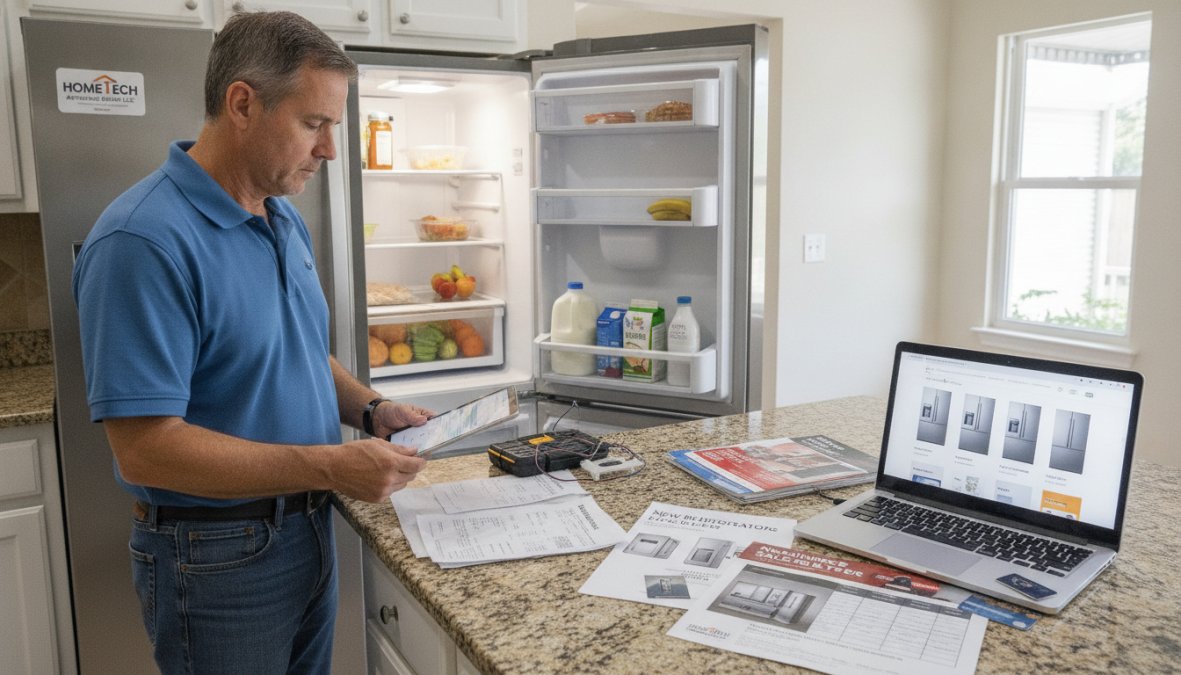
Service calls cost $75-$150 for diagnostics, which often applies toward repair costs if you proceed. Common repair costs include:
- Compressor replacement: $400-$1,200
- Sealed-system refrigerant recharge: $300-$600
- Evaporator fan replacement: $150-$350
- Condenser fan replacement: $150-$400
- Thermostat replacement: $100-$300
- Water inlet valve: $150-$350
- Door gasket replacement: $100-$250
- Condenser coil cleaning: $100-$200
Labor rates vary by geography. A two-hour service call with parts can easily reach $500-$800 for complex repairs.
Replacement Cost Considerations
New refrigerator prices vary dramatically by size and features. A basic top-freezer model runs $400-$800. French-door units with ice makers and water dispensers start around $1,200 and climb to $2,500+. Installation and removal add $150-$300. Many retailers include free delivery and haul-away.
| Repair Scenario | Typical Cost | Replacement Cost | Break-Even Point |
|---|---|---|---|
| Single component (thermostat, gasket) | $100-$300 | $1,000-$2,000 | Repair wins if unit has 5+ years life remaining |
| Compressor failure, unit 5-8 years old | $600-$1,000 | $1,200-$2,000 | Depends on brand reliability and remaining lifespan |
| Multiple failures, unit 10+ years old | $1,000-$1,500 | $1,000-$2,000 | Replacement typically wins |
| Sealed-system refrigerant leak, unit 12+ years old | $400-$700 | $1,000-$1,800 | Replacement usually better choice |
Factor in energy efficiency gains. A 15-year-old refrigerator uses 40-50% more electricity than a modern Energy Star model. Over 10 years, that difference could save $1,000-$1,500 in utility costs, effectively subsidizing a replacement.
Common Refrigerator Problems and Solutions
Compressor Failure and Sealed System Issues
The compressor circulates refrigerant through the sealed system, creating the cooling cycle. When it fails, your refrigerator stops cooling entirely. Warning signs include unusual noises (clicking, rattling, grinding), the unit running constantly without cooling properly, or complete loss of cooling. If the compressor failed because the sealed system developed a leak, the underlying problem may recur, making replacement more attractive.
Condenser Coils, Evaporator Fans, and Thermostat Problems
Condenser coil problems manifest as reduced cooling efficiency. Cleaning often restores performance without parts replacement at $100-$200.
Evaporator fan failure prevents cold air from circulating inside. You'll notice the fridge compartment is cold but the freezer warms up, or vice versa. Fan replacement costs $150-$350 and solves the problem completely.
Thermostat failure causes temperature inconsistency. Replacement is straightforward and inexpensive ($100-$300). Always repair a failed thermostat.
Ice Maker, Water Filter, and Door Gasket Failures
These are the most common failure types and almost always worth repairing because replacement costs are low and repairs are reliable.
Ice maker failures can stem from frozen water lines, failed inlet valves, faulty sensors, or motor problems. Repair costs range from $150-$350.
Water filter issues include clogs, slow flow, or failed cartridges. Filter replacement costs $30-$80 and takes 5 minutes. Valve replacement runs $150-$300. Always repair water filter problems.
Door gasket failure allows warm air to infiltrate the refrigerator, forcing the compressor to work overtime. Gasket replacement costs $100-$250 and is a quick repair. This is always worth fixing because a failed gasket increases energy consumption and compressor strain.
DIY Troubleshooting vs. Professional Repair: Making the Right Choice
Some diagnostics you can perform yourself to narrow down the issue and make an informed decision.
What You Can Diagnose at Home
Temperature inconsistency: Check if the thermostat is set correctly and if condenser coils are visibly clogged with dust. Cleaning the coils (unplug first) sometimes restores cooling immediately.
Ice maker not producing ice: Verify the water supply valve is open. Check if the water line is kinked or frozen. Inspect the ice bucket for jams. If water flows freely and the bucket is clear, the inlet valve or ice sensor likely needs professional service.
Water dispenser slow or stopped: Replace the water filter first, this solves the problem in 30% of cases. If flow doesn't improve, the inlet valve or water line needs professional inspection.
Refrigerator running constantly: Check door seals for gaps (close the door on a dollar bill; if it slides out easily, the gasket is failing). Ensure vents aren't blocked. Clean condenser coils. If the unit still runs constantly, compressor or thermostat issues require professional diagnosis.
Unusual noises: Clicking or buzzing usually indicates relay or compressor issues. Rattling often means a loose component or fan blade. Document the noise and describe it to a technician.
When to Call an Appliance Technician
Call a professional if the refrigerator has lost cooling entirely, you suspect sealed-system failure, the compressor is making unusual noises, multiple components are failing simultaneously, or you're unsure whether repair or replacement is the right choice.
Energy Efficiency and Environmental Impact: The Hidden ROI of Replacement
The financial case for replacement strengthens when you factor in energy efficiency. A refrigerator from 2006 uses roughly 45% more electricity than a 2026 Energy Star model. For a household paying $0.13 per kilowatt-hour, that difference translates to $100-$150 annually in extra utility costs.
Over a 10-year period, that's $1,000-$1,500 in wasted energy costs. A new Energy Star refrigerator might cost $1,200-$1,800 more upfront than a basic model, but energy savings offset that premium within 8-10 years. After that, you're saving money every year.
Older refrigerators contain refrigerants that damage the ozone layer if released. Most retailers offer free haul-away with refrigerator purchase, ensuring proper recycling. Newer refrigerant types used in modern units have minimal environmental impact compared to legacy refrigerants.
Warranty Status, Home Warranty, and Financial Protection
Warranty coverage fundamentally changes the repair-or-replace equation.
Most refrigerators come with a 1-year manufacturer's warranty covering parts and labor. Some brands extend coverage to 3-5 years on the sealed system. If your refrigerator is still under warranty and experiences a covered failure, repair costs are minimal or free. This makes repair an obvious choice.
Once warranty expires, you're paying full service costs. A compressor failure that would have been free under warranty now costs $600-$1,000. This timing often triggers replacement decisions.
Home warranty plans sometimes cover refrigerator repairs. Check your policy before calling a technician. Your out-of-pocket cost might be just a service call fee ($50-$75) rather than the full repair cost, making repair significantly more attractive.
Your Repair or Replace Refrigerator Decision: Final Checklist
Step-by-Step Evaluation Process
Step 1: Determine your refrigerator's age. Check the model number or purchase receipt. If you bought it more than 12 years ago, you're in the replacement-favorable zone. If it's 5-8 years old, repair becomes more attractive.
Step 2: Get a professional diagnosis. Call a technician and pay for the diagnostic visit ($75-$150). Knowing exactly what's wrong prevents guessing. The diagnostic fee often applies toward repair costs if you proceed.
Step 3: Calculate repair cost plus likely future repairs. If the repair costs $600 but your refrigerator is 11 years old and has already needed two repairs in three years, add 50% to account for probable future failures. Does the total still make sense?
Step 4: Compare against replacement cost. Get pricing for a replacement refrigerator with similar capacity and features. Include installation and haul-away. Compare this against repair cost plus estimated future repairs.
Step 5: Factor in energy savings. If your refrigerator is 10+ years old, calculate annual energy cost difference between your current unit and an Energy Star replacement. Multiply by the number of years you expect to keep the new refrigerator (typically 10-15 years). This number often justifies replacement.
Step 6: Consider warranty and financial protection. Check if your refrigerator is still under warranty or if you have home warranty coverage. If repair is free or heavily subsidized, repair wins. If you're paying full cost and the refrigerator is old, replacement becomes more attractive.
Step 7: Make your decision. If repair cost is under 40% of replacement cost and your refrigerator is under 10 years old, repair. If repair cost is 50%+ of replacement cost or your unit is 12+ years old, replace.
When Preventative Maintenance Extends Appliance Longevity
Regular maintenance can extend your refrigerator's lifespan by 2-3 years and prevent many common failures.
Clean condenser coils quarterly. Dust accumulation reduces efficiency and forces the compressor to work harder. Unplug the refrigerator, locate the coils, and vacuum them.
Check door gaskets monthly. Close the door on a dollar bill. If it slides out easily, the gasket is failing. Replace it before warm air infiltrates the unit.
Inspect water lines annually (if your refrigerator has an ice maker or water dispenser). Look for kinks, cracks, or leaks. Replace water filters every 6 months.
Ensure proper ventilation. Leave 2-3 inches of clearance on all sides for air circulation.
| Maintenance Task | Frequency | Cost | Benefit |
|---|---|---|---|
| Clean condenser coils | Quarterly | $0 | Prevents efficiency loss and compressor strain |
| Check door gaskets | Monthly | $0 | Prevents warm air infiltration |
| Replace water filters | Every 6 months | $30-$80/year | Prevents clogs and bacterial growth |
| Inspect water lines | Annually | $0 | Catches leaks before they cause damage |
Conclusion
The repair or replace refrigerator decision comes down to three questions: How old is your unit? What's actually broken? How much will it cost to fix versus replace?
If your refrigerator is young (under 8 years), experiencing a single isolated failure, and repair costs are under 40% of replacement, repair is the clear choice. If your unit is old (12+ years), has experienced multiple failures, and the repair would exceed 50% of replacement cost, replacement makes financial and practical sense.
When you're uncertain, professional diagnosis from an experienced appliance technician removes guesswork. Home Tech's EPA 608-certified technicians serve the Phoenix metro area with same-day and next-day appointments, no hidden fees, and a 100% satisfaction guarantee. They'll diagnose your refrigerator's problem, explain your options, and help you make the decision that saves you the most money over time.
Get started with Home Tech today. Call (602) 486-1901 or visit Home Tech Appliance Repair to book your diagnostic appointment. Whether your refrigerator needs repair or replacement, we'll help you make the right choice and get your kitchen back to normal fast.
Frequently Asked Questions
At what age should you replace a refrigerator?
Most refrigerators reach the end of their average lifespan around 10-15 years, though this varies by brand and usage. If your refrigerator is approaching 10 years and experiences a major repair, especially compressor failure or sealed system issues, replacement often makes financial sense. Newer ENERGY STAR models can offset replacement costs through energy savings over time.
Is it worth repairing a 10-year-old refrigerator?
It depends on the repair cost and problem type. Use the 50% rule: if repair cost exceeds 50% of a new replacement unit's price, replacement is typically more cost-effective. However, consider the appliance's condition history, your warranty coverage, and energy efficiency gains. A single repair on a well-maintained 10-year-old refrigerator may still be worthwhile.
What are the most common refrigerator problems that require professional repair?
Common issues include compressor failure, refrigerant leaks in sealed systems, condenser coil blockages, evaporator fan malfunctions, thermostat failures, ice maker problems, and door gasket deterioration. Many of these, especially sealed-system work, require EPA 608-certified appliance technicians. Diagnostic steps help determine if repair is feasible or replacement is necessary.
How much does refrigerator repair typically cost compared to buying new?
Repair costs vary widely based on the problem and your location. Service call fees, parts, and labor all factor in. Rather than guessing, contact a local appliance technician for a diagnostic estimate. Then compare that cost to replacement pricing for similar capacity and features. This real data, not average estimates, drives the best repair-or-replace decision.
Can preventative maintenance help me avoid expensive refrigerator repairs?
Yes. Regular condenser coil cleaning, door gasket inspection, water filter replacement, and thermostat checks extend appliance longevity and prevent many common failures. Preventative maintenance reduces repair frequency and can delay replacement by several years, improving your cost-benefit analysis and maximizing appliance lifespan.