 ultimate_guide
Repair or Replace Commercial Refrigerator: A 2026 Guide
Table of Contents
- When to Repair or Replace Commercial Refrigerator: The 50% Rule Framework
- Commercial Refrigerator Lifespan and Equipment Longevity
- Diagnosing Common Commercial Refrigeration Problems
- Commercial Refrigerator Maintenance Tips to Extend Equipment Life
- Commercial Refrigeration Repair Cost and ROI Analysis
- Warranty Impact and Compliance in Commercial Refrigeration Regulations US
- Repair or Replace: A Step-by-Step Decision Process
- Conclusion: Making the Right Call for Your Commercial Refrigeration
- Frequently Asked Questions
Repair or Replace Commercial Refrigerator: A 2026 Guide
Last Updated: July 26, 2026
When a commercial refrigerator breaks down, deciding between repair or replacement can mean the difference between a manageable setback and a financial crisis. Walk-in coolers and reach-in units are essential to food service operations, and downtime costs mount fast. At Home Tech, we've helped restaurants, grocery stores, and food service businesses navigate this scenario hundreds of times. Below, we'll show you how to answer the repair-or-replace question with a framework that accounts for repair costs, equipment lifespan, energy efficiency, and hidden expenses most guides overlook.
When to Repair or Replace Commercial Refrigerator: The 50% Rule Framework
The 50% rule is the industry standard for deciding whether to repair or replace commercial refrigerator equipment. Multiply the age of your unit (in years) by the repair cost estimate. If that number exceeds 50% of the replacement cost, replacement becomes the smarter financial choice.
Example: Your 8-year-old walk-in cooler needs a compressor replacement estimated at $2,500. A new unit costs $6,000. Using the rule: 8 years × $2,500 = $20,000, which exceeds 50% of $6,000 ($3,000), so replacement is recommended.
How the 50% Rule Works
The 50% rule originated in HVAC and commercial refrigeration industries as a quick decision filter. The logic: if you're paying half the replacement cost to fix aging equipment, you're betting the unit will last long enough to justify that repair. Once equipment enters its later years, that bet becomes increasingly risky.
However, several factors shift the calculation. A 7-year-old unit with a major repair may still have 3-5 years of reliable operation left, making repair worthwhile. Conversely, a 4-year-old unit with a $3,000 repair against a $5,000 replacement might be replaced if the new unit offers 40% better energy efficiency, since operating cost savings compound over time.
Beyond the 50% Rule: Additional Decision Factors
Energy efficiency improvements in newer units can save 15-25% annually on operating costs. A $6,000 replacement unit using 30% less electricity than your 12-year-old model will pay for itself in energy savings alone within 5-7 years, making replacement the better long-term investment.
Warranty coverage is another hidden variable. Repairs on aging equipment often void existing warranties or create coverage gaps. Food safety implications matter too, temperature fluctuations from failing refrigeration can lead to spoilage, liability, and regulatory violations costing far more than equipment replacement.
Downtime risk deserves its own calculation. If your cooler fails during peak season and same-day service isn't available, lost inventory and operational disruption can exceed repair costs by multiples.
Commercial Refrigerator Lifespan and Equipment Longevity
Commercial refrigeration equipment is built tougher than residential units. Walk-in coolers typically last 10-15 years under normal use. Reach-in refrigerators and freezers average 12-18 years. These timelines assume regular maintenance: cleaning condenser coils, checking door gaskets, monitoring refrigerant levels, and addressing small issues before they cascade.
Equipment receiving preventative maintenance consistently lasts toward the upper end of these ranges. Units that are neglected fail 2-4 years earlier.
Typical Service Life for Walk-In Coolers and Reach-In Units
Walk-in coolers tend to outlast reach-in units because they distribute cooling load more evenly and have fewer moving parts per cubic foot of storage. A well-maintained walk-in cooler reliably operates for 12-15 years. Reach-in units, which cycle on and off more frequently, typically last 10-14 years.
The compressor is the most critical component and often determines equipment lifespan. A compressor failure around year 10-12 marks a decision point: repair for $1,500-$3,500 or replace the entire unit for $4,000-$8,000. If your unit is already 10+ years old, a compressor failure often signals replacement.
Evaporator and condenser coils have predictable failure windows. Corrosion and refrigerant leaks become common after year 8-10. By year 12, most units have experienced at least one major component failure.
Signs Your Unit Is Approaching End of Life
Temperature fluctuations that can't be corrected by thermostat adjustment suggest compressor wear or refrigerant loss. If your unit runs constantly but doesn't maintain temperature, the cooling system is failing.
Visible corrosion on the exterior or rust on hinges indicates moisture damage and potential internal degradation. Strange noises, grinding, squealing, or frequent compressor cycling, signal mechanical stress. Frost accumulation inside the unit, especially on evaporator coils, suggests air circulation problems or refrigerant issues.
Most telling is the pattern of repairs. If you've had three or more significant repairs in the past 18 months, your unit is in decline.
Diagnosing Common Commercial Refrigeration Problems
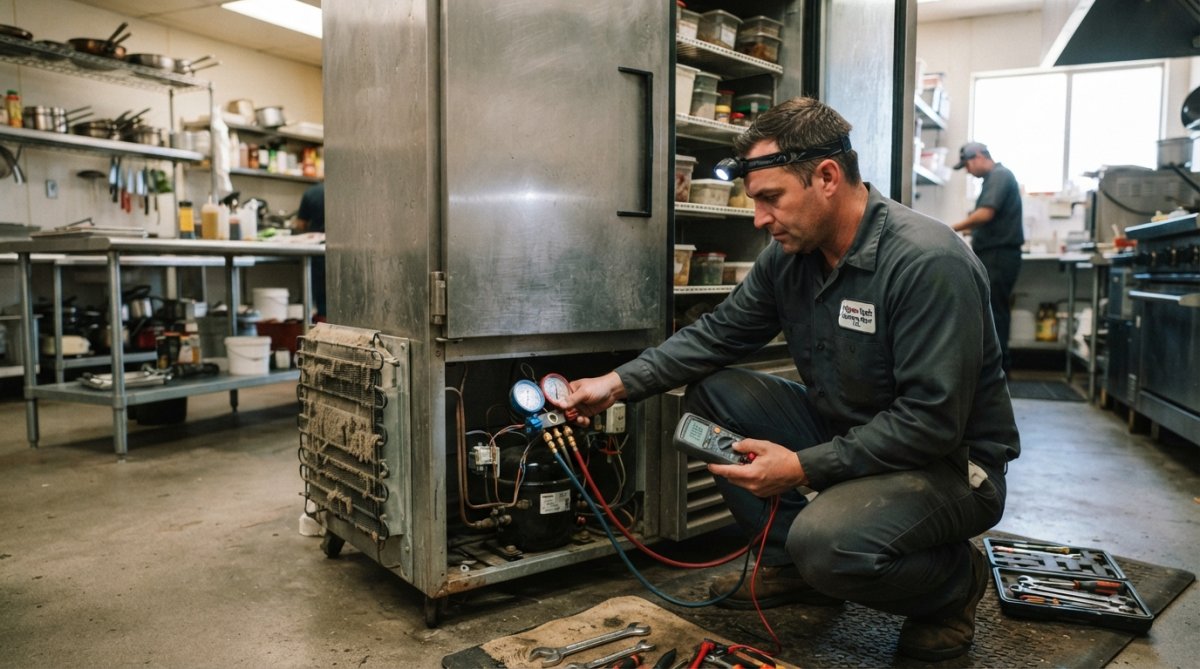
Before deciding whether to repair or replace, you need an accurate diagnosis. Many problems that seem catastrophic can be traced to simple issues: a clogged drain line, a thermostat out of calibration, or a failing door gasket. Other failures, like compressor breakdown, are genuinely expensive and signal end-of-life.
Temperature Fluctuations and Cooling Failures
Temperature fluctuations are the most common complaint. Start with the thermostat. If the temperature setting doesn't match actual internal temperature, the thermostat may be out of calibration or failing, a $150-$400 repair. Check with an independent thermometer to confirm.
Restricted air circulation is the next common culprit. If shelving blocks vents or condenser coils are clogged with dust, cooling can't distribute effectively. Clean the condenser coils and remove obstructions; this often solves the problem at zero cost. If air circulation remains poor, the fan motor may be failing, a $400-$800 repair.
Refrigerant loss is more serious. If the system is low on refrigerant, cooling capacity drops and the compressor works harder, eventually failing. A refrigerant recharge costs $300-$600, but if the system is leaking, you're treating the symptom. Finding and sealing the leak costs $500-$1,200. If the leak is in the sealed system itself, replacement is often smarter than repair.
Compressor and Refrigerant Issues
The compressor is the heart of your cooling system. Compressor replacement costs $1,500-$3,500, making it one of the most expensive single repairs.
Compressor failure rarely happens without warning. Listen for grinding or squealing noises indicating internal wear. If the compressor cycles on and off more frequently than usual, it's working harder to maintain temperature. If it won't start at all, the issue may be electrical (cheaper) or internal failure (expensive).
A qualified EPA 608-certified technician should check system pressure, subcooling, and superheat to determine if the compressor is genuinely failing or if the problem is low refrigerant, a clogged expansion device, or air in the system. This diagnostic typically costs $85-$150 and is worth the investment before committing to a $2,000+ repair.
If the compressor is confirmed as failed and your unit is 10+ years old, replacement is usually the right call. If your unit is 5-8 years old, repair is typically justified.
Door Gaskets, Hinges, and Seal Problems
A failing door gasket lets cold air escape, forcing the compressor to work harder. Inspect the gasket by closing the door on a dollar bill. If you can pull it out easily, the gasket is no longer sealing, replacement costs $100-$300 and is one of the most cost-effective maintenance investments you can make. A failed gasket can increase operating costs by 10-15%.
Hinges wear from repeated opening and closing. Loose hinges allow the door to sag, misaligning the gasket and preventing proper sealing. Hinge adjustment or replacement costs $150-$400. Check hinges and gaskets during regular maintenance. A $200 gasket replacement today prevents $500 in excess operating costs and compressor wear over the next year.
Evaporator and Condenser Coil Maintenance
Dirty or blocked coils reduce efficiency dramatically. Condenser coil cleaning should happen quarterly in dusty environments, twice yearly otherwise. Evaporator coil problems are more serious. Frost buildup suggests airflow restriction or refrigerant issues. Coil replacement costs $800-$1,500 and often signals that replacement makes more financial sense than repair.
Coil corrosion is common in coastal environments or high-humidity facilities. Corroded coils leak refrigerant and can't be reliably repaired. If corrosion is visible, coil replacement or unit replacement is likely necessary.
Commercial Refrigerator Maintenance Tips to Extend Equipment Life
Preventative maintenance is the single most effective strategy for extending equipment life and avoiding catastrophic failures. A maintenance program costs a few hundred dollars annually but prevents thousands in emergency repairs.
Preventative Maintenance Checklists
Establish a maintenance schedule and stick to it. Monthly tasks include checking door gaskets, cleaning visible debris, and visually inspecting for unusual signs. Quarterly maintenance includes thorough condenser coil cleaning, drain line inspection, and thermostat verification. Annual service should include a full system diagnostic by a certified technician, pressure checks, refrigerant analysis, electrical system inspection, and component wear assessment.
Document every maintenance visit and repair. This history becomes invaluable when deciding whether to repair or replace.
| Maintenance Task | Frequency | DIY or Pro | Cost Range | Impact |
|---|---|---|---|---|
| Door gasket inspection | Monthly | DIY | $0 | Prevents efficiency loss |
| Condenser coil cleaning | Quarterly | DIY | $0-50 | Maintains cooling capacity |
| Drain line flushing | Quarterly | DIY | $0-30 | Prevents water damage |
| Thermostat calibration check | Quarterly | DIY | $0 | Ensures accurate temperature |
| Full system diagnostic | Annually | Pro | $150-250 | Catches developing problems |
| Refrigerant pressure check | Annually | Pro | $100-150 | Identifies leaks early |
| Hinge and seal lubrication | Annually | DIY | $20-40 | Reduces wear |
Thermostat Calibration and Air Circulation
A thermostat that drifts 2-3 degrees can cause significant problems. Check your thermostat monthly against an independent thermometer.
Air circulation problems are often overlooked. Shelving positioned too close to cooling vents blocks airflow. In walk-in coolers, ensure air circulates freely around stored items. The evaporator fan circulates cold air throughout the unit. If the fan is noisy, running intermittently, or not running at all, cooling efficiency drops sharply. Fan motor replacement costs $300-$600 and should be done promptly.
Drain Line and Ventilation Care
Drain lines accumulate condensation and debris. A clogged drain line causes water to back up inside the unit, creating mold, odors, and potential food contamination. Flush drain lines quarterly with warm water and mild cleaning solution. This simple task costs nothing and prevents expensive problems.
Ventilation around the unit matters, especially for reach-in refrigerators. Leave at least 6 inches of clearance on all sides of the unit, and ensure exhaust air isn't recirculated back into the condenser intake.
Commercial Refrigeration Repair Cost and ROI Analysis
The decision ultimately comes down to financial analysis. Raw repair cost is only part of the picture. Account for operating costs, downtime risk, and remaining useful life.
Calculating True Repair vs. Replace ROI
Repair Scenario:
- Repair cost: $2,500
- Expected remaining life: 3 years
- Annual operating cost: $1,800/year
- Total 3-year cost: $2,500 + ($1,800 × 3) = $7,900
Replace Scenario:
- New unit cost: $6,000
- Expected life: 12 years
- Annual operating cost (25% more efficient): $1,350/year
- 3-year cost: $6,000 + ($1,350 × 3) = $10,050
- 12-year cost: $6,000 + ($1,350 × 12) = $22,200
In this example, repair is cheaper over 3 years. But over 12 years, replacement becomes significantly cheaper because the new unit's energy efficiency compounds. The break-even point is typically 5-7 years for units with significant efficiency improvements.
Energy Efficiency Gains and Operating Cost Savings
Modern commercial refrigeration equipment is substantially more efficient than units from 10+ years ago. A modern walk-in cooler uses 25-35% less energy than an equivalent unit from 2010-2012. That translates to real monthly savings.
If your current unit costs $1,800/year to operate and a replacement saves 30%, you're looking at $540/year in energy savings. Over 10 years, that's $5,400 in operational cost reduction. Many utilities offer rebates for replacing old commercial refrigeration with high-efficiency models, ranging from $500-$2,000. Check with your local utility company before deciding.
Downtime Cost Estimation and Food Safety Impact
Downtime cost is often the hidden factor that tips the decision toward replacement. If your unit fails completely and you can't get service for 24 hours, what's the cost? For a small restaurant, a full day of lost inventory might be $1,000-$3,000. For a mid-sized grocery store, it could be $10,000+.
Temperature fluctuations from failing refrigeration can render food unsafe to sell, creating liability and regulatory violations. The cost of a food safety incident can exceed $50,000 for a small operation.
Warranty Impact and Compliance in Commercial Refrigeration Regulations US
Warranty coverage changes dramatically between repair and replacement scenarios.
How Repairs Affect Warranty Coverage
When you repair commercial refrigeration equipment, you're usually working with whatever warranty came with the original unit. Most commercial refrigeration warranties are 1-3 years from purchase. If your unit is 8 years old, any factory warranty has expired. Third-party repair shops may offer limited warranties, typically 30-90 days on parts and labor.
A new unit comes with a manufacturer's warranty, typically 1-3 years on parts and labor, plus extended warranty options. This warranty covers defects and failures, providing protection against unexpected repair costs. Some repairs can void remaining warranty coverage. Always verify warranty implications before choosing a repair shop.
EPA Compliance, Refrigerant Phase-Out, and Disposal Requirements
The EPA has been phasing out older refrigerants due to ozone depletion and climate concerns. R-22 refrigerant, common in units manufactured before 2010, is being phased out. If your unit uses R-22 and develops a leak, you face a choice: repair with increasingly expensive R-22, retrofit the system to use newer refrigerant (expensive and complex), or replace the unit.
When you replace a unit, proper disposal of the old equipment is required. The EPA mandates that refrigerant be recovered and recycled by certified technicians before the unit is scrapped. This adds $100-$300 to the replacement cost but is legally required and environmentally responsible.
Repair or Replace: A Step-by-Step Decision Process
Here's a systematic process for making the repair versus replace decision.
Step 1: Assess Current Equipment Condition
Start with a thorough inspection. How old is the unit? What's the maintenance history? Are there visible signs of wear, corrosion, loose hinges, damaged gaskets? Has the unit had multiple repairs in the past 18 months?
Document the current problem. Is it a simple issue (thermostat, gasket) or a major component failure (compressor, coil)? Get a written diagnosis from a qualified technician.
Step 2: Get a Diagnostic and Repair Estimate
Contact a certified refrigeration technician for a full diagnostic. The diagnostic should include system pressure checks, refrigerant analysis, electrical system inspection, and assessment of all major components.
Get the repair estimate in writing, including labor and parts costs. Ask about warranty coverage on the repair. Verify that the technician is EPA 608-certified.
Step 3: Calculate the 50% Rule and Total Cost of Ownership
Apply the 50% rule: multiply equipment age by repair cost and compare to 50% of replacement cost. Then extend the analysis to 10 years, accounting for operating costs, maintenance, and expected remaining life.
Step 4: Evaluate Downtime Risk and Food Safety Implications
Consider your business's tolerance for downtime. If your operation can't function without the unit, replacement may be justified for reliability and warranty coverage alone. Assess food safety risk. If the unit has had temperature fluctuation problems, replacement eliminates that risk.
Step 5: Make Your Decision and Schedule Service
Once you've completed the analysis, make your decision. If choosing repair, schedule service immediately to minimize downtime. If choosing replacement, get quotes from multiple suppliers and schedule installation.
Conclusion: Making the Right Call for Your Commercial Refrigeration
The repair or replace decision isn't just about math, it's about understanding your business's needs, risk tolerance, and financial situation. The 50% rule provides a starting framework, but factors like energy efficiency gains, downtime risk, food safety, and warranty coverage often matter more.
If your unit is past 10 years old and facing a major repair, replacement is usually smarter. If your unit is 5-8 years old with a single component failure, repair is typically justified. If your unit is under 5 years old, repair almost always makes sense.
Home Tech has helped hundreds of Phoenix-area restaurants, grocery stores, and food service businesses navigate this decision. We provide honest diagnostics, written repair estimates, and transparent guidance on whether repair or replacement makes sense for your situation. When you need same-day service and professional guidance you can trust, contact Home Tech at (602) 486-1901 or visit hometechappliancerepair.com to schedule your diagnostic today.
Frequently Asked Questions
How do I know if I should repair or replace my commercial refrigerator?
Use the 50% rule as your starting point: if repair costs exceed 50% of replacement cost, replacement is typically more economical. However, also consider equipment age, remaining lifespan, downtime costs, energy efficiency gains, and warranty implications. A service technician can provide a diagnostic and repair estimate to help you calculate true ROI. For units near or past their typical lifespan (10-15 years for most commercial refrigeration), replacement often makes financial sense even if repair is temporarily cheaper.
What is the average commercial refrigerator lifespan?
Most commercial refrigeration equipment, including walk-in coolers, reach-in refrigerators, and ice makers, has a typical service life of 10 to 15 years with proper maintenance. Factors affecting lifespan include usage intensity, maintenance frequency, refrigerant type, and environmental conditions. Units operating in high-temperature environments or with heavy daily use may require replacement sooner. Regular preventative maintenance can extend equipment life, but significant compressor or sealed-system failures typically signal end-of-life.
What commercial refrigeration regulations US should I know about when replacing equipment?
The EPA regulates refrigerants under the Clean Air Act. Older systems using R12 or R22 are being phased out; replacements must use approved alternatives like R404a, R407a, R410A, R32, or R454B. When replacing equipment, ensure your service technician is EPA 608 certified for proper refrigerant handling and disposal. Additionally, food service equipment must meet NSF standards for food safety, and commercial HVAC systems must comply with state energy efficiency codes. Always verify local and state requirements before purchasing replacement equipment.
How can I reduce commercial refrigeration repair costs and extend equipment life?
Implement a preventative maintenance checklist: clean condenser and evaporator coils monthly, inspect door gaskets and hinges quarterly, calibrate thermostats, check refrigerant levels, and ensure proper air circulation and ventilation. Clean drain lines regularly to prevent blockages. Schedule professional service annually or semi-annually depending on usage. These commercial refrigerator maintenance tips reduce emergency breakdowns, improve energy efficiency, and can add years to equipment life, ultimately lowering total operating costs and downtime risk.
What is the real cost difference between repair and replacement when factoring in energy efficiency?
Newer commercial refrigeration equipment typically consumes 20-40% less energy than units 10+ years old. While replacement has higher upfront cost, energy savings, reduced downtime, improved food safety, and elimination of repeat repairs create significant ROI over 5-10 years. Calculate your current annual operating costs, compare to new equipment specifications, and factor in downtime expenses (food loss, labor, customer impact). Many businesses find replacement breaks even within 3-5 years when energy and maintenance savings are included, especially if current equipment requires frequent repairs.
How does a repair affect my commercial refrigerator warranty?
Third-party repairs may void or limit manufacturer warranty coverage, depending on your equipment's warranty terms. Some manufacturers allow repairs only by certified technicians or authorized service centers. Before authorizing any repair, review your warranty documentation or contact the manufacturer to confirm coverage. Replacement equipment typically comes with a new manufacturer warranty (commonly 1-5 years), which can be extended through service plans. Factor warranty implications into your repair-versus-replace decision, especially for units still under coverage.
What are the biggest signs my commercial refrigerator needs immediate attention?
Watch for temperature fluctuations, inability to reach or maintain set temperature, unusual compressor noise or vibration, visible refrigerant leaks, frost buildup on evaporator coils, door gasket deterioration, or ice maker failure. These indicate compressor stress, refrigerant loss, or sealed-system problems. Call a service technician immediately, continued operation risks food spoilage, food safety violations, and catastrophic compressor failure. Prompt diagnostic service can sometimes save equipment through refrigerant recharge or coil cleaning; delaying repair increases replacement likelihood and downtime cost.
For immediate commercial refrigeration issues, same-day emergency service is available. Home Tech's EPA 608-certified technicians understand that equipment downtime costs money. We show up on time, diagnose accurately, and help you make the right repair or replace decision based on your specific situation, not a sales pitch. Call now for a same-day appointment or a no-pressure consultation on whether repair or replacement is right for your equipment.