 comparison
Is My Washing Machine Worth Repairing? A 2026 Decision Guide
Table of Contents
- Is Your Washing Machine Worth Repairing? The 50% Rule Framework
- Washing Machine Lifespan: What You Actually Get
- Signs a Washing Machine Needs Replacing
- Common Washing Machine Problems and Repair Costs
- Average Cost of Washing Machine Repair vs. New Purchase
- DIY Repair vs. Professional Service: When to Call a Technician
- Environmental Impact: The Case for Repair Over Replacement
- How to Make Your Final Repair or Replace Decision
- Frequently Asked Questions
Last Updated: July 7, 2026
Is Your Washing Machine Worth Repairing? The 50% Rule Framework
When your washing machine breaks down, the decision hinges on math, not emotion. The 50% Rule is your primary tool: if repair cost exceeds 50% of a comparable new machine's price, replacement typically makes financial sense. However, this rule is a starting point, not a final verdict. Your actual decision depends on machine age, repair frequency, warranty status, and remaining useful life.
According to Consumer Reports appliance reliability data, the average washing machine lifespan is 8-12 years. What separates a worthwhile repair from wasted money is understanding the specific failure, your machine's remaining life, and whether this repair signals the start of a failure cycle.
How the 50% Rule Works
Compare the repair quote to the cost of a new machine in the same category. If repair exceeds 50% of replacement, replacement becomes cost-effective.
A standard top-load washer costs $500-800 new. A transmission failure repair runs $300-500. Since $400 (mid-range repair) is less than 50% of $650 (mid-range replacement), repair wins financially. The 50% Rule accounts for labor costs, which typically add $100-200 to parts. Get repair quotes from at least two sources before deciding, as labor rates vary significantly by region.
When the 50% Rule Breaks Down
The 50% Rule works well for mid-life machines (5-8 years old) but becomes less useful at the extremes. For machines under 3 years old, a major repair almost always makes sense. For machines over 10 years old, even a repair under 50% may not be worthwhile if you're facing multiple failures within 12 months.
Environmental impact also challenges the rule's logic. Repairing extends machine life and prevents landfill waste. Warranty status is another critical factor. Covered repairs cost nothing, making replacement financially irrational. If warranty just expired and you're facing major component failure, replacement includes new warranty protection for years ahead.
Washing Machine Lifespan: What You Actually Get
Modern washing machines are engineered to last 8-12 years under normal use. Lifespan depends heavily on machine type and usage intensity. A machine running 3 loads per week will outlast one running 15 loads weekly.
Top-load machines with mechanical agitation typically last 10-14 years due to simpler design and fewer electronic components. Front-load machines typically last 8-10 years but are more complex, with more failure points. High-end machines with smart features often fail in the 6-9 year range due to additional electronics and sensors.
Age Benchmarks by Machine Type
Top-load machines have a central agitator, drum, and transmission. When they fail, it's usually the transmission or drum bearings, both repairable. Mechanical simplicity means fewer electronic components to fail prematurely.
Front-load machines are more efficient but complex. Common issues include seal degradation, motor bearing wear, and control board failures. They require more maintenance to reach full lifespan.
High-end machines with smart features often fail in the 6-9 year range. Additional electronics, sensors, and WiFi modules introduce complexity that increases failure risk. Repairs often require replacing entire circuit boards, costing nearly as much as a basic replacement machine.
Modern Electronics vs. Vintage Durability
Vintage washing machines from the 1970s-1980s are legendary for durability; many still run today with minimal repair. Modern machines are more efficient and convenient but more complex and prone to failure.
Modern electronics handle water temperature, cycle timing, load sensing, and spin speeds with precision. But more components mean more failure points. A control board malfunction requires replacement; in a vintage machine, you might have adjusted a mechanical dial. Repairability varies dramatically. Vintage machines have readily available parts and straightforward procedures. Modern machines often require proprietary parts and manufacturer diagnostics.
Signs a Washing Machine Needs Replacing
Certain failure patterns signal that repair is no longer cost-effective. These aren't always catastrophic breakdowns; sometimes it's the accumulation of smaller failures that tips the scales toward replacement.
Critical Failure Indicators
A machine that's failed twice in 12 months signals systemic wear. The first failure might be a one-off issue; the second suggests rapid aging. Even if the current repair is under 50% of replacement, you're likely facing a third failure within 6-12 months.
Transmission failure in a top-load machine is critical. Repair costs $300-500 and buys 2-4 more years if the machine is otherwise sound. But if your machine is already 10+ years old, transmission failure often signals replacement time.
Drum bearing failure produces loud grinding or squealing during spin cycles. Bearing replacement is labor-intensive and costs $400-700. For machines over 10 years old, this repair rarely justifies the cost.
Water leaks from multiple points (seal, pump, tub) suggest pervasive wear. Multiple leaks indicate end-of-life, with repairs totaling $600-900.
Frequency of Repairs as a Warning Signal
A machine needing service once every 2-3 years is normal for older machines. Twice in one year is a warning. Three times in 12 months signals replacement time.
Repeated repairs compound quickly. Two $300 repairs in one year is $600, approaching budget replacement cost. Three $300 repairs is $900, exceeding many models. Machines entering a repair cycle rarely recover. Even after successful repair, underlying wear continues affecting other components.
Common Washing Machine Problems and Repair Costs
Understanding which failures are fixable helps you evaluate repair quotes intelligently.
Major Component Failures: Transmission, Motor, Drum Bearings
The transmission controls agitation and spin cycles in top-load washers. Failure means the washer won't agitate or spin properly. Repair costs $400-650 total (parts plus labor).
Motor failure is less common but more expensive. When it fails, the entire wash cycle stops. Motor replacement costs $350-550 total. For machines over 10 years old, motor failure often triggers replacement.
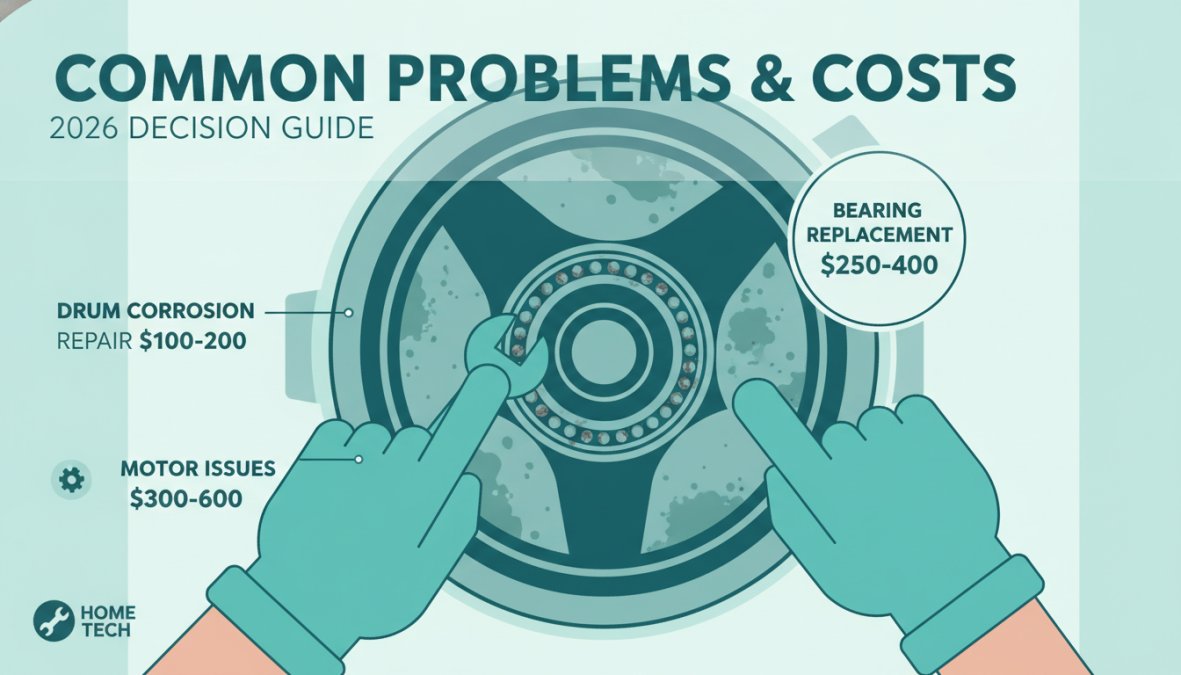
Drum bearing failure produces grinding or squealing sounds during spin cycles. Bearing replacement requires disassembling the entire tub and drum assembly, making it labor-intensive. Cost runs $400-700 total. For machines over 8 years old, bearing failure often justifies replacement.
Minor Issues: Seals, Drain Pump, Control Board
Seal failure is the most common problem. Water pooling under the machine during wash cycles indicates seal wear. Seal replacement costs $150-300 total and typically extends machine life by 2-3 years.
Drain pump failure means water won't drain from the tub. Pump replacement costs $200-350 total. It's a common wear item, and replacing a failed pump is usually cost-effective.
Control board failure is increasingly common in modern machines. The control board manages cycle timing, water temperature, and sensor inputs. Replacement costs $300-600 depending on model. For budget machines, control board failure often triggers replacement because the board costs nearly as much as a new machine.
| Problem | Repair Cost | Lifespan Impact | Replacement Trigger |
|---|---|---|---|
| Seal failure | $150-300 | Extends 2-3 years | No, unless repeated |
| Drain pump | $200-350 | Extends 2-3 years | No, unless frequent |
| Transmission | $400-650 | Extends 3-4 years | Yes, if 10+ years old |
| Motor | $350-550 | Extends 3-4 years | Yes, if 10+ years old |
| Drum bearings | $400-700 | Extends 2-3 years | Yes, if 8+ years old |
| Control board | $300-600 | Extends 2-3 years | Yes, if budget model |
Average Cost of Washing Machine Repair vs. New Purchase
The financial comparison hinges on three numbers: repair cost, replacement cost, and machine age.
Labor Costs and Parts Availability
Professional repair labor typically runs $100-150 per service call, plus parts. Labor costs vary by region and technician experience. Common parts like seals, pumps, and motors are readily available for popular brands. Specialty parts for less common brands or older machines may take 5-10 days to arrive.
DIY parts are available online for many common failures. However, complex repairs like transmission or bearing replacement require specialized tools and expertise. Attempting these yourself risks damaging other components and voiding warranty protection.
Brand Reliability and Warranty Considerations
Some brands are more reliable than others. Top-load machines from Whirlpool and Maytag tend to be durable and repairable. Front-load machines from LG and Samsung are efficient but experience higher failure rates with seals and control boards.
Warranty status dramatically changes the calculation. Machines under manufacturer warranty (typically 1 year) have covered repairs at no cost. Extended warranties (2-5 years) cover major components. If you're under extended warranty, replacement makes no financial sense.
New machines come with manufacturer warranties (typically 1 year parts and labor, sometimes 5-10 years on specific components). This protection is valuable during critical first years.
DIY Repair vs. Professional Service: When to Call a Technician
Some washing machine problems are simple enough for DIY diagnosis. Others require professional tools, expertise, and safety precautions.
What You Can Diagnose Yourself
Water leaks are often traceable to visible sources. Check inlet hose connections at the back of the machine; they may be loose or cracked. Check the drain hose for kinks or clogs. Both are fixable without professional help.
Drain problems can sometimes be resolved by cleaning the drain filter. Many machines have a small filter at the bottom front that catches lint and debris. If the machine still won't drain, the pump may be clogged, a risky DIY task.
Lid or door latch issues are often simple fixes. If the latch is clearly bent or broken, replacement parts are available online and installation is straightforward.
Loud noises during spin cycles often indicate something is stuck in the drum. Stop the cycle, drain the water, and inspect the drum for foreign objects.
Why Complex Repairs Require Professional Help
Transmission, motor, and bearing repairs require disassembling the machine to access internal components. This process risks damaging seals, wires, and other components if done incorrectly. Professional technicians have done this hundreds of times.
Control board diagnostics require specialized equipment. Error codes and electrical failures can't be accurately diagnosed with a multimeter. Water and electricity mix dangerously. Washing machines operate at 120V or 240V. Accessing internal components while plugged in risks electric shock.
Environmental Impact: The Case for Repair Over Replacement
Manufacturing a new washing machine consumes significant resources: raw materials, energy, water, and chemicals. A typical manufacturing process generates 500-1000 pounds of waste and consumes 200+ gallons of water. Replacing a machine that could be repaired for $400 means creating all that waste to avoid a $400 expense.
Repair extends the useful life of materials already extracted from the earth. Steel, copper, plastic, and electronics components represent embodied energy and environmental cost already paid. Repairing preserves that investment; replacement starts the environmental ledger over.
For environmentally conscious households, repair becomes the default choice unless the machine is genuinely beyond recovery.
How to Make Your Final Repair or Replace Decision
Follow this step-by-step evaluation to arrive at a clear answer.
Step-by-Step Evaluation Checklist
Step 1: Get an exact repair quote. Call a professional technician and get a specific diagnosis and quote.
Step 2: Research replacement cost. Visit retailer websites and identify a replacement machine in the same category.
Step 3: Apply the 50% Rule. If repair cost is less than 50% of replacement cost, repair is the default choice. If repair exceeds 50%, move to Step 4.
Step 4: Check machine age. If your machine is under 5 years old, repair almost always makes sense. If your machine is 10+ years old, replacement becomes more attractive.
Step 5: Count recent repairs. If your machine has required two or more repairs in 12 months, you're in a failure cycle. Replacement is likely better, even if the current repair is under 50%.
Step 6: Verify warranty status. If your machine is under manufacturer or extended warranty, the repair is likely covered. Covered repair always beats replacement financially.
Step 7: Consider environmental impact. If sustainability is important to you, repair wins unless the machine is genuinely beyond recovery.
Step 8: Make the decision. If repair cost is under 50%, machine is under 8 years old, and repair frequency is low, repair. If repair exceeds 50%, machine is 10+ years old, or repair frequency is high, replace.
| Decision Factor | Favors Repair | Favors Replacement |
|---|---|---|
| Repair cost vs. replacement | Under 50% | Over 50% |
| Machine age | Under 8 years | Over 10 years |
| Repair frequency (12 months) | One repair or fewer | Two or more repairs |
| Warranty status | Under warranty | Warranty expired |
| Environmental priority | High | Low |
| Machine type | Simple (top-load) | Complex (smart, high-end) |
Deciding whether your washing machine is worth repairing comes down to a clear financial comparison, machine age, and repair history. The 50% Rule provides a solid starting point, but context matters. A 4-year-old machine in its first repair should almost certainly be fixed, while a 12-year-old machine in its third repair this year should probably be replaced.
Home Tech's approach focuses on cost-effective repair over replacement. We diagnose the exact failure, provide transparent pricing, and help you understand your options. For machines in the Phoenix metro area, we offer same-day and next-day appointments with no hidden fees and a 100% satisfaction guarantee. Call (602) 486-1901 or visit hometechappliancerepair.com to schedule a diagnostic and get a repair quote that helps you make the right decision.
Frequently Asked Questions
How do I know if my washing machine is worth fixing?
Use the 50% Rule: if repair costs exceed 50% of a new machine's price, replacement is usually more cost-effective. Also consider the machine's age relative to its typical lifespan, frequency of recent repairs, and warranty status. If it's past mid-life and needs major component work (transmission, motor, drum bearings), replacement often makes financial sense. Get a professional diagnostic to understand the actual repair scope before deciding.
What is the average washing machine lifespan?
Most modern washers last 8-12 years with regular maintenance, though vintage machines can exceed 20 years. Front-loaders typically last 10-14 years; top-loaders 8-12 years. High-end models with advanced electronics may fail sooner due to control board complexity, while simpler vintage machines often outlast newer counterparts. Your actual lifespan depends on water quality, usage frequency, maintenance, and brand reliability. Warranty periods often reflect manufacturer expectations for component durability.
What are the signs that a washing machine is dying?
Critical warning signs include: leaking water, inability to complete cycles, unusual noises (grinding, squealing), failure to drain or spin, visible rust or corrosion, and error codes on the control board. If repairs are needed more than once per year or the machine is over 10 years old, replacement may be imminent. Multiple failing components, seals, drain pump, and motor issues occurring together, indicate wear and tear across the entire appliance, signaling end-of-life.
Is it cheaper to repair or replace a washing machine?
Repairs are cost-effective for machines under 5 years old with single-component failures (seals, drain pump). For machines 8+ years old needing major work (transmission, motor), replacement is usually cheaper long-term when factoring in energy efficiency gains and future repairs. Calculate 5-year costs: repair cost + projected future repairs versus new machine price plus installation. Environmental impact also favors repair when feasible, reducing waste while saving money on quality machines still within their lifespan.
Should I repair my washing machine if it's still under warranty?
Yes, warranty coverage makes repair the clear choice financially. Most warranties cover parts and labor for major failures, eliminating out-of-pocket costs. Even if your machine is nearing the end of its warranty period, repair is typically free or low-cost. Once warranty expires, the 50% Rule and machine age become your decision drivers. Check your warranty documentation for coverage details, as some warranties exclude certain components or require manufacturer-authorized service only.