 comparison
Is a Tankless Water Heater Worth It for Restaurants?
Table of Contents
- Tank vs. Tankless: The Restaurant Kitchen Reality
- Commercial Water Heater Sizing Guide for Restaurant Kitchens
- Tankless Water Heater Energy Savings for Restaurants: What the Numbers Show
- Upfront Costs, Installation, and ROI for Restaurant Owners
- Commercial Tankless Water Heater Maintenance: Keeping the Kitchen Running
- Code Compliance, Permitting, and Water Quality in Restaurants
- Is a Tankless Water Heater Worth It for Your Restaurant?
- Frequently Asked Questions
Last Updated: September 12, 2026
Tank vs. Tankless: The Restaurant Kitchen Reality
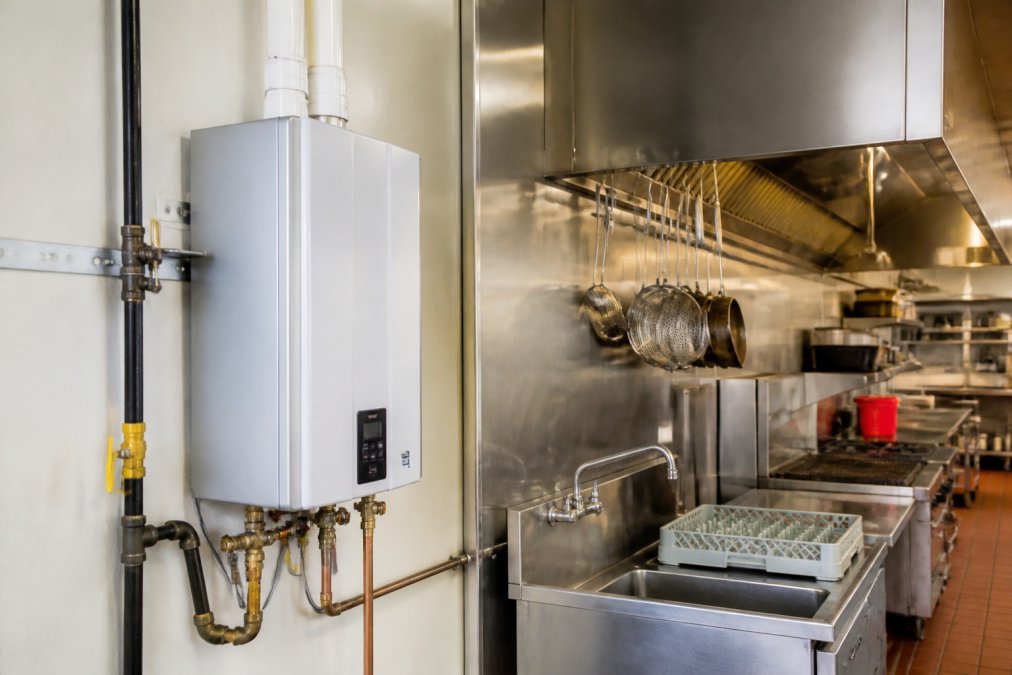
Is a tankless water heater worth it for restaurants? For most commercial kitchens with steady-to-high hot water demand, yes, with one condition: the unit must be correctly sized and professionally installed. Tankless systems heat water on demand, eliminate standby heat loss, and free up floor space. Undersized units, though, create the exact problem they were meant to solve.
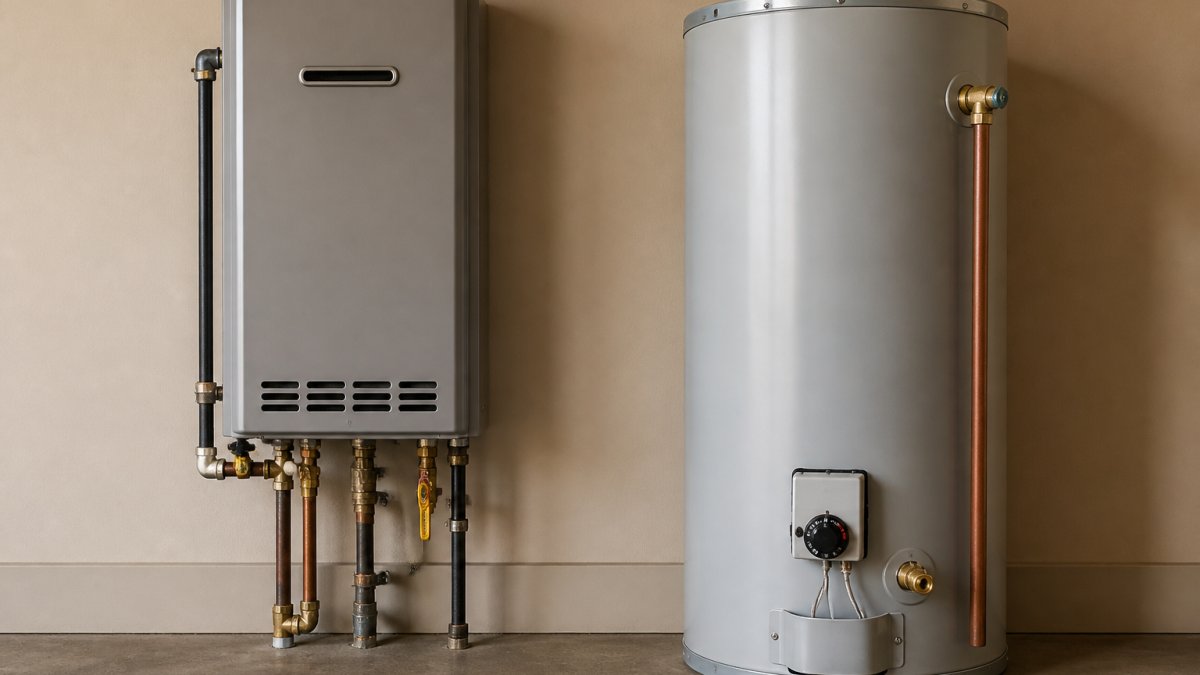
A tankless water heater is a water heating system that heats water only when a fixture calls for it, passing cold water through a heat exchanger rather than storing hot water in a tank. For restaurants, that distinction matters because hot water demand is spiky: dishwashing surges, hand sinks run constantly, and mop sinks pull volume at closing.
Traditional storage-based models keep a tank of hot water at temperature around the clock. That's standby heat loss you pay for whether you're open or not.
Commercial Water Heater Sizing Guide for Restaurant Kitchens
Sizing is the single most common reason a commercial tankless installation disappoints. A commercial water heater sizing guide for restaurants starts with peak demand, not building square footage.
Three numbers drive the decision:
- Flow rate (GPM): the gallons per minute the unit must deliver simultaneously across all fixtures.
- Temperature rise: incoming cold water temperature subtracted from your target output.
- BTU capacity or kW: the heating power required to hit that flow at that rise.
A gas-fired tankless unit with high BTU capacity handles larger simultaneous loads; electric tankless models suit point-of-use applications like a single hand sink or dishwasher.
Count your fixtures honestly. Add the dishwasher, hand sinks, mop sink, and any prep stations that may run at once. That total, not the average, sizes the unit.
Tankless Water Heater Energy Savings for Restaurants: What the Numbers Show
Tankless water heater energy savings for restaurants come primarily from one source: no standby heat loss. A storage tank reheats water continuously; a tankless unit fires only on demand. Thermal efficiency on modern condensing units is high, and the Energy Star program rates qualifying models on that basis (energystar.gov).
The savings are real but context-dependent. A restaurant with low, steady hot water use sees a smaller benefit than one with intermittent high-volume demand. Operational expenses drop most in facilities that were previously heating a large tank around the clock for occasional use.
Energy Star water heater guidance outlines how efficiency ratings translate to real operating costs.
Upfront Costs, Installation, and ROI for Restaurant Owners
Most buying guides stop at "tankless costs more upfront." That's useless for a restaurant owner writing a capital check. The real question is which cost lines move, by how much, and whether the payback lands inside your equipment replacement horizon.
Where the money actually goes
A commercial tankless install has four cost buckets, and the equipment is rarely the largest one:
- The unit itself. Gas-fired condensing commercial units with the BTU capacity to serve a dishwasher plus hand sinks typically run well above residential pricing. Electric point-of-use units are cheaper per unit but you may need several.
- Gas supply and meter capacity. A high-BTU commercial tankless unit can require a larger gas meter, a dedicated regulator, and upsized black iron or CSST runs from the meter to the unit. If the existing service is already near capacity, the utility may need to upgrade the meter, a lead-time item, not a same-week item.
- Venting. Condensing units vent in PVC or CPVC and can often use a sidewall termination; non-condensing units need Category III stainless venting and different clearances. Switching categories changes both material cost and where the unit can physically go.
- Electrical and controls. Electric tankless units draw high amperage and usually need dedicated circuits and often a panel upgrade. Gas units still need power for controls, ignition, and pumps.
- Make-up air and combustion air. A commercial kitchen already runs in negative pressure from hood exhaust. Adding a high-BTU gas appliance can trigger a make-up air requirement that has nothing to do with the water heater and everything to do with your budget.
A payback framework you can actually run
- Baseline your current hot water energy spend. Pull 12 months of gas (or electric) bills and estimate the share attributable to water heating. For a storage tank, standby loss is a real, measurable slice, a tank sitting at temperature 24/7 loses heat whether you're open or not.
- Estimate tankless consumption at your real demand profile. Tankless eliminates standby loss but does not eliminate the energy required to heat the water you actually use. The savings come from the standby slice, not from a magic efficiency multiplier.
- Net the annual savings. Annual savings ≈ (standby loss eliminated) × (your utility rate). If your kitchen runs 14 hours a day at high volume, standby loss is a smaller share of the bill than it is for a low-volume operation.
- Add total installed cost, not just equipment: unit + gas work + venting + electrical + permit fees + any make-up air work.
- Divide installed cost by annual savings for a simple payback in years.
A common pattern: high-volume kitchens with steady demand see longer paybacks because standby loss was already a small fraction of their bill. Low-volume or intermittent-use kitchens, catering operations, bars with limited food service, seasonal spots, often see the strongest payback because they were paying to keep a tank hot for occasional use.
The trade-offs the marketing sheet won't show you
| Factor | Tank | Tankless |
|---|---|---|
| Standby heat loss | Continuous | None |
| Floor space | Large footprint | Wall-mounted, compact |
| Upfront cost | Lower | Higher, and install can exceed unit cost |
| Peak demand | Limited by tank size | Limited by sizing and gas/electrical capacity |
| Maintenance | Periodic flush | Annual descaling, more often in hard water |
| Lifespan | Shorter | Longer with care |
| Retrofit risk | Low | Gas, venting, and electrical may all need work |
If payback lands inside your replacement horizon and your facility can support the gas, venting, and electrical load, tankless is usually the stronger choice. If the retrofit scope balloons, a high-efficiency storage tank may be the better financial call, and that's a legitimate answer, not a cop-out.
Commercial Tankless Water Heater Maintenance: Keeping the Kitchen Running
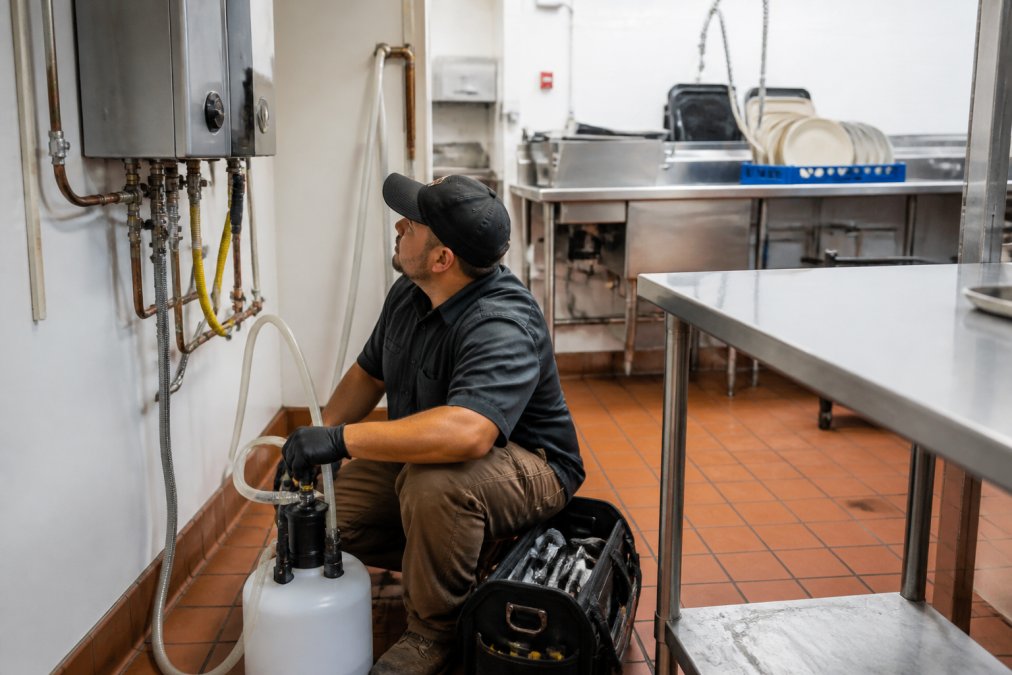
Commercial tankless water heater maintenance is not optional, and skipping it is the fastest way to void your efficiency gains. The heat exchanger accumulates scale, and scale reduces flow and forces the unit to work harder.
A workable maintenance schedule:
- Monthly: check error codes, inspect the intake filter, confirm venting is clear.
- Annually: professional descaling of the heat exchanger.
- As needed: flush sediment, verify water pressure, test temperature consistency at fixtures.
In hard-water areas, descaling may need to happen more often. Water quality directly affects how quickly scale builds, which is why a water test before installation pays for itself.
Home Tech services tank and tankless water heaters, gas and electric, including sediment flushing and error code troubleshooting for tankless systems. If your unit is throwing codes mid-service, that's a call worth making before a dinner rush.
Code Compliance, Permitting, and Water Quality in Restaurants
Code compliance is the angle most buying guides skip, and it's often the difference between a smooth install and a stalled one. A commercial kitchen is not a house with a bigger sink, it's a regulated food-service environment with overlapping plumbing, gas, electrical, and health requirements.
The permits you'll likely need
A commercial water heater swap is rarely a like-for-like permit. Expect to touch several jurisdictions:
- Plumbing permit. Required in most jurisdictions for any water heater replacement, and almost always for a change in system type (tank to tankless).
- Gas permit and inspection. If you're adding a high-BTU gas appliance, the gas piping, regulator, and meter capacity all fall under the gas code. Your utility may need to approve a meter upgrade separately.
- Electrical permit. Electric tankless units draw high amperage and typically need dedicated circuits; a panel upgrade is a separate permit and inspection.
- Mechanical/venting permit. Venting category, termination location, and clearances are inspected. Condensing and non-condensing units have different rules.
- Health department review. Your local health code governs hot water temperature at hand sinks and dishwashing machines (the FDA). A change in water heating system can trigger a re-inspection of those fixtures.
The retrofit realities that blow up timelines
- Gas meter capacity. A commercial tankless unit can demand more BTU than the existing meter can deliver. Utility meter upgrades have lead times measured in weeks, not days.
- Venting path. Condensing units can often vent in PVC through a sidewall; non-condensing units need stainless and different clearances. Where the unit can physically mount depends on which category you buy.
- Combustion and make-up air. Commercial hoods put the kitchen under negative pressure. Adding a high-BTU gas appliance can trigger a make-up air requirement that is a separate scope of work.
- Electrical service. Electric tankless units often require a service upgrade. If the panel is already loaded, that's a project, not an afternoon.
- Backflow prevention. Many jurisdictions require backflow prevention on the cold water supply to the water heater. Confirm with your plumber before the unit is ordered.
Water quality: the silent cost driver
Hard water is the single biggest threat to a tankless heat exchanger in a high-volume kitchen. Scale builds on the heat exchanger, restricts flow, and forces the unit to work harder, which erodes exactly the efficiency you bought the unit for. In hard-water areas, descaling may need to happen more than once a year.
A simple water hardness test before installation tells you whether you need a softener or a more aggressive maintenance schedule. Skipping that test is how owners end up with a unit that's limed up inside two years and a warranty conversation they'd rather not have.
Home Tech services tank and tankless water heaters, gas and electric, including sediment flushing and error code troubleshooting for tankless systems. If your unit is throwing codes mid-service, that's a call worth making before a dinner rush.
Is a Tankless Water Heater Worth It for Your Restaurant?
Is a tankless water heater worth it for restaurants with high, variable hot water demand? Usually yes, provided the unit is correctly sized and your facility can support it. The decision comes down to three checks: peak flow rate and BTU capacity, installation and permitting feasibility, and a realistic maintenance commitment.
Where tankless wins: on-demand hot water, no standby heat loss, compact appliance footprint, and consistent temperature during peak demand. Where it struggles: undersized installs, hard water without treatment, and facilities that won't keep up with descaling.
If you're weighing a replacement for an aging unit, get the sizing and water quality assessed first. That assessment, not the marketing sheet, tells you whether tankless is the right call.
Home Tech is EPA 608 certified and services tank and tankless water heaters across the metro area, with same-day and next-day appointments and a 100% satisfaction guarantee on every repair.
Frequently Asked Questions
What is the downside of tankless water heaters for restaurants?
The biggest downsides are higher upfront cost and the need for adequate gas or electrical capacity. A commercial tankless water heater restaurants rely on may require gas line or amperage upgrades, which adds to installation costs. Maintenance is also more frequent: hard water causes scale buildup in the heat exchanger, so descaling is typically needed once or twice a year depending on water quality. Without a maintenance schedule, flow rate and temperature consistency can drop during peak demand.
How does a tankless water heater impact monthly utility costs for restaurants?
Tankless units heat water only when a fixture calls for it, so they avoid the standby heat loss that storage tanks experience around the clock. That can lower gas or electric consumption, especially in restaurants with long idle periods between service rushes. Actual savings depend on your utility rates, usage patterns, and whether the unit is sized correctly. An undersized system runs longer and erodes the savings, which is why a proper commercial water heater sizing guide matters before you buy.
Do tankless water heaters meet health department requirements for sanitization?
Health departments require hot water at specific temperatures for handwashing and dish sanitization, typically per local plumbing and food code rules. A properly sized commercial tankless unit with digital temperature control can hold those setpoints consistently, which is one reason operators choose them. The key is verifying the unit can deliver the required flow rate at the required temperature during peak demand, and confirming the installation meets local code and permitting requirements in your area.
How long do commercial tankless water heaters last compared to traditional tanks?
Tankless units generally last longer than storage tanks because there is no tank to corrode. With regular commercial tankless water heater maintenance, including descaling and annual inspections, many units deliver a longer service life than a typical tank. Hard water shortens that lifespan, so water quality matters. If your restaurant already deals with scale on other equipment, plan for more frequent descaling to protect the heat exchanger and keep the system running efficiently.
The challenge with any water heater decision is that the wrong size or a skipped maintenance schedule costs you far more than the unit itself. Home Tech handles tank and tankless water heater service, including heating element and thermostat replacement, sediment flushing, and error code troubleshooting for tankless systems, backed by same-day availability and EPA 608 certified technicians. Get started with Home Tech and keep your kitchen's hot water running without the guesswork.