 comparison
HVAC Maintenance vs Repair: Cost Comparison
Table of Contents
- HVAC Maintenance vs Repair: Which Costs Less?
- Average Cost of HVAC Maintenance
- Average Cost of HVAC Repair
- The 50% Rule: When to Replace Instead of Repair
- Signs Your AC Needs Refrigerant or Other Repairs
- Preventive HVAC Maintenance Checklist
- Maintenance Plans vs Pay-Per-Repair: The Real Savings
- Frequently Asked Questions
Last Updated: August 20, 2026
HVAC Maintenance vs Repair: Which Costs Less?
When your air conditioning system starts making strange noises or your heating system won't kick on, the question isn't just "what's wrong?", it's "how much is this going to cost?" The answer depends on a choice many homeowners face: should you invest in preventive maintenance, or wait until something breaks and pay for repairs? Understanding the real difference in cost between HVAC maintenance vs repair cost comparison can save you thousands over the life of your system.
Home Tech has spent over a decade helping Phoenix-area homeowners navigate this exact decision. The truth is simpler than most contractors make it sound: preventive maintenance costs less upfront but saves dramatically on emergency repairs. Repairs, on the other hand, are cheaper in the moment, until they aren't. A single refrigerant leak or compressor failure can wipe out a year's worth of maintenance savings in one service call.
Below, we'll show you exactly what average cost of HVAC maintenance looks like, compare it to repair expenses, and help you figure out which approach actually makes financial sense for your situation.
Average Cost of HVAC Maintenance
Preventive HVAC maintenance typically falls into two categories: individual tune-ups and annual maintenance plans.
A single seasonal tune-up, whether for cooling or heating, generally costs less than an emergency service call. These visits include filter replacement, thermostat calibration, coil cleaning, and system diagnostics. Many homeowners schedule one in spring before cooling season and another in fall before heating season.
Maintenance plans from local providers offer a more predictable cost structure. These subscriptions bundle two annual visits with priority scheduling, diagnostic fee waivers, and repair discounts. For example, some plans start around $150 to $280 per year for a single system, while others charge monthly. The advantage is knowing exactly what you'll spend and what you'll receive: scheduled visits, no surprise diagnostic charges, and often 10-15% off any repairs that do occur.
The real value of maintenance plans emerges when you factor in what they prevent. A clogged filter reduces efficiency and strains your compressor. A refrigerant leak that goes undetected can turn into a failed compressor, a much costlier repair. Preventive maintenance catches these issues early, when they're cheap to fix.
For homeowners with multiple systems or those in harsh climates, the annual cost of maintenance plans often pays for itself in a single avoided repair. That's the math that makes preventive HVAC maintenance vs repair cost comparison so clear: spend a little now, or spend a lot later.
Average Cost of HVAC Repair
Repair costs vary wildly depending on what's broken. A simple filter replacement or thermostat fix might run $100-200. A refrigerant recharge, which is one of the most common repairs, typically costs more because it requires EPA 608-certified technicians and involves diagnosing the source of the leak.
A diagnostic fee, the cost to identify what's wrong before any repair happens, often runs $75-150. Some contractors waive this fee if you proceed with the repair. Others don't. This is where maintenance plans shine: they typically eliminate diagnostic fees entirely.
The expensive repairs are the ones most homeowners dread. A failed compressor, which is the heart of your AC system, can cost thousands to replace. An evaporator coil leak or condenser unit failure pushes repair costs even higher. These aren't small problems, they're the kind that make homeowners wonder if it's time to replace the whole system instead.
Emergency calls amplify these costs. If your system fails on a weekend, holiday, or in the middle of a 115-degree summer day, you'll pay premium labor rates. Some contractors charge double or triple their standard rates for emergency service. This is where the gap between maintenance and repair becomes painfully obvious: a $200 maintenance visit in May could have prevented a $2,000 emergency repair in July.
The unpredictability of repair costs is exactly why maintenance plans exist. They trade the uncertainty of "what will break and when" for the certainty of "I know what I'm spending and I'm covered if something goes wrong."
The 50% Rule: When to Replace Instead of Repair
The 50% rule is the industry standard for deciding whether to repair or replace an aging HVAC system. Here's how it works: multiply the age of your system by the cost of repair. If that number exceeds 50% of the cost to replace the system, replacement is usually the better financial choice.
Example: Your 12-year-old AC unit needs a compressor repair that costs $1,500. A new system costs $5,000. The calculation: 12 × $1,500 = $18,000. Since $18,000 is well above 50% of $5,000, you'd replace.
But the 50% rule is just a starting point. Other factors matter more than the math alone suggests.
A system that's 15+ years old is approaching the end of its service life anyway. Even if the 50% rule says repair, you're probably looking at another major failure within 2-3 years. The cumulative cost of multiple repairs often exceeds the cost of replacement. Additionally, older systems use refrigerants being phased out by the EPA. Recharging an R22 system, for example, is increasingly expensive because the refrigerant itself is scarce and regulated.
Energy efficiency is another hidden cost. A 15-year-old system runs at 70-80% efficiency. A new system runs at 95%+. Over 10 years, that efficiency gap translates to thousands in extra utility bills. When you factor that into the replacement decision, a new system often pays for itself through lower energy costs.
The 50% rule tells you when repair becomes financially irrational. But the full picture includes system age, remaining service life, refrigerant type, and energy costs. If your system is old, a major repair is often the last money you'll spend before replacement becomes inevitable.
Signs Your AC Needs Refrigerant or Other Repairs
Your AC system communicates when something is wrong. The trick is recognizing the signals before a small problem becomes an expensive emergency.
Frost buildup on the outdoor condenser unit or refrigerant lines is a classic sign of a leak. Your system is designed to circulate refrigerant in a closed loop, if you see frost, refrigerant is escaping. The system will keep running, but it's working harder to cool your home with less refrigerant. Left untreated, this leads to compressor failure.
Weak airflow from your vents, even with the thermostat set high, suggests a clogged filter, blocked ductwork, or a failing blower motor. This is one of the easiest problems to catch early. A filter replacement costs almost nothing. A blower motor replacement costs considerably more.
Strange noises, grinding, squealing, or hissing, mean something inside the system is failing. Grinding usually points to the compressor or motor bearing. Squealing often comes from the blower motor or belt. Hissing can indicate a refrigerant leak. None of these fix themselves. The longer you wait, the more damage spreads.
Higher-than-normal utility bills are a subtle sign that your system is struggling. As efficiency drops due to refrigerant loss, clogged filters, or component wear, your system runs longer to reach the thermostat setting. You don't see the repair need, you just see the bill.
Warm air coming from the vents during cooling season is the most obvious sign. Your system isn't working. This demands immediate attention, but it's also the point where most homeowners end up paying emergency rates.
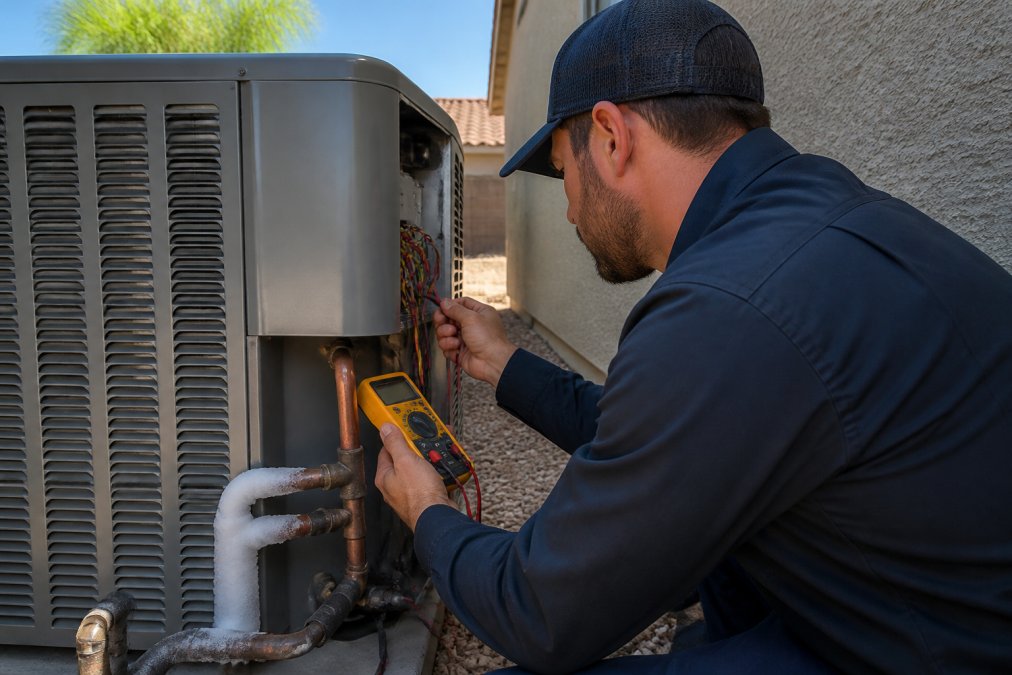
The pattern is clear: the earlier you catch a problem, the cheaper the fix. This is the entire argument for preventive HVAC maintenance vs repair cost comparison. Maintenance visits catch these signs during routine inspections. Waiting for symptoms means paying more.
Preventive HVAC Maintenance Checklist
A solid maintenance routine keeps your system running efficiently and catches problems early. Here's what professional technicians check during a typical tune-up:
Air filter inspection and replacement. A clogged filter restricts airflow, forces your system to work harder, and reduces efficiency. Filters should be checked monthly and replaced every 1-3 months depending on use and air quality.
Thermostat calibration. Your thermostat tells the system when to run. If it's off by even a few degrees, your system cycles unnecessarily, wasting energy and creating wear.
Condenser coil cleaning. The outdoor unit's condenser coil sheds heat to the outside air. When it's clogged with dust and debris, the system can't reject heat efficiently. Cleaning improves performance and prevents overheating.
Evaporator coil inspection. The indoor coil absorbs heat from your home. Dirt buildup reduces efficiency and can lead to ice formation. A technician checks for leaks and proper drainage.
Refrigerant level check. The system should maintain a specific refrigerant charge. Low refrigerant indicates a leak. A technician measures the charge and tops it off if needed, then investigates the source of any loss.
Electrical connections and component inspection. Loose connections generate heat and cause failures. A technician tightens connections and checks capacitors, relays, and contactors for wear.
System diagnostics. Modern systems have built-in diagnostics. A technician reads error codes, checks pressure and temperature readings, and runs the system through a full cycle to verify operation.
Ductwork inspection. Leaky ducts waste conditioned air before it reaches your home. A technician checks for obvious leaks and blockages.
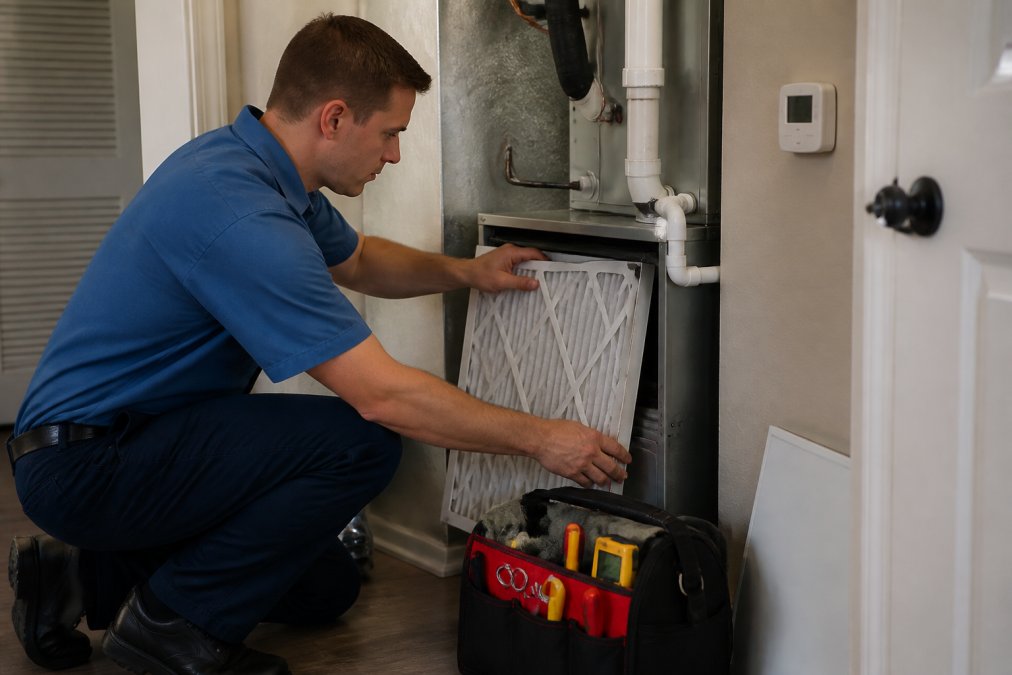
Most homeowners can handle filter replacement themselves. Everything else requires a licensed technician. A bi-annual maintenance visit, one in spring for cooling, one in fall for heating, covers all of this and costs far less than an emergency repair.
Maintenance Plans vs Pay-Per-Repair: The Real Savings
The choice between a maintenance plan and paying for repairs as they happen comes down to predictability and risk tolerance.
Pay-as-you-go repair is cheaper if your system never breaks. You pay nothing until something fails, then you pay for that specific repair. For a new system in perfect condition, this can be the lowest-cost option. But "if" is a big word. Most systems will need at least one repair over their 15-20 year service life. When that repair hits, you pay full price with no discount.
Maintenance plans cost a fixed amount, typically $150-280 per year or $15-25 per month, whether you need service or not. In exchange, you get two scheduled visits, diagnostic fee waivers, and 10-15% off repairs. If your system stays healthy, you're paying for prevention that never gets used. If your system needs a repair, you've already saved the diagnostic fee and get a discount on the work.
The math breaks even quickly. A single diagnostic fee ($75-150) plus one repair with a 15% discount often pays back the annual maintenance plan cost. After that, every repair saves you money. Over 10 years, a homeowner with a maintenance plan typically spends less than one with pay-as-you-go repairs, even if the system stays relatively healthy.
The real advantage of maintenance plans is psychological and practical. You know what you're spending. You get priority scheduling, which matters during peak seasons. You avoid the stress of an unexpected $2,000 bill. And you catch small problems before they become big ones.
| Factor | Pay-Per-Repair | Maintenance Plan |
|---|---|---|
| Upfront cost | $0 until repair needed | $150-280/year |
| Diagnostic fee | Charged each time | Waived |
| Repair discounts | None | 10-15% typical |
| Scheduling priority | Standard wait times | Priority scheduling |
| Cost predictability | Unpredictable | Predictable |
| Best for | Systems in perfect condition | Most homeowners |
For most homeowners, a maintenance plan wins. You trade a small, predictable cost for protection against large, unpredictable ones. That's the real savings in HVAC maintenance vs repair cost comparison.
Home Tech offers same-day and next-day appointments for both maintenance visits and emergency repairs, with no hidden fees and a 100% satisfaction guarantee. Whether you're looking to set up preventive HVAC maintenance or you need an emergency repair, scheduling early in the season beats waiting for a breakdown. Call (602) 486-1901 or visit hometechappliancerepair.com to book your appointment and start protecting your system before the next season hits.
Choosing between preventive maintenance and paying for repairs as they happen isn't just about this year's budget, it's about protecting yourself from the expensive failures that hit when you can't afford them. Maintenance costs less, prevents emergencies, and gives you peace of mind. When your HVAC system needs attention, Home Tech's EPA 608-certified technicians provide honest diagnostics and cost-effective repairs, whether you're looking to maintain your system or fix an urgent problem. Get started with a maintenance plan or emergency repair today.
Frequently Asked Questions
What is the 50% rule for HVAC systems?
The 50% rule states that if the cost of repair exceeds 50% of the replacement cost for a new HVAC system, replacement is usually the better financial choice. For example, if a new system costs $6,000 and a repair would be $3,200, replacement makes sense because you'd spend half the replacement cost on a system that's nearing the end of its service life. This rule helps homeowners avoid pouring money into aging equipment.
Is an HVAC maintenance program worth the annual cost?
Yes, preventive maintenance typically saves money over time. A maintenance plan includes two annual tune-ups, diagnostic fee waivers, and repair discounts (usually 10-15%). These plans prevent emergency repairs, extend system longevity, and improve energy efficiency. Most homeowners see ROI within the first year through avoided emergency service calls and reduced utility bills, especially in hot climates where AC runs year-round.
What are the signs your AC needs refrigerant?
Key indicators include reduced cooling output, warm air from vents, frost buildup on the outdoor condenser unit, hissing sounds near the compressor, and higher-than-normal utility bills. A refrigerant leak is the most common cause. If your system is low on refrigerant, it means there's a leak somewhere in the sealed system. A licensed HVAC technician can diagnose the leak, repair it, and recharge the system with the correct refrigerant type (R410A, R454B, etc.).
How often should HVAC maintenance be performed?
Professional HVAC maintenance should happen twice per year: once before cooling season (spring) and once before heating season (fall). This bi-annual service schedule ensures your system runs efficiently, catches small problems before they become expensive repairs, and maintains manufacturer warranty coverage. Some systems in harsh climates may benefit from additional seasonal inspections.