 blog
How Often to Service Commercial AC: A 2026 Guide
Table of Contents
- Why Commercial HVAC Maintenance Is Critical
- How Often to Service Commercial AC: Recommended Frequency
- Commercial HVAC Maintenance Schedule by Season
- Commercial AC Preventative Maintenance Checklist
- Factors That Affect How Often You Need AC Service
- Benefits of Commercial AC Maintenance
- What's Included in a Commercial AC Service Visit
- Cost of Commercial AC Service and Maintenance
- Frequently Asked Questions
How Often to Service Commercial AC: A 2026 Guide
Last Updated: July 24, 2026
Commercial HVAC systems run constantly in demanding environments, retail spaces, office buildings, restaurants, warehouses. When one fails, you lose revenue immediately. Understanding how often to service commercial AC is the difference between staying ahead of problems and facing emergency repairs that cost thousands.
At Home Tech, we've seen the pattern repeat: facilities that stick to a preventative maintenance schedule avoid 80% of the failures we respond to in emergency mode. Below, we'll show you exactly how often to service commercial AC based on your system type, usage intensity, and climate, plus what's included in each visit and why it matters for your bottom line.
Why Commercial HVAC Maintenance Is Critical
Your commercial AC system handles larger volumes of air, operates longer hours, and supports critical functions, keeping customers comfortable, protecting inventory, or maintaining safe working conditions. A breakdown means lost productivity, potential spoilage, or a closed storefront.
Preventative maintenance catches problems before they cascade. A refrigerant leak detected during routine inspection costs a few hundred dollars to fix. Ignored, it becomes a compressor failure costing thousands and leaving your system down for days. Regular service also extends equipment lifespan from 8-10 years (neglected) to 15-20 years (maintained), a difference of tens of thousands in replacement costs. Additionally, many commercial leases and warranties require documented preventative maintenance to remain valid.
How Often to Service Commercial AC: Recommended Frequency
The standard recommendation is biannual service: once before cooling season and once before heating season. However, this baseline changes based on how hard your system works.
Most commercial buildings benefit from two full service visits per year, spring to prepare for summer cooling and fall to ready the system for winter. Between these major visits, high-use systems should receive quarterly inspections to catch developing problems early. A retail space with standard 9-to-5 hours can run on a biannual schedule. A restaurant with 16-hour daily operation or a data center running 24/7 needs more frequent attention.
Biannual Service Schedule
Biannual service means two comprehensive check-ups per year. Spring service (March-April) prepares your system for peak cooling demand, verifying compressor operation, refrigerant charge, condenser coil cleanliness, thermostat accuracy, and electrical connections. Fall service (September-October) readies the system for heating season and addresses issues from heavy summer use, with the same comprehensive checks plus verification of heating components.
For most commercial buildings with standard operating hours and moderate climate conditions, biannual service is the industry baseline and aligns with manufacturer recommendations.
Quarterly Inspections for High-Use Systems
Systems operating more than 12 hours daily or in harsh climates benefit from quarterly inspections between major service visits. These shorter visits focus on critical components: refrigerant levels, compressor temperature and amperage draw, condenser fan operation, and filter condition.
Quarterly inspections catch refrigerant leaks before they become catastrophic and detect electrical issues early. High-use systems include restaurants, data centers, hospitals, and manufacturing facilities where downtime costs far exceed the service fee.
Commercial HVAC Maintenance Schedule by Season
Seasonal maintenance timing matters because your system experiences different stresses in summer and winter.
Spring Preparation for Cooling Season
Spring is when cooling demand accelerates. A spring inspection verifies the system is ready to handle the load after minimal winter use.
Technicians check refrigerant levels (small leaks may have developed unnoticed), replace filters (winter operation leaves them dirty), clean condenser coils (removing winter dust and debris), calibrate thermostats (ensuring accurate setpoint), and inspect electrical connections (vibration may have loosened them). These checks restore efficiency before peak summer demand.
Fall Readiness for Heating Season
Fall preparation mirrors spring but focuses on heating components. Refrigerant levels are verified, filters are replaced, heating components are tested, ductwork is inspected for leaks, and outdoor units may be winterized if exposed to freezing conditions.
(/best-residential-and-commercial-hvac-contractors-scottsdale/) Maintenance Schedule by Season]Commercial AC Preventative Maintenance Checklist
A thorough preventative maintenance visit covers specific components in a logical sequence.
| Maintenance Task | Frequency | Duration | Priority |
|---|---|---|---|
| Filter replacement | Every 1-3 months | 15 minutes | High |
| Refrigerant level check | Biannual | 20 minutes | High |
| Condenser coil cleaning | Biannual | 30-45 minutes | High |
| Evaporator coil inspection | Biannual | 25 minutes | High |
| Thermostat calibration | Biannual | 15 minutes | Medium |
| Electrical connection inspection | Biannual | 30 minutes | High |
| Compressor performance test | Quarterly | 20 minutes | High |
| Ductwork inspection | Annual | 45 minutes | Medium |
| Capacitor testing | Biannual | 15 minutes | High |
| Fan blade inspection | Biannual | 10 minutes | Medium |
Filter replacement is the most frequent task. Commercial filters should be checked monthly and replaced every 1-3 months depending on dust levels. Clogged filters reduce airflow, increase compressor strain, and waste energy.
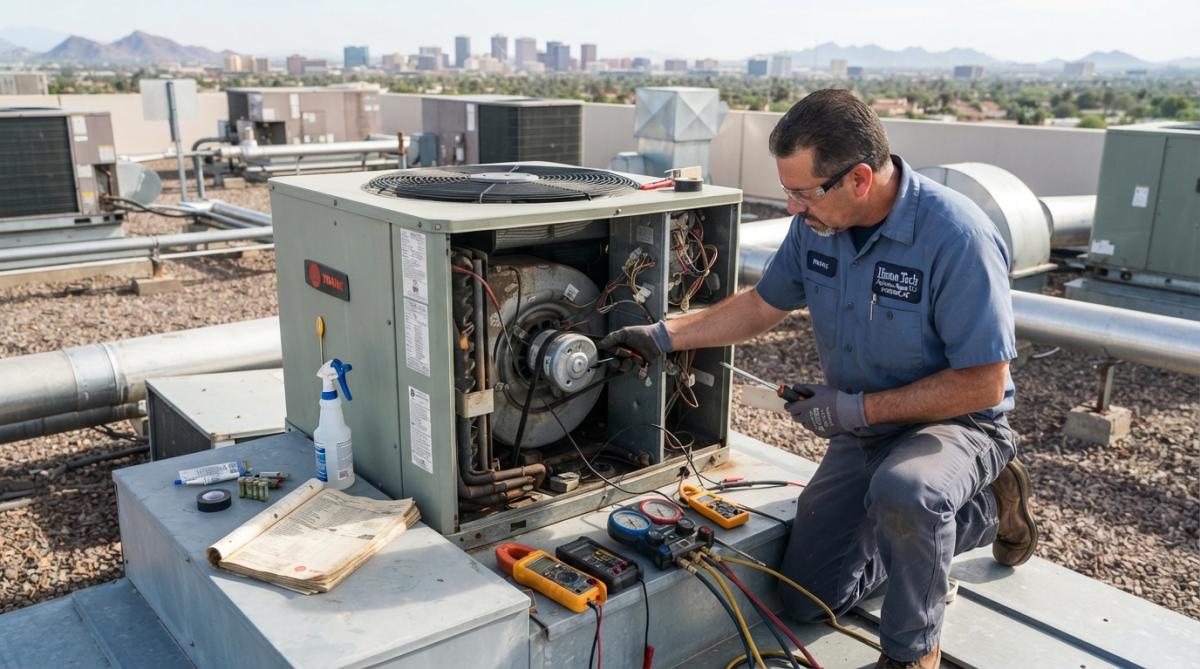
Refrigerant level checking requires specialized equipment and EPA certification. Low pressure indicates a leak; high pressure indicates overcharge or restricted airflow.
Condenser coil cleaning removes dirt, debris, and biological growth that reduces heat rejection efficiency. Cleaning restores the coil's ability to reject heat, lowering compressor workload and energy consumption.
Evaporator coil inspection checks for dirt, mold, and corrosion inside the indoor unit. Dirty coils reduce cooling capacity and can harbor mold.
Thermostat calibration ensures accurate temperature reading. Miscalibrated thermostats cause the system to over-cool or under-cool, wasting energy.
Electrical connection inspection checks every terminal for corrosion, looseness, and heat damage. Loose connections increase electrical resistance and generate heat.
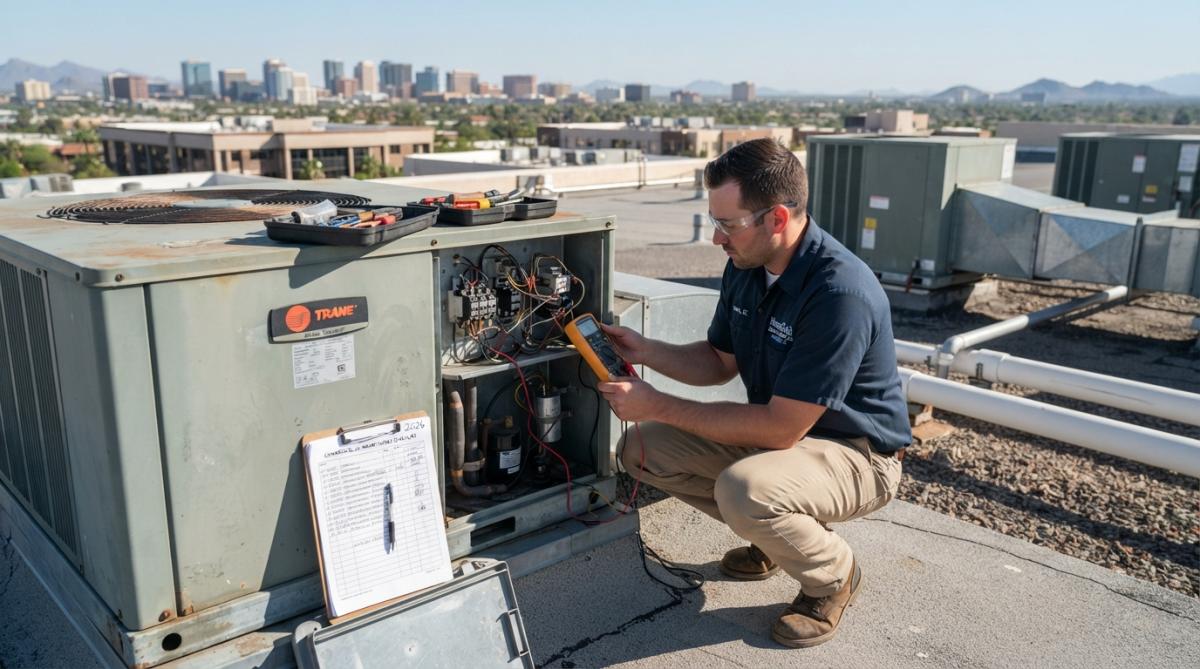
Compressor performance testing measures discharge temperature, suction pressure, discharge pressure, and electrical current draw to reveal whether the compressor operates within normal parameters.
Ductwork inspection identifies leaks, disconnections, and insulation damage. Leaky ducts waste conditioned air and reduce efficiency.
Capacitor testing verifies that electrical capacitors hold proper charge. Failed capacitors prevent compressors and fans from starting.
Fan blade inspection checks for bent, cracked, or corroded blades that reduce airflow and create vibration.
Factors That Affect How Often You Need AC Service
The biannual baseline works for average conditions, but several factors push systems toward more frequent service.
System Age and Equipment Type
Older systems need more frequent attention. A system in its first 5 years typically runs reliably on a biannual schedule; a system in its second decade may develop leaks and wear justifying quarterly inspections.
Packaged rooftop units experience more weather exposure than split systems and accumulate dirt faster. Reciprocating compressors (common in older systems) wear faster than scroll compressors (standard in newer equipment).
Climate and Local Environmental Conditions
Hot, dry climates accelerate system wear. Desert climates with 120°F summer temperatures force compressors to work harder and accumulate dust rapidly, justifying quarterly inspections.
Coastal environments expose outdoor units to salt air, which corrodes aluminum coils and electrical connections faster. Humid climates promote mold growth on coils and increase cooling demand. Dusty environments clog filters and condenser coils rapidly.
Operating Hours and Usage Intensity
Systems running 24/7 wear 3-4 times faster than systems running 8 hours daily. A data center HVAC system needs quarterly inspections or more frequent monitoring. A retail space operating 10 hours daily can run on a biannual schedule.
Benefits of Commercial AC Maintenance
Preventative maintenance delivers measurable business benefits. Energy efficiency improves 10-15% when coils are clean, refrigerant levels are correct, and connections are tight. For a building spending $10,000 yearly on HVAC energy, that's $1,000-$1,500 in annual savings.
Equipment lifespan extends dramatically, 15-20 years with maintenance versus 8-10 years neglected. Downtime risk decreases as preventative maintenance catches problems before failures occur. Warranty coverage remains valid with documented maintenance. Indoor air quality improves when filters are fresh and coils are clean. System reliability supports business operations by ensuring the system runs when you need it.
What's Included in a Commercial AC Service Visit
A complete service visit typically runs 2-4 hours. The technician performs visual inspection of indoor and outdoor units, measures voltage and amperage at key points, uses pressure gauges to check refrigerant charge, assesses compressor performance by measuring discharge temperature, replaces filters, cleans coils, tests thermostat accuracy, inspects ductwork for leaks, and concludes with a written report documenting findings and recommendations.
Cost of Commercial AC Service and Maintenance
Biannual service costs vary by system size and region but cost less per visit than emergency repairs. Emergency repair calls cost significantly more, a compressor replacement easily costs several times what two years of preventative service would cost.
Many facility managers find that preventative maintenance contracts make financial sense by guaranteeing scheduled visits, spreading costs across the year, and often including priority response between visits.
Home Tech provides commercial HVAC service throughout the Phoenix metro area, including Chandler, Gilbert, Tempe, Scottsdale, and surrounding communities. Our EPA 608-certified technicians perform complete preventative maintenance on commercial AC systems serving retail, office, restaurant, and industrial facilities. We offer same-day and next-day appointments with no hidden fees and a 100% satisfaction guarantee.
For facilities in the greater Phoenix area with commercial HVAC systems requiring service, contact Home Tech at (602) 486-1901 or visit hometechappliancerepair.com to schedule a maintenance appointment.
The cost of skipping preventative maintenance is always higher than the cost of doing it. A compressor failure, refrigerant leak, or electrical problem left unaddressed becomes an emergency costing thousands and disrupting your business. Biannual service or quarterly inspections for high-use systems prevent most problems before they become emergencies. Get started with a maintenance plan that matches your system's workload, and you'll avoid the expensive surprises that catch unprepared facility managers off guard.
EPA 608 Certification Requirements for HVAC Technicians
ASHRAE Commercial HVAC Maintenance Standards
U.S. Department of Energy Commercial Building Energy Code
Frequently Asked Questions
How often should commercial HVAC systems be serviced?
Most commercial HVAC systems should be serviced biannually, once before the cooling season (spring) and once before the heating season (fall). However, high-use commercial systems in demanding environments may benefit from quarterly inspections. The exact frequency depends on system age, climate, usage intensity, and equipment type. Older systems or those operating continuously may require more frequent service to maintain reliability and energy efficiency.
What should be included in a commercial AC preventative maintenance checklist?
A comprehensive commercial AC preventative maintenance checklist includes filter replacement, coil cleaning, refrigerant level checks, thermostat calibration, electrical connection inspection, condenser unit cleaning, ductwork inspection, and compressor performance evaluation. Technicians should also verify proper airflow, test safety controls, and document all findings. Regular maintenance checklists help facility managers track service history and identify patterns that signal potential equipment failure before emergency repairs become necessary.
What are the benefits of regular commercial AC maintenance?
Regular commercial AC maintenance reduces unexpected downtime, extends equipment lifespan, improves energy efficiency, lowers operational costs, and maintains air quality and ventilation standards. Preventative maintenance also helps avoid costly emergency repairs, ensures system reliability during peak seasons, and supports compliance with building codes and safety regulations. Facilities that prioritize preventative maintenance typically see 20-30% better energy performance and fewer unplanned service interruptions compared to reactive-only approaches.
How much does commercial AC service typically cost?
Commercial AC service costs vary based on system size, equipment type, service complexity, and your location. Biannual preventative maintenance contracts are generally more affordable than emergency repairs, which can be significantly more expensive due to labor urgency and potential equipment replacement. For accurate pricing on commercial AC service in your area, contact a licensed HVAC contractor for a quote. Many providers offer service agreements that bundle routine maintenance at a predictable annual cost, helping facility managers budget effectively.