 comparison
Gas vs Electric Water Heater Repairs: Costs, Parts & Maintenance
Table of Contents
- Gas vs Electric Water Heater Repairs: Key Differences at a Glance
- How Gas and Electric Systems Differ Structurally
- Why Repair Approaches Vary Between Types
- Common Water Heater Problems: Gas vs Electric
- Gas Water Heater Troubleshooting: Diagnosis and Solutions
- Electric Water Heater Troubleshooting: Diagnosis and Solutions
- Water Heater Repair Cost Breakdown: Gas vs Electric
- Repair vs Replace: Decision Matrix for Gas and Electric Units
- DIY vs Professional Repair: Safety and Risk Assessment
- Maintenance to Prevent Costly Water Heater Repairs
- Frequently Asked Questions
Last Updated: July 25, 2026
Gas vs Electric Water Heater Repairs: Key Differences at a Glance
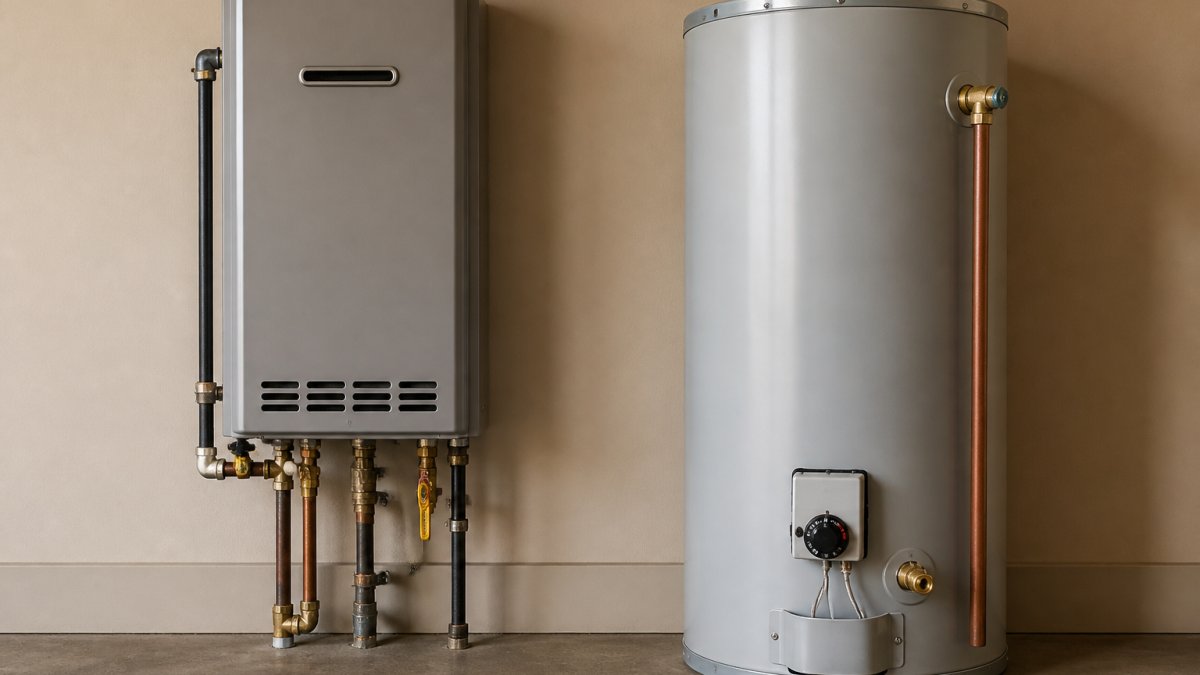
Gas water heaters use combustion with pilot lights, thermocouples, gas valves, and venting systems. Electric water heaters rely on heating elements submerged in the tank, controlled by thermostats and circuit breakers. Gas failures typically involve gas line or venting issues, while electric failures point to electrical connections or heating element burnout.
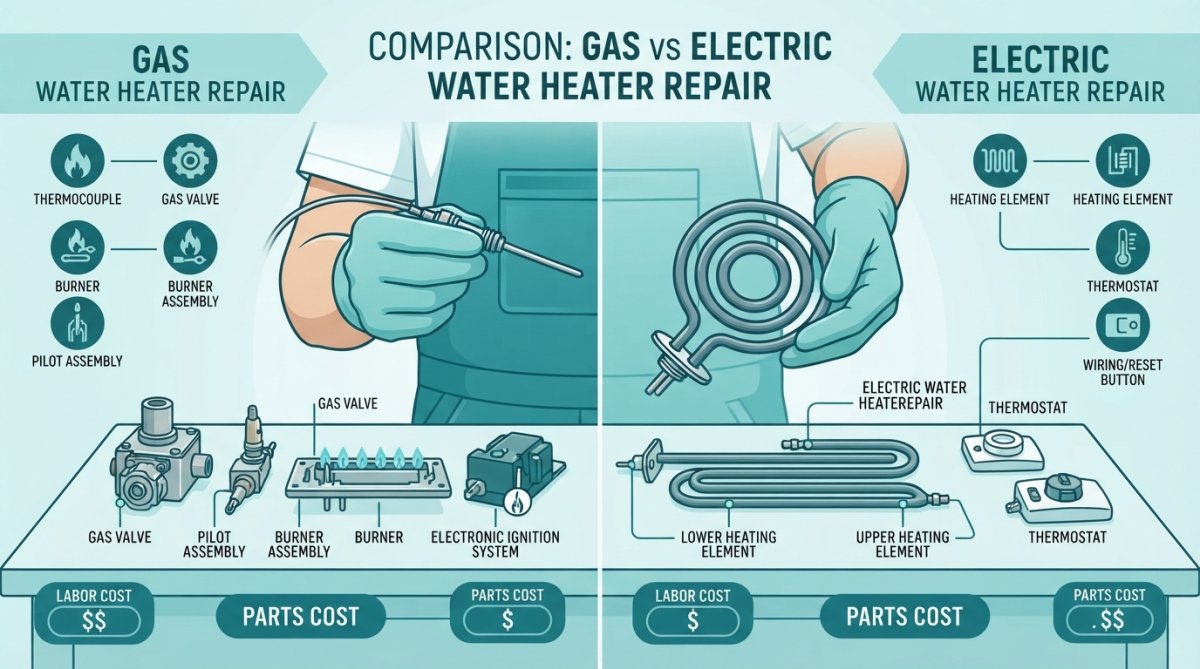
How Gas and Electric Systems Differ Structurally
Gas water heaters operate through controlled combustion. Natural gas ignites at a pilot light, heating a metal flue through the tank. A thermostat controls the gas valve to maintain temperature. Hot gases exit through a venting system. An anode rod inside the tank prevents corrosion.
Electric water heaters use two heating elements submerged directly in the water. When the thermostat detects temperature drop, it energizes one or both elements. The system runs on 240V household voltage, controlled by a dedicated circuit breaker. Like gas units, electric heaters have an anode rod and pressure relief valve.
The venting requirement creates a major structural difference. Gas units MUST vent combustion byproducts outside your home for safety. Electric units produce no combustion gases and need no venting, allowing placement in any room.
Why Repair Approaches Vary Between Types
When a gas water heater stops producing hot water, a technician checks the pilot light first. If it's out, the issue might be a thermocouple, gas valve malfunction, or sediment blocking the pilot opening. These require specific tools: a combustible gas leak detector, manometer, and knowledge of gas line safety codes.
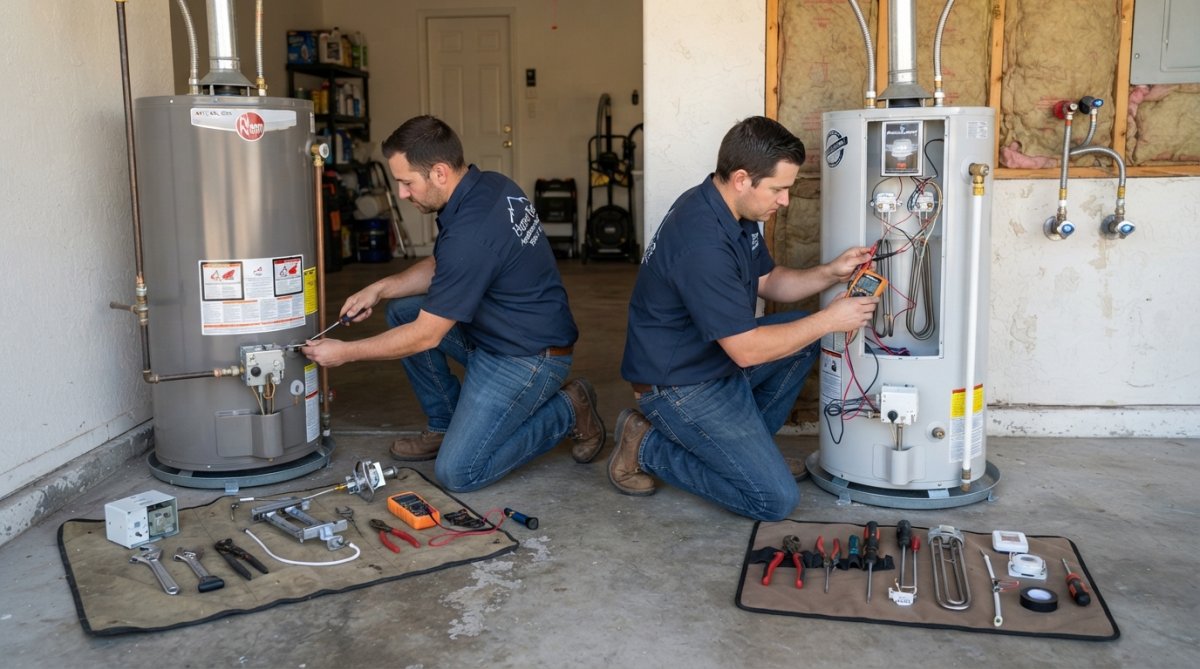
Electric water heater diagnostics focus on electrical continuity and heating element resistance. A technician uses a multimeter to check for voltage at the circuit breaker, tests the thermostat, and measures heating element resistance.
Gas repairs often require EPA 608 certification for sealed-system tankless models and knowledge of gas codes and venting practices. Electric repairs are more straightforward electrically but still demand respect for high voltage and proper circuit breaker handling.
Recovery time after repair varies. A gas pilot light relight takes 10 minutes. A heating element swap takes 30-45 minutes. A thermocouple replacement takes 20-30 minutes.
Common Water Heater Problems: Gas vs Electric
Gas Water Heater Issues
The pilot light going out accounts for roughly 30-40% of no-hot-water calls. A pilot light can extinguish from a draft, failed thermocouple, dirty pilot opening, or malfunctioning gas valve. The fix ranges from simple (relighting the pilot) to moderate (thermocouple replacement, $150-250).
Thermocouple failure is the second most common gas issue. The thermocouple generates a small electrical signal telling the gas valve to keep flowing. When it fails, the gas valve shuts off even though the pilot is burning. Replacement typically costs $150-250 total.
Gas valve failures are less common but more expensive. If it sticks or fails internally, you might get no ignition or the burner might light then shut off immediately. Gas valve replacement typically costs $300-500.
Venting problems prevent combustion gases from escaping. A blocked vent (from bird nests, lint, or ice) might cause a gas smell or yellow flame instead of blue. Venting repairs involve clearing blockages or replacing damaged vent pipe, costing $200-500.
Sediment buildup reduces heating efficiency and can clog the pilot opening. Flushing the tank removes sediment and restores performance.
Electric Water Heater Issues
Electric water heaters fail primarily at the heating elements. An element that burns out stops heating water entirely. An element that shorts internally can trip the circuit breaker repeatedly. Element replacement costs $200-400 total.
Thermostat failure is the second most common issue. A failed thermostat might leave elements running constantly (overheating the tank) or never energize them (no heat). Thermostat replacement is usually $150-250.
Circuit breaker trips usually indicate a short in a heating element, failed thermostat, or wiring fault. A technician must test elements and thermostat to isolate the fault.
Lukewarm water from a dual-element tank usually means the upper element has failed. Replacing just the upper element costs $150-250.
Slow recovery indicates sediment buildup insulating heating elements from water contact, or a partially failed element. Flushing removes sediment; if recovery doesn't improve, the element needs replacement.
Gas Water Heater Troubleshooting: Diagnosis and Solutions
Pilot Light and Ignition Problems
Your gas water heater won't produce heat but the pilot light is burning. This is almost always a thermocouple issue. When it fails, the valve closes even though the pilot is lit.
To confirm, turn up the thermostat. If the main burner ignites briefly then shuts off within 30 seconds, the thermocouple has failed. Thermocouple replacement involves turning off gas, removing the old thermocouple, and installing an identical replacement. The part costs $15-40; labor adds $100-150. The entire job takes 20-30 minutes.
If the pilot light won't stay lit, the issue might be a dirty pilot opening, failed gas valve, or draft. A technician will clean the pilot opening first, then test the thermocouple and gas valve if cleaning doesn't work.
Pilot light won't ignite at all and you smell gas, pointing to either no spark at the igniter or a gas valve stuck closed. Electronic ignition failures require replacing the ignition module ($200-300). Standing pilot issues usually involve thermocouple or gas valve problems.
Gas Line and Venting Issues
A gas smell near your water heater demands immediate attention. This could indicate a gas leak, incomplete combustion, or blocked vent. Do not ignore this.
A gas leak typically occurs at connection points. A technician uses a combustible gas detector to pinpoint the leak, then tightens or replaces the connection. If the leak is in the gas line itself, the line must be replaced. Gas line repair is not DIY-safe.
Incomplete combustion produces a yellow or orange flame instead of blue and often creates a rotten egg smell. This usually means the vent is partially blocked, preventing proper oxygen supply. A blocked vent can be cleared by removing the blockage, or the vent pipe might need replacement if damaged. Venting repairs cost $150-400.
A vent that has separated or corroded allows combustion gases including carbon monoxide to leak into your home. This is a serious safety hazard. Do not use the water heater until the vent is repaired. Vent pipe replacement typically costs $200-500.
Thermocouple and Gas Valve Failures
A thermocouple that reads low resistance has failed and needs replacement. A thermocouple that reads normal resistance but doesn't stop the gas valve from closing when the pilot is extinguished also needs replacement.
Gas valve failures are diagnosed by testing voltage at the valve coil. No voltage when the thermostat calls for heat suggests a wiring issue or thermostat failure. Voltage present but the valve won't open suggests internal valve failure. Gas valve replacement is a job for a licensed technician, as these are safety-critical components.
A gas valve that cycles on and off rapidly usually indicates a thermocouple problem. Replacement of the thermocouple often fixes this. If the valve itself is faulty, replacement costs $300-500.
Electric Water Heater Troubleshooting: Diagnosis and Solutions
Heating Element and Thermostat Failures
An electric water heater that produces no hot water requires testing both the circuit breaker and heating elements. First, confirm the circuit breaker hasn't tripped. If it has, flip it back on. If it trips again immediately, a heating element has likely shorted internally.
To test a heating element, a technician turns off power at the breaker, drains the tank, and measures the element's resistance with a multimeter. A working element shows 10-30 ohms. An open element shows infinite resistance. A shorted element shows near-zero resistance. Either failure requires replacement.
Element replacement involves turning off power, draining the tank, unbolting the old element, and installing an identical replacement. The part costs $50-150; labor adds $100-200. Total time is 45 minutes to an hour. If both elements have failed, the second replacement usually costs less because the tank is already drained.
A thermostat that fails in the "always on" position causes the tank to overheat, triggering the pressure relief valve to discharge water. A thermostat that fails in the "always off" position produces no heat. Thermostat replacement costs $100-200 total.
Circuit Breaker and Electrical Connection Issues
If the circuit breaker is tripping repeatedly, the problem is either a short in a heating element or a wiring fault. A technician will test the elements first. If elements test good, the wiring or thermostat is creating the short.
A loose electrical connection at the breaker or water heater terminal can cause arcing and trip the breaker. These connections must be tightened or replaced by a licensed electrician. Never attempt this yourself.
If the breaker won't reset at all, the circuit itself might be damaged. This requires an electrician to test the circuit wiring and potentially replace the breaker.
A water heater that draws no power might have a tripped breaker, blown fuse, or wiring fault. A technician will test voltage at the breaker and water heater terminals to isolate the issue.
Water Temperature and Recovery Problems
Lukewarm water from a dual-element tank usually means the upper element has failed. Replacing just the upper element costs $150-250.
Slow recovery indicates sediment buildup or a partially failed element. Flushing removes sediment; if recovery doesn't improve, the element needs replacement.
Temperature fluctuations often point to a thermostat cycling erratically or a partially shorted heating element. Testing will reveal which component is at fault.
Water Heater Repair Cost Breakdown: Gas vs Electric
Service Call and Diagnostic Fees
Most water heater repair companies charge a service call fee ($75-150) that's credited toward repairs if you proceed. A gas water heater diagnostic involves testing the pilot light, thermocouple voltage, gas pressure, and venting. An electric water heater diagnostic includes testing circuit voltage, heating element resistance, and thermostat function. Both take 20-30 minutes.
If you decide to proceed with repair, the diagnostic fee typically applies toward the repair cost.
Common Repair Parts and Labor Costs
| Repair Type | Gas | Electric | Typical Duration |
|---|---|---|---|
| Thermocouple / Upper Element | $150-250 | $150-250 | 20-30 min |
| Gas Valve / Lower Element | $300-500 | $150-250 | 30-45 min |
| Anode Rod Replacement | $150-250 | $150-250 | 20-30 min |
| Tank Flushing | $150-250 | $150-250 | 45-60 min |
| Venting Repair | $200-500 | N/A | 30-90 min |
| Pressure Relief Valve | $100-200 | $100-200 | 15-20 min |
Gas water heater repairs cluster around combustion components and venting. A thermocouple replacement runs $150-250 total. A gas valve replacement runs $300-500. Venting repairs vary depending on whether the vent is simply blocked or requires pipe replacement.
Electric water heater repairs focus on heating elements and thermostats. An element replacement runs $150-250 total. A thermostat replacement runs $100-200. These are typically cheaper than gas valve replacements.
Both types share anode rod replacement ($150-250) and tank flushing ($150-250). Labor rates vary by region. Most repairs fall into the 20-60 minute range.
Operating Cost Differences Over Time
A typical household uses 40-50 gallons of hot water daily. A gas water heater might cost $15-25 per month to operate, while an electric water heater might cost $30-50 per month. Over 10 years, that's a difference of $1,800-3,000 in favor of gas. However, gas water heaters often cost more to repair because gas valves and venting components are more expensive.
Repair vs Replace: Decision Matrix for Gas and Electric Units
Age and Remaining Lifespan Indicators
A water heater's age is the strongest predictor of whether repair makes sense. Most tank water heaters last 8-12 years. If your unit is 10 years old and needs a $400 repair, replacement might be smarter than repair.
Check the serial number on the water heater to find the manufacture date. Gas units typically last 8-12 years. Electric units often last 10-15 years because they have fewer moving parts. Tankless units are less predictable, some last 15+ years, but expensive component failures can occur at 5-10 years.
If your unit is under 5 years old, repair almost always makes sense. If your unit is 8-10 years old, the decision becomes more nuanced. If your unit is over 12 years old, replacement is usually the better choice.
When Repair Costs Justify Replacement
If repair cost exceeds 50% of replacement cost and your unit is over 8 years old, replacement is usually smarter.
A new gas water heater costs $400-800 (unit only) plus $300-500 for installation. Total: $700-1,300. A new electric water heater costs $300-600 (unit only) plus $200-400 for installation. Total: $500-1,000.
If your 10-year-old gas water heater needs a $500 gas valve replacement, you're spending 50-70% of the cost of a new unit. Replacement makes sense because you'd get a warranty and better efficiency.
If your 3-year-old electric water heater needs a $200 element replacement, you're spending 20-40% of replacement cost. Repair is clearly the right choice.
DIY vs Professional Repair: Safety and Risk Assessment
Gas Water Heater Safety Concerns
Do not attempt gas water heater repairs yourself. Gas leaks, incomplete combustion, and improper venting can cause carbon monoxide poisoning, explosions, or fires.
Relighting a pilot light is the only gas water heater task that's safe for homeowners. You turn off the water heater, locate the pilot light assembly, find the ignition button, and follow the manufacturer's instructions. This takes 5 minutes and carries minimal risk.
Everything else, thermocouple replacement, gas valve work, venting repairs, gas line connections, requires a licensed technician. A mistake can create an undetected gas leak or allow carbon monoxide to accumulate in your home.
Electric Water Heater Safety Concerns
Electric water heater repairs carry serious risks. High voltage (240V) can cause electrocution. A shorted heating element can cause a fire if not properly isolated.
Draining the tank is safe for homeowners. You turn off power at the circuit breaker, attach a garden hose to the drain valve, and let the water drain. This takes 20-30 minutes.
Testing heating elements with a multimeter requires electrical knowledge. A mistake, like testing while the breaker is on, can cause electrocution.
Replacing a heating element requires removing the old element, installing the new one, and resealing. If the seal isn't tight, the tank will leak. If you don't refill the tank properly before turning on power, the heating element can burn out immediately.
Maintenance to Prevent Costly Water Heater Repairs
Gas Water Heater Maintenance Schedule
Inspect the pilot light monthly. It should burn blue with a small yellow tip. A yellow or orange flame suggests incomplete combustion, which means the vent might be blocked or the pilot opening is dirty.
Check the venting system annually. Look for visible damage, corrosion, or separation of vent pipes. Ensure the vent opening is clear of obstructions. A blocked vent is a carbon monoxide hazard.
Flush the tank annually. Drain 5-10 gallons from the drain valve at the bottom of the tank. If the water is brown or cloudy, sediment is present. A full tank flush is recommended every 2-3 years.
Inspect the anode rod every 2-3 years. If it's corroded to less than half its original diameter, it should be replaced. Anode rod replacement costs $150-250 and extends tank life by 5+ years.
Test the pressure relief valve annually. Lift the lever on the relief valve slightly, you should hear a hiss of pressure release. If it doesn't, the valve might be stuck and should be replaced.
Electric Water Heater Maintenance Schedule
Inspect the circuit breaker monthly. It should switch on smoothly and stay on. If it trips frequently, a heating element or thermostat might be failing.
Check for leaks around the tank and connections monthly. Water pooling under the tank suggests a leak requiring prompt attention.
Flush the tank annually. Drain 5-10 gallons from the drain valve and do a full drain-and-flush every 2-3 years.
Inspect the anode rod every 2-3 years and replace it if corroded.
Test the pressure relief valve annually. Lift the lever and listen for a pressure release.
Check the thermostat setting annually. Your thermostat should be set to 120°F (49°C), which is hot enough for most household uses and prevents scalding.
| Maintenance Task | Gas | Electric | Frequency |
|---|---|---|---|
| Pilot light inspection | Yes | N/A | Monthly |
| Vent system check | Yes | N/A | Annual |
| Tank flushing (partial) | Yes | Yes | Annual |
| Tank flushing (full) | Yes | Yes | Every 2-3 years |
| Anode rod inspection | Yes | Yes | Every 2-3 years |
| Pressure relief valve test | Yes | Yes | Annual |
| Circuit breaker check | N/A | Yes | Monthly |
| Leak inspection | Yes | Yes | Monthly |
| Professional inspection | Yes | Yes | Every 2-3 years |
Regular maintenance extends water heater life by 3-5 years and prevents emergency failures. A $200 annual flushing and inspection can prevent a $500+ emergency repair call.
When your water heater fails, the repair path depends on whether you have a gas or electric system, the age of your unit, and the cost of the repair relative to replacement. Gas repairs often involve combustion components and venting, requiring EPA-certified technicians. Electric repairs focus on heating elements and electrical connections, which are typically cheaper but still demand professional expertise. Home Tech has serviced both gas and electric water heaters across the Phoenix metro area for over 10 years, we offer same-day diagnostics, no hidden fees, and a 100% satisfaction guarantee. Call (602) 486-1901 or visit hometechappliancerepair.com to schedule your water heater repair today.
Frequently Asked Questions
What are the most common problems with gas water heaters?
Gas water heater problems typically involve the pilot light failing to ignite, thermocouple malfunction, gas valve failures, and venting system blockages. Sediment buildup inside the tank can also reduce heating efficiency. A faulty thermocouple prevents the gas valve from opening, while pilot light issues often stem from dirt or drafts. Venting problems occur when carbon monoxide cannot escape safely. Professional diagnosis ensures safety, especially when dealing with gas line integrity and combustion-related issues.
Is it cheaper to repair a gas or electric water heater?
Repair costs vary by the specific problem, but gas water heater repairs often involve higher labor costs due to safety requirements around venting and gas lines, while electric repairs typically focus on heating elements and thermostats. However, operating costs favor gas over time in most regions due to lower utility rates. The true cost comparison depends on your local natural gas and electricity rates, the age of your unit, and whether the repair is a simple part replacement or requires extensive work. Contact a licensed technician for an accurate quote.
When should I repair versus replace my water heater?
If your water heater is under 8 years old and the repair cost is less than 50% of a replacement unit, repair is usually the better choice. Units over 12 years old approaching end-of-life are better replaced, especially if repairs are frequent. Consider the energy efficiency rating, older units consume more energy, so replacement may save money long-term. A professional can assess your unit's condition, lifespan, and repair history to recommend the most cost-effective option for your situation.
Can I troubleshoot gas and electric water heater issues myself?
Basic troubleshooting like checking the thermostat setting, resetting a tripped circuit breaker, or inspecting for visible leaks is safe for homeowners. However, gas water heater repairs involving the pilot light, thermocouple, gas valve, or venting system require a licensed professional due to carbon monoxide and combustion hazards. Electric repairs involving the heating element or high-voltage connections also pose shock risks. DIY repairs on these critical components can void warranties and create safety hazards. Professional diagnosis is recommended for any complex issue.
What maintenance prevents expensive water heater repairs?
Regular flushing removes sediment buildup that reduces efficiency and damages the tank. For gas units, inspect the pilot light and venting system annually. For electric units, test the pressure relief valve and check for leaks. Inspect the anode rod every 2-3 years and replace if heavily corroded. Maintain proper thermostat settings (120°F is standard). Annual professional inspection catches small problems before they become costly repairs. These maintenance steps extend lifespan and improve energy efficiency for both gas and electric systems.