 listicle
Commercial Dryer Vent Inspection Checklist for Facility Managers
Table of Contents
- Why a Commercial Dryer Vent Inspection Checklist Belongs in Your PM Program
- The Core Dryer Vent Inspection Checklist: 10 Items to Verify
- How to Measure Airflow and Drying Performance, Not Guess at It
- Setting Commercial Dryer Vent Cleaning Frequency by Risk
- What Your Commercial Dryer Vent Maintenance Log Must Capture
- Building a Dryer Vent Inspection Form Staff Will Actually Use
- Commercial Dryer Vent Cleaning Best Practices and Fire-Code Requirements
- Inspection Safety, Access Controls, and Corrective-Action Workflow
- Frequently Asked Questions
Last Updated: October 19, 2026
Why a Commercial Dryer Vent Inspection Checklist Belongs in Your PM Program
A commercial dryer vent inspection checklist is a documented set of visual and performance checks a facility manager runs on every dryer exhaust system, from the lint screen to the exterior termination, on a scheduled basis.
Most facility teams already inspect HVAC filters and walk-in cooler coils on a schedule. Dryer exhaust deserves the same treatment, especially in laundromats and multifamily laundry rooms where several units share ductwork.
The Core Dryer Vent Inspection Checklist: 10 Items to Verify
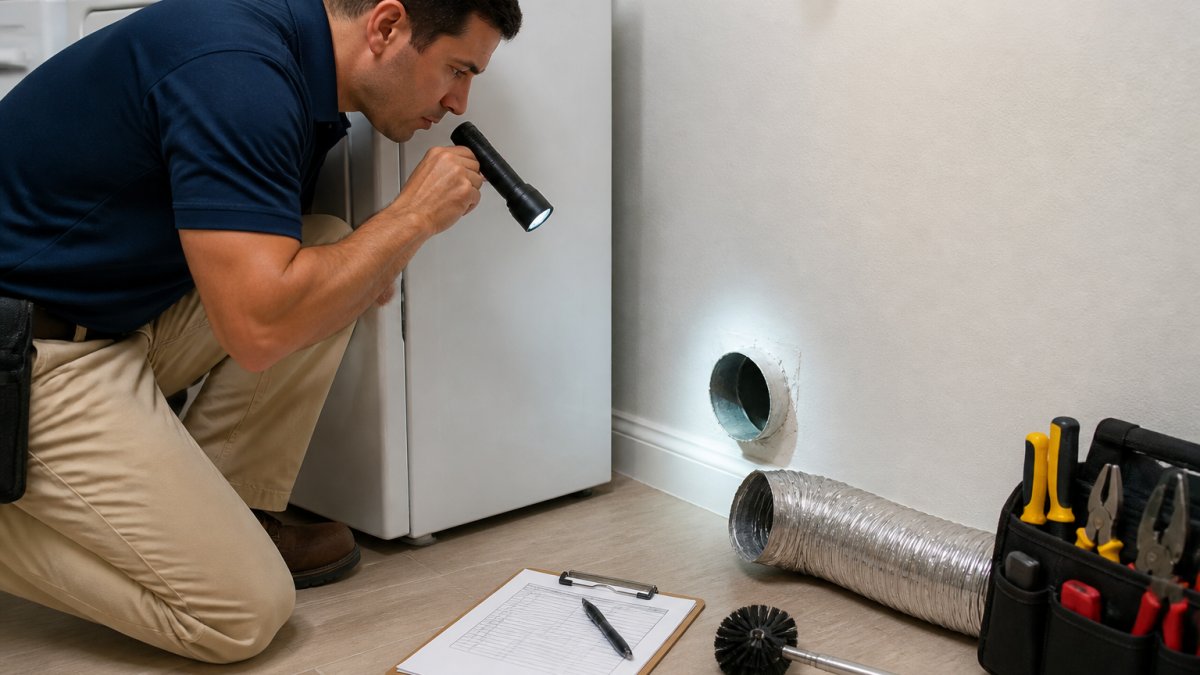
The core dryer vent inspection checklist covers ten items grouped into three areas: lint and debris, airflow and ductwork, and the unit housing and access panels.
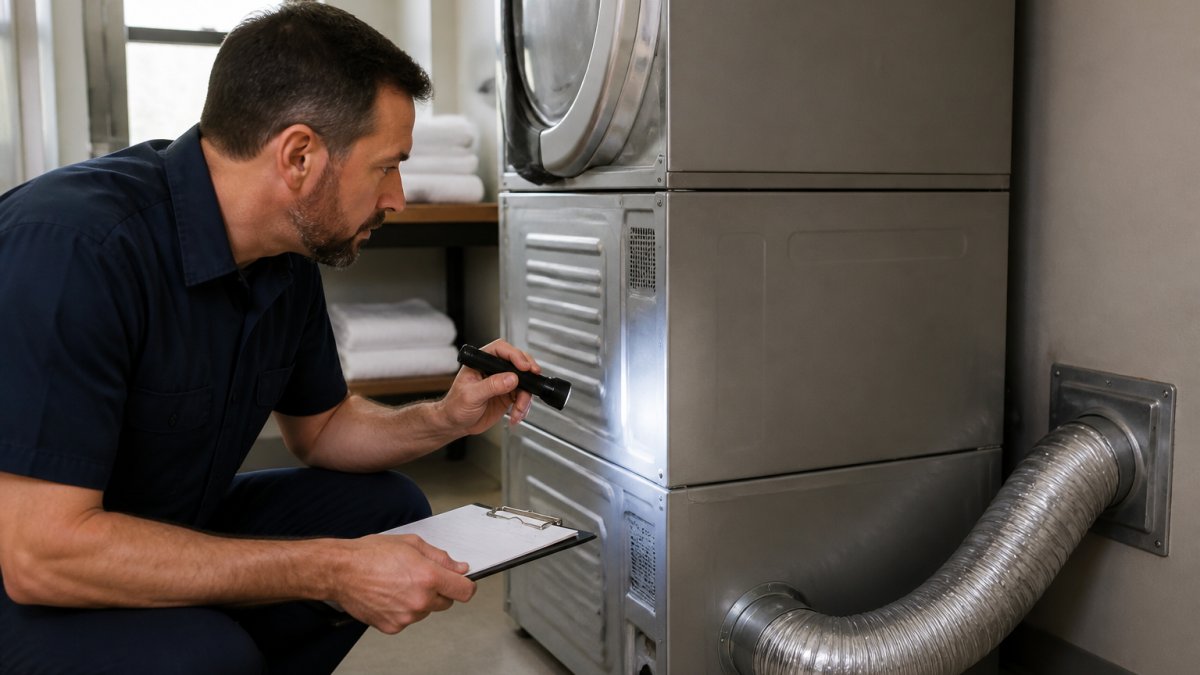
Lint, Dust, and Debris Buildup
Lint buildup is the first thing to check and the most common finding. Inspect the lint screen, the lint trap housing, and the area behind the dryer. Note any lint accumulation on the floor, walls, or duct connections. Construction dust and pest contamination belong in the same record, since both signal gaps in the system.
Airflow, Ductwork, and Vent Termination
Airflow restriction shows up as longer dry times and a warm laundry room. Check the exhaust duct for crushed sections, sagging runs, and disconnected joints. Verify the vent termination and exterior outlet are clear and that the damper operation is unobstructed by lint or nests.
Housing, Casing, and Access Panels
Visible damage to the housing or casing, loose panels, and blocked access panels all belong on the list. Confirm the access panel opens fully so the next inspection does not require disassembly. Record the unit number and location for every finding.
How to Measure Airflow and Drying Performance, Not Guess at It
Most checklist articles tell you to "check airflow" and stop there. For a commercial laundry, airflow is the one metric that turns a visual walkthrough into a maintenance program, so it deserves a defined procedure, a baseline, and a threshold for action.
What to Measure and Where
Take three readings per unit and record all three:
- Exhaust airflow at the termination. Use a handheld anemometer or a pitot-tube probe at the exterior vent outlet, holding the sensor at a consistent distance and angle every time. Record in feet per minute (fpm). Consistency matters more than the instrument: the same probe, the same position, the same person where possible.
- Static pressure in the duct run. A manometer reading at an accessible test port or at the blower housing inlet shows how hard the system is working to move air. Rising static pressure with falling velocity is the classic signature of lint restriction.
- Dry time for a standard load. Time a representative load (same weight, same fabric mix, same heat setting) and record minutes. This is the number operators feel first and the one that justifies a service call.
Establishing a Baseline
The first inspection is a baseline, not a pass/fail. Record airflow, static pressure, dry time, and laundry room temperature on a clean, freshly serviced system, then compare every later reading against that unit's own baseline rather than a generic target. Manufacturer specifications and the dryer's installation manual give the design exhaust capacity and maximum allowable duct length and equivalent run; use those figures as the outer limit, and use your measured baseline as the day-to-day reference.
When a Reading Warrants Service
Use trend logic, not a single number:
- A drop of roughly 10 percent or more in termination velocity from baseline, sustained across two inspections, warrants duct cleaning.
- A steady rise in static pressure across two or three inspections points to accumulation in the run, not a one-time blockage.
- Dry time stretching by several minutes on the same standard load, with airflow down, is a combined signal to schedule service before the thermal cutoff trips.
Recording the Reading
Log the instrument used, the measurement location, the date, and the reading, plus a photo of the termination at each inspection. A before-and-after pair around a cleaning is the single most useful record a facility manager can hold, because it proves the work changed the condition. Keep the numbers in the same units every time so trends are comparable across staff turnover and vendors.
Setting Commercial Dryer Vent Cleaning Frequency by Risk
Commercial dryer vent cleaning frequency should follow risk, not a fixed calendar. A single dryer in a small office laundry room may need annual cleaning, while a laundromat running dozens of loads a day needs quarterly checks and cleaning whenever airflow readings drop below baseline.
Use a simple risk tier: low (light use, short duct run), medium (daily use, shared duct), and high (continuous operation, long or complex ductwork). High-risk systems get inspected monthly and cleaned on condition. Document the reasoning behind each tier so the schedule survives staff turnover.
What Your Commercial Dryer Vent Maintenance Log Must Capture
A commercial dryer vent maintenance log must capture the unit number, location, inspection date, inspector name, airflow reading, condition findings, and the follow-up action taken. Without those fields, the log is a memory aid rather than a maintenance record.
Add a photo slot for each finding and a corrective maintenance field with a due date. Service logs that show a clear before-and-after airflow reading are far more useful when you need to justify a repair or a cleaning contract.
Building a Dryer Vent Inspection Form Staff Will Actually Use
A dryer vent inspection form works when it fits on one page and takes under ten minutes per unit. Structure it as a numbered checklist with a pass/fail box, a notes field, and a photo prompt for every fail.
Use plain language on the form: "Lint screen clear? Yes/No" beats "Assess lint screen condition." Group the ten items under the same three headings used above so the form mirrors the training.
Commercial Dryer Vent Cleaning Best Practices and Fire-Code Requirements
Commercial dryer vent cleaning best practices start with removing lint from the entire duct run, not just the trap, and confirming airflow improves after cleaning. Cleaning should include the duct interior, the termination, and the blower housing where accessible.
Fire-code requirements for dryer vent installation, maintenance, and inspection are set by local building codes and referenced standards such as NFPA 211, Standard for Chimneys, Fireplaces, Vents, and Solid Fuel-Burning Appliances. The U.S. Fire Administration tracks residential and commercial fire causes, and dryer vent lint remains a documented contributor.
Inspection Safety, Access Controls, and Corrective-Action Workflow
Safety and follow-through are where a checklist either becomes a program or becomes paperwork. This section covers the controls before anyone reaches behind a dryer and the workflow that turns a finding into a closed item.
Safety and Access Controls
- Shut down and isolate. De-energize the dryer before reaching behind it or opening any duct. Where the unit has a lockable disconnect, apply lockout/tagout and verify the unit cannot start. Never open a duct or reach into a blower housing while the unit is running.
- Control the access, not just the task. Confirm access panels open fully and are reachable without moving stored goods or climbing over equipment. Keep the laundry room clear of boxes, carts, and supplies that block inspection access.
- Elevated and roof terminations. Exterior terminations on roofs or high walls require safe access: a secured ladder, fall protection where required by the employer's safety program, and a second person where the site's rules call for it. Do not send staff onto a roof to check a vent without the same access controls used for any other roof work.
A Prioritized Corrective-Action Workflow
Every finding gets a severity, an owner, a due date, and a verification step. A finding with no due date is a finding that gets ignored.
| Severity | Example Finding | Immediate Action | Owner | Due | Verification |
|---|---|---|---|---|---|
| Critical | Disconnected or crushed duct, restricted unit use | Remove unit from service, tag out | Facility manager | Same day | Technician confirms repair and re-measures airflow |
| High | Airflow well below baseline, rising static pressure | Schedule duct cleaning | Maintenance lead | Within the week | Post-cleaning airflow reading recorded |
| Medium | Lint accumulation at housing or behind unit | Clean on the spot | Inspector | Same shift | Photo and recheck next inspection |
| Low | Loose panel, minor casing damage | Document with photo | Maintenance lead | Next scheduled PM | Part replaced and panel secured |
Closing the Loop
Track each item through three states: open, scheduled, and closed. A closed item needs evidence, not just a checkbox: a post-cleaning airflow reading, a repair photo, or a technician's sign-off. Review open items at the start of every inspection cycle so nothing ages out silently, and carry unresolved items forward with their original due date so the record shows how long a condition persisted.
Frequently Asked Questions
What should a commercial dryer vent inspection include?
A complete dryer vent inspection covers ten areas: lint and debris buildup inside the duct, airflow restriction measured at the termination, ductwork condition and routing, the exterior vent termination and damper, filters and accessible components, the dryer housing and casing, access panel condition, sensor and switch function, drying performance on a timed cycle, and the service log. Record each item with the unit number, laundry room location, and observed condition so findings can be compared against the previous inspection.
How often should commercial dryer vents be inspected?
Set commercial dryer vent cleaning frequency by risk rather than a single calendar rule. High-use laundromats and multi-family laundry rooms often need quarterly inspection and cleaning, restaurant and hotel laundry operations every three to six months, and low-volume facilities annually. Any unit with a long duct run, multiple elbows, or a history of lint accumulation should move to the shorter interval. Document the basis for each interval so a new facility manager can defend the schedule.
What are the warning signs of a blocked commercial dryer vent?
Watch for loads that take longer than the rated cycle to dry, dryers that shut off on high-limit thermostats, a hot dryer cabinet or laundry room, lint visible around the vent termination, a damper that stays closed, and moisture or lint streaks on the exterior wall. Any of these means airflow restriction is already affecting drying performance. Treat the finding as a corrective maintenance ticket, not a note for next quarter.
What should facility managers record in a dryer vent inspection log?
A commercial dryer vent maintenance log should capture the date, inspector name, unit number, laundry room location, measured airflow or drying time, condition of the duct and termination, lint volume removed, any visible damage, corrective actions taken, and the follow-up date. Attach photos of the duct interior and termination. A log with measured values and photos is what proves the inspection happened and supports warranty or insurance claims after an incident.
Can facility staff clean commercial dryer vents themselves, or should a professional do it?
Staff can handle filter cleaning, lint removal at the dryer connection, and visual checks of the termination. Full duct cleaning on commercial systems, especially shared exhaust with long runs or roof terminations, needs rotary brush and vacuum equipment plus safe roof or ladder access. Bring in a professional when the duct exceeds a short run, when airflow readings are below the dryer manufacturer's specification, or when the termination is not safely reachable. Keep the inspection form and log current either way.
Commercial laundry equipment downtime costs real money, and vent problems rarely announce themselves until a unit overheats or a load takes twice as long to dry. Home Tech repairs commercial dryers and laundromat equipment across the metro area, with same-day and next-day appointments, no hidden fees, and a 100% satisfaction guarantee on every repair. When an inspection turns up a fault beyond cleaning, get started with Home Tech and put a certified technician on the schedule.