 listicle
Best Tankless Water Heater Descaling Solution 2026
Table of Contents
- Quick Comparison: Top Descaling Solutions for 2026
- Signs Your Tankless Water Heater Needs Descaling
- Vinegar vs Commercial Descaler for Water Heaters
- How to Descale a Tankless Water Heater Safely
- Product Reviews: Best Tankless Water Heater Descaling Solutions
- Warranty and Disposal: What Manufacturers Don't Tell You
- How to Choose the Right Solution for Your Home
- Conclusion: Protect Your Investment
- Frequently Asked Questions
Last Updated: September 11, 2026
Quick Comparison: Top Descaling Solutions for 2026
The best tankless water heater descaling solution 2026 depends on your water hardness and scale buildup. For most homes, a citric acid-based descaler balances safety and performance; for heavy calcium carbonate deposits, a methanesulfonic acid formula works faster.
This guide covers four options, from budget vinegar to professional-grade formulas, plus the safety and warranty details most roundups skip.
| Solution | Active Ingredient | Strength | Best For | Starting Price |
|---|---|---|---|---|
| J.C. Whitlam Flow-Aide | Proprietary biodegradable blend | Heavy | Professional-grade routine descaling | $25/quart |
| Chromex | Citric acid | Moderate | Sensitive systems, food-grade preference | $20/quart |
| Calci-Free | Methanesulfonic acid | Very heavy | Severe hard water scaling | $30/quart |
| Distilled White Vinegar | 5% acetic acid | Light | Budget preventative maintenance | $3/gallon |
Signs Your Tankless Water Heater Needs Descaling
Mineral buildup announces itself long before the unit quits. Watch for these signals:
- Rising energy bills with no change in usage
- Fluctuating hot water temperature, especially the classic cold-water sandwich mid-shower
- Reduced flow rate at fixtures
- Error codes tied to overheating or blocked flow
- Banging or rumbling sounds from the heat exchanger
Hard water accelerates all of this. In high-hardness regions, scale can coat the heat exchanger in months rather than years (energy.gov). If you notice two or more signs, it is time to descale. Our EPA 608-certified technicians handle sediment flushing and error code troubleshooting on tankless systems when the DIY route stalls.
Vinegar vs Commercial Descaler for Water Heaters
Distilled white vinegar is the cheapest route, and for light, routine maintenance it works. Its 5% acetic acid slowly dissolves calcium carbonate but needs longer circulation and struggles once deposits thicken, it is a weak acid, fine for a thin film and frustrating against a hardened crust (peer-reviewed research).
Commercial descalers use stronger acids, and the differences between them are not marketing. Citric acid formulas sit in the middle: safe for most plumbing, NSF-certified in some cases, but slower on extreme buildup. Methanesulfonic acid products attack stubborn scale aggressively but demand gloves, goggles, and good ventilation.
How the three compare in practice:
| Factor | Distilled White Vinegar (5% acetic acid) | Citric Acid Descaler | Methanesulfonic Acid Descaler |
|---|---|---|---|
| Typical circulation time | 60-90 minutes, often repeated | 45-60 minutes | 30-45 minutes |
| Best against | Light, routine film | Moderate scale, food-grade preference | Heavy calcium carbonate, hard water |
| Material compatibility | Safe on copper, steel, rubber, most plastics | Safe on most residential plumbing | Requires care with some metals; check the label |
| Handling | Food-safe, minimal PPE | Mild acid, gloves recommended | Gloves and eye protection required |
| Cost per cycle | Lowest | Moderate | Highest |
| Warranty risk | Low, but some manufacturers specify approved descalers only | Low on most brands | Varies, check your manual |
The honest answer: vinegar for prevention, commercial descaler for correction. If your unit already shows temperature swings or error codes, vinegar may not be enough.
The warranty angle most guides skip. Manufacturers do not all treat descalers the same. Some name an approved descaler in the service manual and will deny a heat exchanger claim if a non-approved acid was used; others allow any citric-acid-based product. Check your manual's descaling section, if it names a product, use that product, or at minimum one with the same active ingredient. Keep the receipt and log the date.
Disposal matters too. Spent descaling solution is acidic and should never go down a storm drain or onto plants. Neutralize it with baking soda until fizzing stops, then flush down a household drain with plenty of water. Vinegar runoff is mild enough to dilute and pour down a drain in most cases, but commercial acid runoff should always be neutralized first. Check local wastewater rules for larger volumes.
How to Descale a Tankless Water Heater Safely
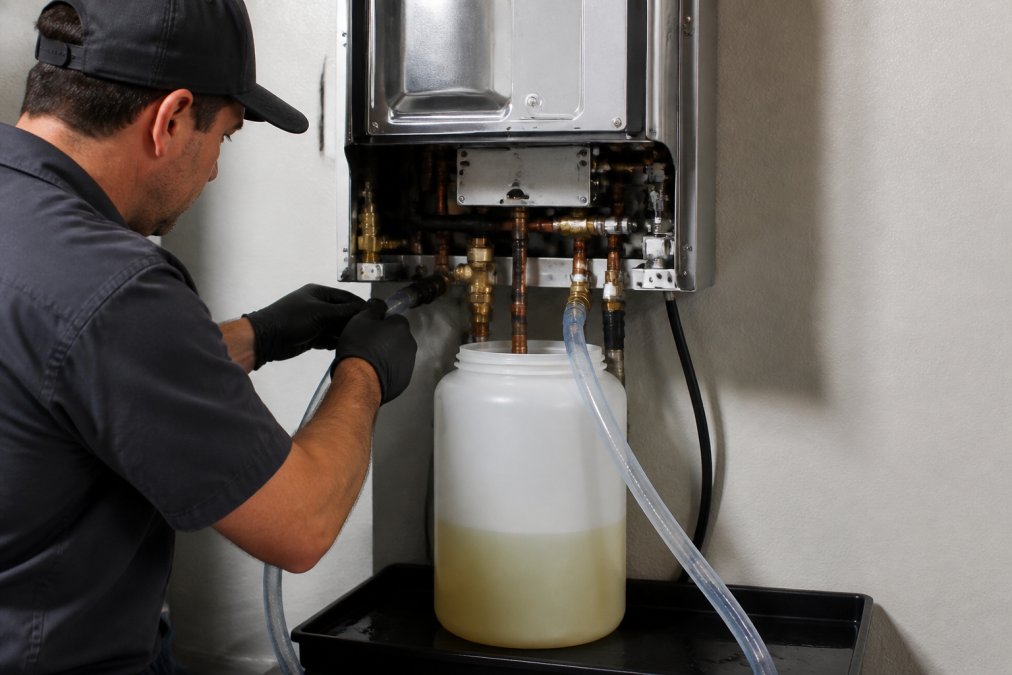
The safest descaling method uses a circulation pump, two hoses, and the unit's isolation valves, and runs 45 to 90 minutes depending on buildup. The procedure below matches most manufacturers' service manuals, with the practical details that determine whether the cycle actually removes scale.
What you'll need:
- A submersible circulation pump rated for the job. Most residential tankless units need 3 to 5 GPM with enough head pressure to push solution through the heat exchanger coil. A pond or fountain pump rated for continuous duty is the common choice; a 1 GPM pump will circulate but will not scrub deposits loose in reasonable time.
- Two 5-gallon buckets, one for fresh solution, one for the return line so you can watch the color of the runoff.
- Descaling solution mixed per the label, usually a 1:3 or 1:4 ratio of descaler to water.
- The manufacturer's service port connections (many units ship with them; some require an adapter kit).
- Nitrile gloves, splash goggles, and a drop cloth, acid splashes are the most common DIY injury here.
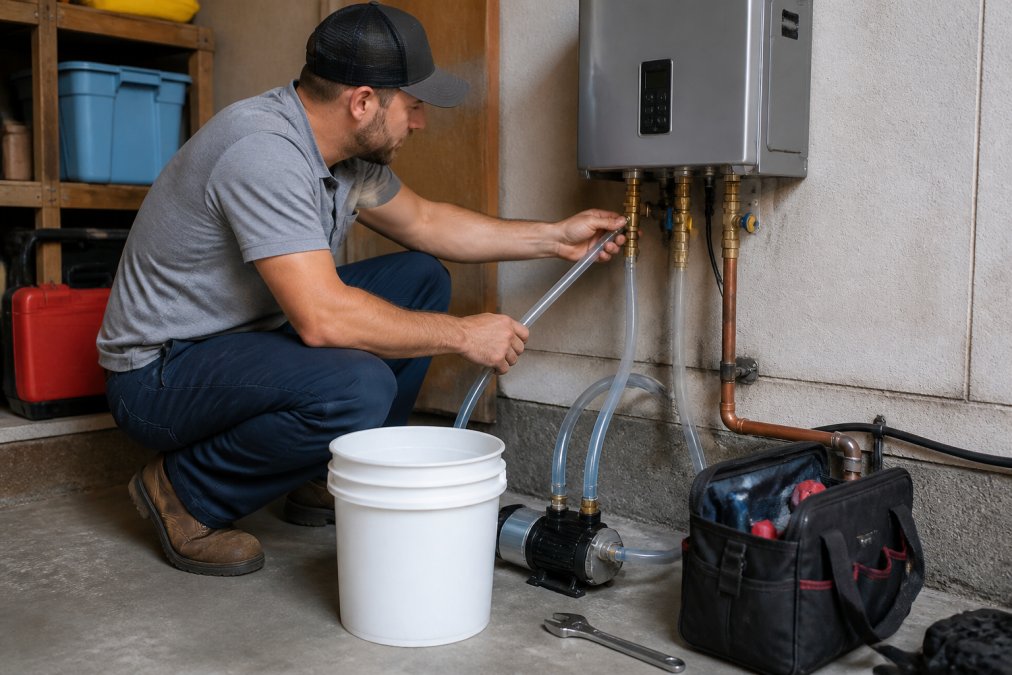
- Shut off power and gas, then close the isolation valves. On gas units, close the gas shutoff; on electric units, kill the breaker, not just the wall switch. Confirm the unit is cool first, hot solution through a hot exchanger is a scald risk.
- Connect the pump hoses to the service ports. The cold-water service port is the inlet side of the heat exchanger and is where most scale collects. Route the pump outlet to the cold port and the return hose from the hot port back to your bucket.
- Mix the descaling solution with water per the label, usually a 1:3 or 1:4 ratio, in the bucket, not the unit. Warm water (around 100-120°F) speeds the reaction, but never boiling water, it can deform plastic fittings and accelerate corrosion (osha.gov).
- Circulate for 45 minutes, reversing flow direction halfway through. If the runoff turns dark or gritty in the first 10 minutes, that is normal, the acid is working. If it stays clear, the unit may not have needed descaling.
- Flush with clean water until runoff runs clear. Run fresh water through the pump for at least 5 minutes, until the return bucket shows no tint and no foam, residual acid will attack the metal over time.
- Reopen valves, restore power, and test hot water at a fixture. Run a faucet on full hot for 2-3 minutes and check the outlet temperature holds steady. A cold-water sandwich mid-run means scale remains or the flow sensor is fouled.
Expected result: steady outlet temperature and restored flow rate. If scale persists, repeat the cycle. Two full cycles back-to-back is the practical limit before you should suspect a mechanical problem rather than scale.
If the isolation valves will not close or are seized: do not force them. A broken isolation valve turns a two-hour DIY job into a plumber call, and on some units it is part of the service port assembly. If the valves will not seal, stop and call a technician.
Post-flush verification checklist:
- Outlet temperature holds within a few degrees of setpoint for a full 3-minute draw.
- Flow rate at the fixture is back to what it was when the unit was new.
- No error codes on the display after 24 hours of normal use.
- No acid smell or residue at the service ports.
If any fail, the problem may be beyond scale, a failing flow sensor, a scaled mixing valve, or a damaged heat exchanger. That is when a technician's diagnostic tools beat another descaling cycle.
Product Reviews: Best Tankless Water Heater Descaling Solutions
Each of these four options has a clear use case. Here's how they compare in practice.
J.C. Whitlam Flow-Aide: The Industry Standard
Flow-Aide is a descaler that dissolves scale, lime, and rust without attacking copper, steel, or rubber.
Pros: Highly effective on heavy buildup; widely recommended by plumbers. Cons: Costs more than vinegar.
Chromex: Citric Acid for Sensitive Systems
Chromex leans on citric acid with NSF-certified components, making it a pick for anyone who prefers a food-grade cleaner over synthetic acids. It is compatible with most major tankless brands, but extreme scale may need a longer soak.
Pros: Environmentally friendly; safe for residential plumbing. Cons: Slower on tough deposits.
Calci-Free: Heavy-Duty Scale Removal
Calci-Free uses methanesulfonic acid to break down calcium carbonate fast. In high-hardness regions, it clears what weaker descalers may leave behind, but the potency that makes it effective also demands gloves and eye protection.
Pros: Very aggressive on stubborn calcium; effective in hard water. Cons: Requires careful handling.
Distilled White Vinegar: Budget DIY Option
At roughly $3 per gallon, vinegar is the cheapest maintenance tool available. Its 5% acidity is food-safe and gentle on every plumbing material. Use it for routine preventative cycles, not for rescuing a scaled-up unit.
Pros: Extremely inexpensive; safe for all materials. Cons: Less effective on heavy buildup; needs longer circulation.
Warranty and Disposal: What Manufacturers Don't Tell You
Two details decide whether descaling protects or costs you. First, warranty: most manufacturers require documented annual descaling to keep heat exchanger coverage valid. Neglecting it gives them grounds to deny a claim. Keep a log of dates and products used.
Second, disposal. Spent descaling solution is acidic and should never go down a storm drain or onto plants. Neutralize it with baking soda until fizzing stops, then flush down a household drain with plenty of water. Check local wastewater rules for larger volumes.
How to Choose the Right Solution for Your Home
Match the product to your water, not to marketing. Start by testing hardness: a simple strip test tells you whether you are in light, moderate, or severe scale territory.
- Soft to slightly hard water: distilled white vinegar, quarterly
- Moderately hard water: citric acid descaler like Chromex, every 6 months
- Very hard water: Flow-Aide or Calci-Free, every 3 to 4 months
For units throwing persistent error codes or showing no improvement after two descaling cycles, the problem may be beyond scale. Home Tech services tank and tankless water heaters, gas and electric, covering heating element and thermostat replacement alongside sediment flushing.
Conclusion: Protect Your Investment
A tankless water heater is a long-term purchase, and scale is the quiet force that shortens its life. The right descaling solution, matched to your water hardness and used on schedule, keeps thermal efficiency and your warranty intact.
If DIY descaling feels risky, or your unit keeps throwing error codes after a flush, Home Tech can help. Our licensed, insured technicians handle sediment flushing, error code troubleshooting, and heating element replacement on tankless and tank systems, with same-day and next-day appointments and no hidden fees. Book an appointment with us and keep your hot water running the way it should.
Frequently Asked Questions
What is the best product for descaling a tankless water heater?
J.C. Whitlam Flow-Aide is widely considered the industry standard for professional-grade descaling. It is biodegradable and safe for copper, steel, and rubber components. For a citric acid alternative, Chromex is NSF-certified and gentler on sensitive systems. Calci-Free uses methanesulfonic acid for severe hard water scaling. Distilled white vinegar works for light, routine maintenance but requires longer circulation times and is less effective on heavy mineral buildup.
Can I descale my tankless water heater myself?
Yes, descaling is a manageable DIY task if you have a submersible pump, two hoses, a bucket, and the right descaling solution. You will connect the pump to the service ports, circulate the solution for 30 to 60 minutes, then flush with clean water. However, if you are uncomfortable working with acidic solutions or your unit has error codes, a licensed technician can handle it safely and check for related issues.
How often should you descale a tankless water heater?
Most manufacturers recommend descaling once a year. In areas with hard water, you may need to descale every six to eight months. If you notice reduced hot water flow or error codes, descale immediately regardless of the schedule. A water hardness test can help you set a realistic maintenance cycle for your home.
What vinegar should I use to descale a tankless water heater?
Use plain distilled white vinegar with 5% acidity. Do not use apple cider vinegar, cleaning vinegar with additives, or any flavored vinegar. Distilled white vinegar is food-safe, inexpensive, and safe for all plumbing materials. For heavy scale, commercial descalers like Flow-Aide or Calci-Free work faster and more thoroughly than vinegar alone.
Does descaling affect my tankless water heater warranty?
Descaling with a manufacturer-approved solution and following the recommended maintenance schedule helps preserve your warranty. Using harsh chemicals not approved for your unit or skipping maintenance can void coverage if scale damage causes a failure. Check your owner's manual for approved descaling products and keep records of each maintenance cycle.