 comparison
Best R404A Alternatives for Walk-In Freezers
Table of Contents
- Why R404A Is Being Phased Out
- R448A (Solstice N40): The Industry Standard Alternative
- R449A (Opteon XP40): High-Performance Drop-In Replacement
- R452A (Opteon XP44): Best for Discharge Temperature Matching
- EPA AIM Act Refrigerant Phase-Down Schedule
- Refrigerant Conversion Best Practices for Walk-In Systems
- EPA 608 Certified Technician Requirements for Safe Retrofit
- Comparison Table: GWP, Capacity, and Compatibility
- Frequently Asked Questions
Last Updated: September 23, 2026
Why R404A Is Being Phased Out
R404A has dominated commercial refrigeration for decades, but its days are numbered. The refrigerant carries a Global Warming Potential (GWP) of 3,922, meaning it traps heat in the atmosphere roughly 3,900 times more effectively than carbon dioxide over a 100-year period. That's not a minor environmental concern, it's the reason the EPA and international climate agreements are pushing the phase-out hard.
The phase-down isn't theoretical anymore. Under the EPA's AIM Act (American Innovation and Manufacturing Act), R404A production and imports are declining year after year (the EPA). New equipment manufactured for walk-in freezers can no longer use R404A as a primary refrigerant. For facility managers and restaurant owners, this means retrofit decisions are no longer optional, they're urgent.
The good news: R404A alternatives exist, and many of them work better than you'd expect. The challenge is understanding which R404A alternatives make sense for your specific equipment, budget, and operational needs.
R448A (Solstice N40): The Industry Standard Alternative
R448A is the workhorse replacement for R404A in walk-in freezers. Honeywell's Solstice N40 formulation delivers approximately 65% lower GWP than R404A while maintaining compatibility with existing system infrastructure. For most facility managers, this is the path of least resistance.
Here's why R448A dominates retrofit conversations: it plays nicely with equipment designed for R404A.
R449A (Opteon XP40): High-Performance Drop-In Replacement
Chemours' R449A (marketed as Opteon XP40) offers a compelling alternative when you want proven performance with minimal system modification. Like R448A, it delivers roughly 65% GWP reduction compared to R404A, but the performance characteristics differ slightly.
R452A (Opteon XP44): Best for Discharge Temperature Matching
When discharge temperature is critical to your operation, R452A stands out. Chemours designed this HFO blend specifically to mimic R404A's discharge temperature and mass flow characteristics. For transport refrigeration and walk-in systems where maintaining original operating temperatures prevents equipment stress, R452A minimizes the need for component replacement.
EPA AIM Act Refrigerant Phase-Down Schedule
Understanding the regulatory timeline shapes your retrofit decisions. The EPA's AIM Act mandates declining production and import allowances for high-GWP refrigerants. For R404A specifically, the phase-down creates urgency: existing equipment can continue using R404A until failure, but sourcing replacement refrigerant becomes progressively harder and more expensive as allowances shrink.
Refrigerant Conversion Best Practices for Walk-In Systems
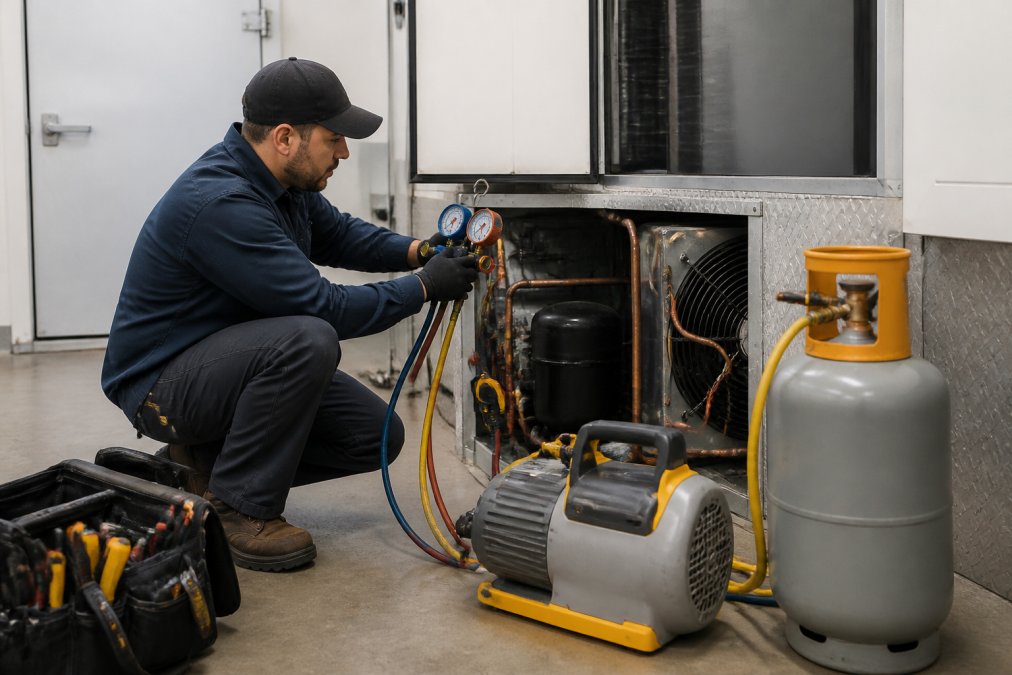
Successful retrofit requires systematic planning and verification at each stage. Unlike generic refrigerant swaps, walk-in freezer conversions demand attention to pressure relationships, oil compatibility, and component tolerance that directly affect performance and longevity.
Pre-Retrofit Documentation Checklist
- Current refrigerant type and charge weight (in pounds)
- Compressor model, displacement (cubic inches per revolution), and oil type currently in use
- Condenser and evaporator coil materials and fin type
- Thermostatic expansion valve (TXV) model number and superheat setting (typically 8-12°F for R404A)
- System operating pressures under full load: high-side (discharge) and low-side (suction) in pounds per square inch gauge (psig)
- Filter-drier type and last replacement date
- Electrical specifications: voltage, phase, and compressor horsepower
System Assessment and Component Compatibility
The technician should also inspect:
- Condenser coil condition: Mineral deposits or corrosion reduce heat rejection. If the coil is more than 10 years old or shows visible scaling, cleaning or replacement improves efficiency with the new refrigerant.
- Evaporator coil frost buildup patterns: Uneven frost indicates airflow restriction or TXV hunting. These issues must be resolved before retrofit to ensure the alternative refrigerant performs optimally.
- Compressor discharge line temperature: Measure this under full-load conditions. If discharge temperature exceeds 220°F with R404A, the system is already stressed. R448A or R449A may require additional subcooling or a liquid-line heat exchanger to prevent compressor overheating.
- Suction line insulation: Damaged or missing insulation causes superheat loss and reduces cooling capacity. Repair or replace before retrofit.
Oil Compatibility and Flushing Requirements
Evacuation and Pressure Testing
Charging and Performance Verification
After charging, the technician measures:
- Superheat (suction line temperature minus saturation temperature at suction pressure): Target 8-12°F for R448A/R449A, 10-15°F for R452A. Adjust TXV if outside range.
- Subcooling (condensing temperature minus liquid line temperature): Target 5-10°F. If subcooling is low, the condenser may be undersized or fouled.
- Discharge temperature: Should not exceed 220°F under full-load conditions. Higher temperatures indicate oil breakdown risk.
- Capacity pull-down test: Run the freezer under full load for 30 minutes and verify it reaches setpoint temperature (typically −10°F to −20°F for walk-in freezers) within normal cycle time.
Post-Retrofit Maintenance and Monitoring
After retrofit, establish a quarterly maintenance schedule:
- Monthly visual inspection: Check for oil streaks or frost at connection points, signs of slow leaks.
- Quarterly pressure and temperature logging: Record high-side and low-side pressures, suction and discharge temperatures, and superheat/subcooling. Trending this data reveals compressor wear or condenser fouling before failure occurs.
- Annual oil analysis: Send a small oil sample to a lab for acid number and moisture content testing. This predicts compressor life and alerts you to degradation before it causes damage.
- Condenser cleaning: Depending on environment (dusty kitchens, outdoor units), clean condenser coils every 6-12 months. Fouled condensers reduce efficiency and increase discharge temperature.
EPA 608 Certified Technician Requirements for Safe Retrofit
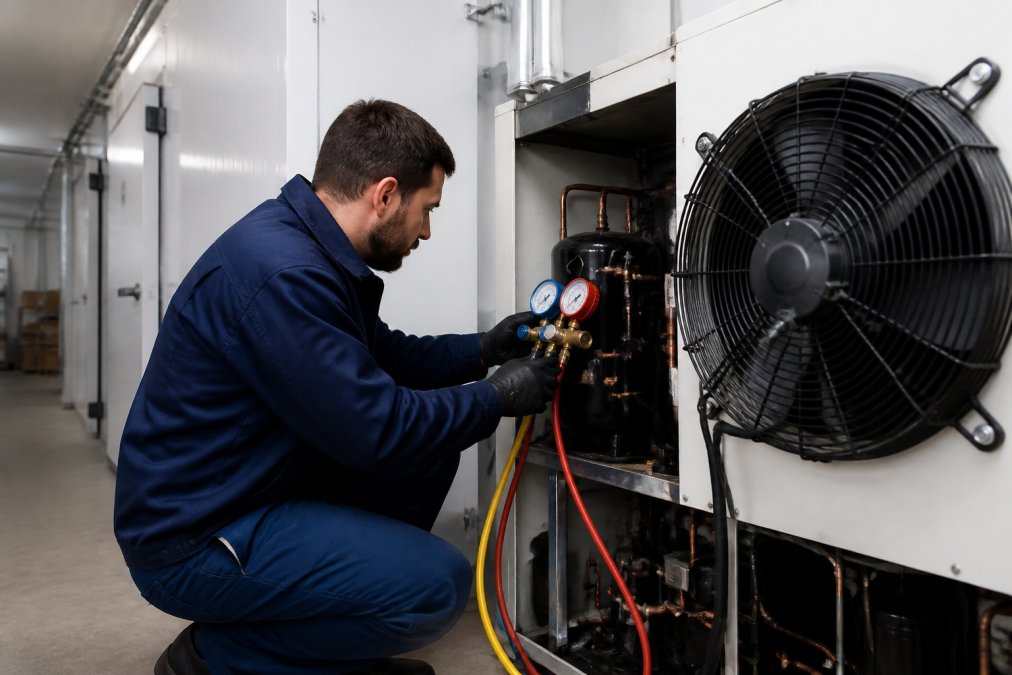
Federal law requires EPA 608 certification for anyone handling refrigerants (the EPA). This isn't optional, and it's not a credential that every repair technician automatically holds. The EPA exam covers refrigerant recovery procedures, system evacuation, leak detection, and safety protocols specific to different refrigerant types.
Comparison Table: GWP, Capacity, and Compatibility
| Refrigerant | GWP Reduction vs. R404A | Capacity Match | TXV Modification | Safety Class | Energy Efficiency vs. R404A | Typical Retrofit Cost* | Best Use Case |
|---|---|---|---|---|---|---|---|
| R448A (Solstice N40) | ~65% | Excellent | Minimal | ASHRAE A1 | +2-4% | $1,200-$1,800 | Standard retrofit, existing infrastructure |
| R449A (Opteon XP40) | ~65% | Excellent | Minimal | ASHRAE A1 | +1-3% | $1,400-$2,000 | Food service, retail freezers |
| R452A (Opteon XP44) | ~50% | Excellent | Minimal | ASHRAE A1 | +0-2% | $1,100-$1,600 | Discharge temperature-critical systems |
| R407A | ~45% | Good | Possible | ASHRAE A1 | −2-0% | $900-$1,400 | Transitional HFC alternative (declining use) |
*Retrofit cost includes EPA 608-certified technician labor (3-5 hours), refrigerant charge, evacuation and pressure testing, and minor component adjustments. Does not include condenser cleaning, TXV replacement, or oil conversion (add $400-$800 if mineral oil system requires flushing).
Energy Consumption and Operating Cost Impact
Long-Term Compressor Lifespan Considerations
- R448A and R449A operate at slightly lower discharge temperatures than R404A in most systems, reducing thermal stress on motor windings and extending compressor life by an estimated 1-2 years in typical food service applications.
- R452A, with its closer discharge temperature match, maintains R404A-equivalent compressor stress. Lifespan is comparable to original equipment.
- R407A, an older HFC blend, shows higher discharge temperatures in some systems and is being phased out in favor of newer alternatives.
Refrigerant Availability and Price Stability
As EPA AIM Act phase-down tightens,
Regulatory Compliance Timeline
The EPA AIM Act mandates:
- 2024 onward: R404A production allowances decline 10% annually. New equipment cannot use R404A.
- 2030: R404A allowances drop to near-zero. Existing equipment can still use recovered/recycled R404A, but new refrigerant supply is effectively unavailable.
- Post-2030: Retrofit or equipment replacement becomes the only option for systems still using R404A.
Frequently Asked Questions
What is a good substitute for R404A refrigerant?
R448A, R449A, and R452A are the three best R404A alternatives for walk-in freezers. R448A and R449A both reduce GWP by approximately 65% and work as drop-in replacements with minimal system changes. R452A is ideal if your system requires matching R404A's discharge temperature characteristics. All three are non-flammable (ASHRAE A1 classification) and approved for commercial refrigeration under EPA regulations.
How does the EPA AIM Act affect my walk-in freezer's R404A refrigerant?
The EPA AIM Act (American Innovation and Manufacturing Act) requires a gradual phase-down of HFC refrigerants like R404A. Existing equipment can continue operating with R404A, but new equipment must use lower-GWP alternatives. If your system needs servicing or recharging, your technician may recommend transitioning to R448A or R449A now to avoid future regulatory pressure and reduce environmental impact.
Do I need to replace my compressor when switching from R404A?
In most cases, no. R448A, R449A, and R452A are designed as drop-in replacements that work with existing compressors and hardware. However, you may need to replace the thermostatic expansion valve (TXV), filter-drier, or oil to ensure compatibility with the new refrigerant. An EPA 608-certified technician will assess your specific system during the retrofit to identify any necessary component upgrades.
What is the difference between R448A and R449A for walk-in freezers?
Both R448A and R449A reduce GWP by about 65% compared to R404A and are non-flammable. R449A (Opteon XP40) has a strong track record in retail and food service applications with excellent capacity and efficiency matching. R448A (Solstice N40) is widely accepted as an industry standard and offers similar performance. The choice depends on your system's specific design and your technician's experience with each product.
Why should I hire an EPA 608-certified technician for a refrigerant conversion?
EPA 608 certification ensures your technician has passed federal exams on refrigerant handling, system safety, and environmental protection. Certified technicians know how to properly recover old refrigerant, prevent leaks, select compatible replacement components, and ensure your system operates safely and legally. Using an uncertified technician exposes you to equipment damage, environmental violations, and potential fines.