 listicle
Alternatives to Replacing an Aging Commercial Condenser
Table of Contents
- When Replacement Isn't the Only Option for an Aging Commercial Condenser
- Repair vs. Replace: A Decision Framework for Aging Condensers
- Quick Comparison: Top Alternatives for Aging Condensers
- Retrofit Options That Extend System Life
- What Is EPA 608 Certified Repair and Why It Matters
- The Commercial HVAC Preventative Maintenance Checklist
- When Replacement Is the Right Call
- Conclusion
- Frequently Asked Questions
Last Updated: September 8, 2026
When Replacement Isn't the Only Option for an Aging Commercial Condenser
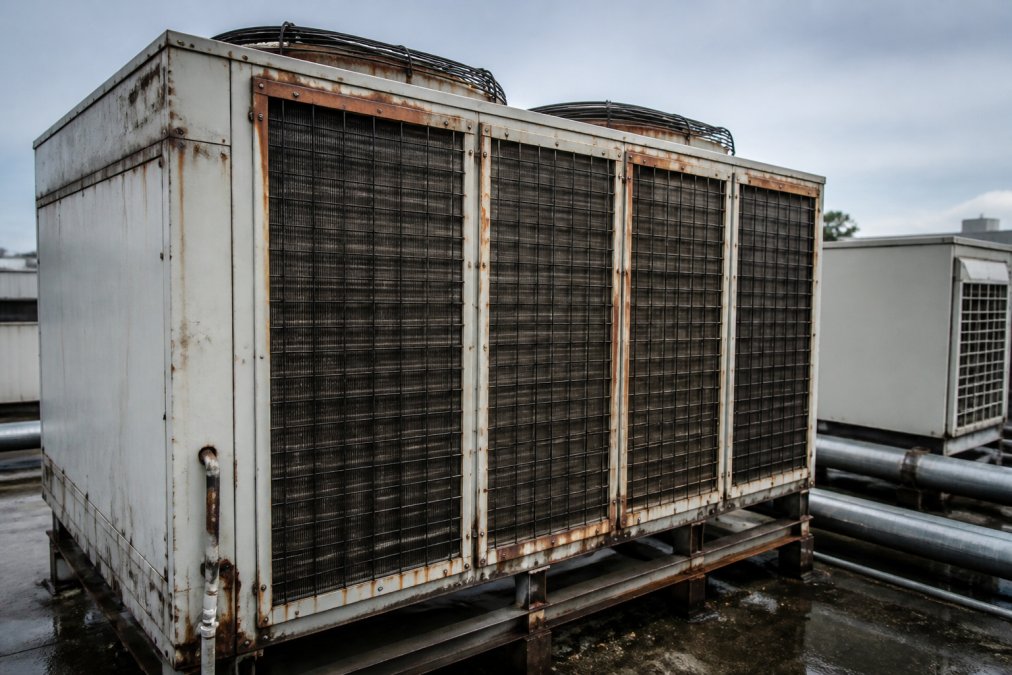
An aging commercial condenser is a cooling system whose efficiency, reliability, and operating costs signal that its service life is nearing an end. When it starts failing, the immediate assumption is often that full replacement is the only path forward, an assumption that can be expensive and premature. Targeted repairs and strategic upgrades can often extend the life of existing equipment for years while deferring a major capital expenditure.
The decision isn't about avoiding a bill; it's about protecting operational efficiency and your bottom line. At Home Tech, we've spent over 10 years servicing commercial condensers across the Phoenix metro.
Before authorizing a costly new installation, evaluate the total cost of ownership, not just the immediate repair quote. Several retrofit options, maintenance strategies, and financial models can restore system reliability at a fraction of the cost.
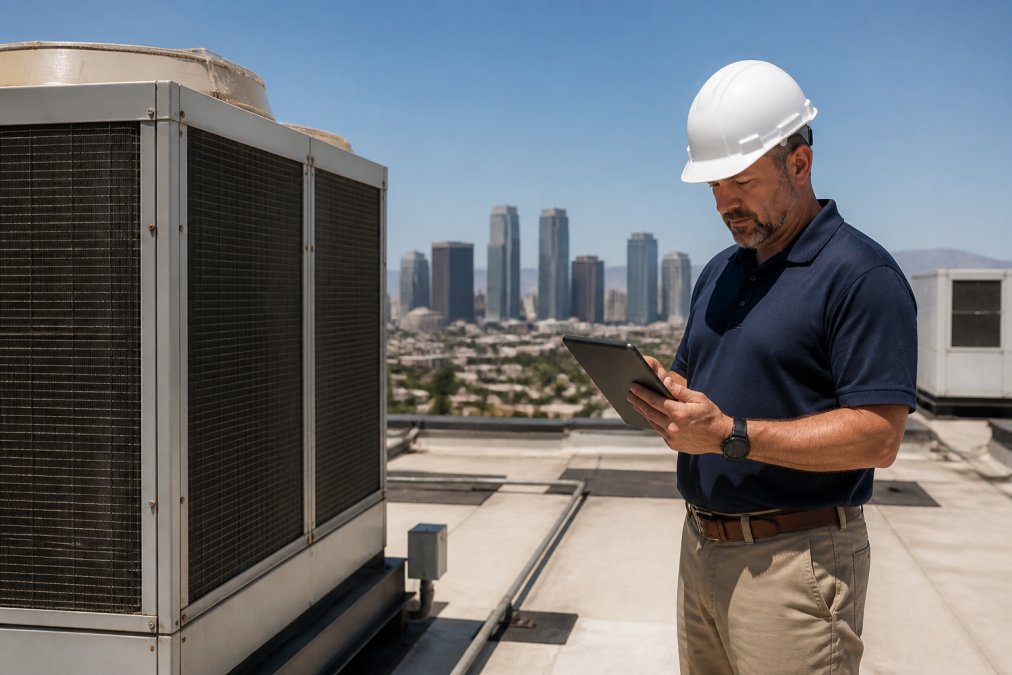
Repair vs. Replace: A Decision Framework for Aging Condensers
The best alternative to replacement depends on a structured evaluation of the system's condition, age, and failure mode, weighing compressor health, parts availability, and energy consumption against the cost of new equipment. A thorough HVAC diagnostics assessment is the first step.
Equipment Age and the 10-Year Rule
Equipment age is the most significant predictor of whether a repair is a sound investment. While a "10-year rule" is a common benchmark, it is not a universal cutoff; actual longevity depends on maintenance history, load conditions, and installation quality.
A system approaching 15 years with frequent compressor failures shifts the economics toward replacement. But a 12-year-old unit with meticulous preventative maintenance can still justify a major component repair. The rule is a trigger for evaluation, not an automatic sentence.
Compressor Failure vs. Minor Component Wear
The nature of the failure is the deciding factor. A compressor failure in an older unit is often the "point of no return" because the compressor represents a significant portion of the system's value, and remaining components may still be at risk of degradation.
Minor component wear, a failing contactor, worn capacitor, or leaking Schrader valve, is routine and inexpensive to repair. If the failure is isolated to a component with a defined lifespan, repair it; if it is systemic, such as a burnout contaminating the refrigerant loop, replacement is more reliable.
The Commercial Total Cost of Ownership (TCO) Model
Commercial facility managers need a Total Cost of Ownership framework over a defined planning horizon, accounting for purchase price, installation, energy, maintenance, unscheduled repairs, and residual value.
A practical TCO calculation uses a 5-year planning horizon:
Scenario A: Continue Repairing the Aging Unit
Start with the current repair estimate, add annual maintenance ($800-$1,500 for a unit over 12 years old), add energy costs (30-50 percent higher for a SEER 10 or below unit), and add a risk factor for unscheduled downtime, a single emergency call for a downed walk-in cooler can cost $500-$1,500 in lost product alone.
Scenario B: Replace with a High-Efficiency Unit
Take the full installed cost ($18,000-$45,000 for a 10-20-ton unit), subtract any utility rebate or federal tax incentive (such as the Section 179D deduction from the Inflation Reduction Act of 2022), and add projected energy savings of 20-40 percent when moving from 10 SEER to 16 SEER or higher.
The crossover is typically between years 3 and 5. A repair over $6,000 on a unit over 15 years old favors replacement; a repair under $3,000 on a unit under 12 years old favors repair. In the gray zone, 12-15 years old with a $3,000-$6,000 repair, the deciding factor is usually the refrigerant type.
The Refrigerant Cost Escalation Factor
A critical variable most frameworks ignore is refrigerant cost. The AIM Act's HFC phasedown is making R-410A progressively more expensive: a 25-pound cylinder rose from roughly $300-$400 in early 2024 to $500-$700 by late 2025, with the trend expected to continue through the EPA's 2029 step-down.
A system losing 10 pounds of refrigerant per year will consume roughly $200-$280 annually at current prices, likely doubling by 2029. With a 10-15 percent annual escalation factor, the economics shift decisively toward replacement or retrofit for leaking systems.
The Availability of Parts and Service Labor
A final factor is parts and labor availability. As manufacturers shift production toward R-454B and R-32 systems, parts for older compressors and control boards become harder to source, with lead times stretching from days to weeks, a real downtime risk during peak cooling season.
If a required compressor or control board is on backorder with no confirmed delivery date, the TCO model must include the cost of lost production or spoilage during the wait. In those cases, replacement with a current-model unit is often the lower-risk decision.
Quick Comparison: Top Alternatives for Aging Condensers
Several viable strategies exist between "do nothing" and "full replacement," ranging from maintenance contracts to advanced retrofits. The right choice depends on your operational constraints and budget.
| Alternative | Best For | Key Benefit | Primary Drawback |
|---|---|---|---|
| Preventative Maintenance Contracts | Systems under 15 years old | Extends system longevity and maintains efficiency | Does not fix design limitations |
| Variable Frequency Drives (VFDs) | Motors running at constant speed | Reduces energy consumption and wear | Requires motor compatibility check |
| R-454B Refrigerant Retrofit | Systems using phased-out refrigerants | Ensures regulatory compliance | Requires professional handling |
| Building Automation Systems (BAS) | Facilities with variable cooling loads | Optimizes performance and provides data | Needs professional configuration |
| Ductless Mini-Split Systems | Supplementing specific zones | High efficiency, no ductwork | Not for large open-plan spaces |
Retrofit Options That Extend System Life
Retrofitting upgrades specific components of an aging condenser to modern standards without replacing the entire unit, a powerful middle ground that reduces energy consumption, improves reliability, and supports regulatory compliance while preserving capital investment.
Variable Frequency Drives (VFDs) and Soft Starts
A Variable Frequency Drive adjusts the condenser motor's speed to match actual cooling demand, modulating instead of running at 100% capacity. This reduces electrical stress and energy consumption, while soft-start capability prevents the current inrush that causes wear.
For facilities with motors running at constant speed regardless of demand, a VFD is highly effective: it extends component lifespan by reducing thermal and mechanical stress and cuts utility bills. The primary consideration is a compatibility check on motor types.
The Financial Case for VFDs in Commercial Settings
A 15-ton condenser with a 5-horsepower fan motor running continuously consumes roughly 32,000 kWh annually in a 2,000-hour cooling season. A VFD modulating fan speed can cut fan energy by 40-60 percent, translating to annual savings of roughly $1,500-$2,300 per condenser at $0.12 per kWh.
A professionally installed VFD retrofit typically costs $2,500-$4,500, putting the simple payback between 18 and 36 months. The secondary benefit is reduced mechanical wear: soft starts eliminate the torque spike that stresses belts, bearings, and motor winding insulation, adding 3-5 years of service life to the fan assembly.
R-454B Refrigerant Retrofits and the Phase-Out Timeline
The regulatory landscape for refrigerants is changing rapidly. The industry is moving from high-GWP refrigerants like R-410A toward lower-GWP alternatives, with R-454B emerging as a leading replacement, driven by the AIM Act of 2020, which directs the EPA to phase down HFC production by 85 percent by 2036.
The EPA's HFC allocation schedule began its first significant step-down on January 1, 2024, with the next major reduction on January 1, 2029, dropping allocation to roughly 40 percent of baseline (the EPA). R-410A will become progressively more expensive and harder to source, with distributors already reporting quarterly price increases.
For an aging condenser with structural integrity, an R-454B retrofit can be viable. The process involves recovering the existing refrigerant, replacing the expansion valve, verifying elastomer and seal compatibility, and recharging. Since R-454B operates at similar pressure to R-410A, the coil and compressor can typically remain in service if in good condition.
The Cost Reality of Waiting
Deferring the retrofit until a major repair is needed is often the wrong economic move. A planned R-454B retrofit during a scheduled maintenance window costs $3,000-$6,000 for a 10-20-ton condenser; waiting until a leak or compressor failure occurs can double the cost.
There is also a supply-chain consideration. As the phase-down accelerates, demand for certified technicians who can perform R-454B retrofits will outpace supply in many areas. Facilities scheduling retrofits in 2026-2027 will have more competitive pricing and shorter lead times than those waiting until 2029.
Smart Controllers and Building Automation Integration
A third retrofit option is adding smart controllers that integrate with a Building Automation System (BAS). These controllers use sensors to monitor discharge pressure, suction pressure, ambient temperature, and compressor run time, adjusting fan speed and staging compressor operation to avoid short-cycling.
The value is data-driven maintenance. A smart controller alerts the manager when performance drifts from baseline, indicating a developing issue such as a dirty coil, low charge, or failing bearing, converting a catastrophic failure into a scheduled $500 repair. Retrofits cost $1,800-$3,500 per condenser, and the diagnostic data often pays for the unit within the first year.
For facilities with an existing BAS, integration is straightforward over standard protocols such as BACnet or Modbus. This visibility is the foundation of a predictive maintenance program, the most effective way to defer the capital expense of full replacement.
What Is EPA 608 Certified Repair and Why It Matters
EPA 608 certified repair is the legal standard for technicians who handle refrigerants in the United States, requiring EPA certification to work on sealed systems. It is designed to prevent the release of ozone-depleting and high-GWP substances, and it is your assurance that a technician understands regulations and proper handling procedures.
Attempting to service a commercial condenser without this certification is illegal and dangerous. Improper handling of refrigerants can lead to system contamination, poor cooling capacity, and significant environmental fines. The EPA's official certification requirements mandate that only certified technicians purchase and handle refrigerants. When evaluating retrofit options, specifically an R-454B conversion, always verify that the service provider holds the necessary credentials. A technician certified under Section 608 has passed a rigorous exam covering the safe handling, recovery, and recycling of refrigerants, which protects your equipment and the environment.
The Commercial HVAC Preventative Maintenance Checklist
A structured preventative maintenance program is the most cost-effective alternative to replacement, preventing minor issues from escalating into catastrophic failures. It goes beyond filter changes to include a comprehensive inspection of the condenser unit, refrigerant levels, and electrical components. Many failures are preceded by weeks of declining performance that a trained eye can catch early.
A thorough maintenance visit should include:
- Condenser Coil Cleaning: Remove dirt, debris, and vegetation from the coils to improve heat transfer and reduce head pressure.
- Refrigerant Leak Detection: Check for leaks and verify the charge is correct to prevent compressor overheating and loss of cooling capacity.
- Electrical Component Inspection: Tighten connections, test capacitors, and check contactors for pitting or wear.
- Airflow Verification: Ensure the condenser fan is operating correctly and moving the proper volume of air across the coil.
- Thermostat and Sensor Calibration: Verify that control sensors are reading accurately to prevent short-cycling.
When Replacement Is the Right Call
All alternatives have a limit. If your aging commercial condenser suffers a major compressor burnout that has contaminated the system with acid, or if the coil is severely corroded and leaking, repair costs can exceed half the price of a new high-efficiency unit, making replacement the financially sound decision.
The decision also hinges on the system's energy efficiency. Older units often have low SEER ratings, meaning they consume significantly more electricity to produce the same cooling capacity as modern equipment. The Department of Energy's guidance on energy efficiency highlights that replacing an old system with an ENERGY STAR certified model can yield substantial savings on utility bills. If your repair quote is high and your current system is inefficient, the total cost of ownership for a new unit may be lower within just a few years.
Conclusion
Managing an aging commercial condenser requires a clear-eyed assessment of options, from targeted repairs and VFD retrofits to refrigerant conversions and maintenance programs. The right choice balances immediate repair costs against long-term efficiency and reliability. When repair is no longer viable, replacement with a high-efficiency model becomes the strategic move.
Navigating these decisions requires a partner who understands the full HVAC lifecycle and the regulatory landscape. Home Tech's EPA 608 certified technicians service all refrigerant types, from legacy R22 to current R410A and the emerging R-454B, and we focus on cost-effective repair over replacement for commercial systems. Whether you need a complex condenser retrofit, a comprehensive diagnostic, or a priority same-day emergency response for a downed walk-in cooler, our team is ready to help you protect your investment and keep your operations running.
Frequently Asked Questions
Is it worth fixing a 20-year-old commercial AC unit?
Often, yes. If the compressor is still functional and the issue is a worn contactor, leaking valve, or dirty coil, repairs can buy years of service for a fraction of replacement cost. The deciding factors are the cost of the repair versus a new unit's price, the system's SEER rating, and whether it still uses an available refrigerant. An EPA 608 certified technician can diagnose the issue and give you a clear repair-versus-replace recommendation based on the system's actual condition.
What is the average lifespan of a commercial HVAC condenser?
A well-maintained commercial condenser typically lasts 15 to 20 years. Units in harsh desert environments or those that run continuously may wear out closer to the 15-year mark. Preventative maintenance, including regular coil cleaning and refrigerant checks, directly impacts system longevity. When a unit passes 15 years, you should evaluate repair costs against the potential for improved energy efficiency and lower utility bills from a newer, Energy Star certified model.
How does EPA 608 certification impact repair options for aging units?
EPA 608 certification is required for technicians who handle refrigerants. This matters for aging units because it ensures repairs involving refrigerant recovery, reclamation, and retrofits are done legally and safely. With the refrigerant phase-out of R-22 and the transition to options like R-454B, a certified technician can determine if your system can be safely retrofitted with a compliant alternative. This expertise can extend the life of your condenser without violating federal regulations.
When is it more cost-effective to repair rather than replace commercial HVAC equipment?
Repair is more cost-effective when the condenser unit is under 15 years old, the compressor is still sound, and the repair cost is less than 30% of a full replacement. Replacing a condenser also means new ductwork connections, pad adjustments, and potentially higher installation fees. If the system has a history of only minor repairs and no major component failures, fixing the immediate issue and following a preventative maintenance schedule is usually the smarter financial move.
Book an appointment with Home Tech today to get a professional assessment of your aging commercial condenser and explore the alternatives that can save you thousands.