 listicle
Alternatives to Expensive HVAC Service Contracts
Table of Contents
- What Is an HVAC Service Contract and Why Homeowners Question the Cost
- DIY HVAC Maintenance Checklist: Tasks You Can Handle Yourself
- Home Warranty Plans vs. Service Contracts: Key Differences
- Signs Your AC Needs Refrigerant and When to Call a Professional
- Average Cost of HVAC Repair Without a Contract
- Comparison of Alternatives: Which Option Saves You the Most Money
- Hidden Limitations in Service Contracts and Warranty Plans
- Conclusion: Building Your Own HVAC Protection Strategy
- Frequently Asked Questions
Last Updated: August 19, 2026
What Is an HVAC Service Contract and Why Homeowners Question the Cost
An HVAC service contract is a maintenance agreement between a homeowner and an HVAC company that covers periodic inspections, tune-ups, and sometimes parts and labor for repairs. These contracts typically cost between $150 and $300 annually and promise priority service, discounted repairs, and peace of mind. Yet many homeowners question whether they're paying for protection they'll never use or if better alternatives exist.
The real question isn't whether you should buy a contract, but whether it's the right type of protection for your specific situation. The best strategy depends on three factors: your system's age, your risk tolerance, and how much maintenance you're willing to do yourself. Some homeowners save thousands by handling basic maintenance and skipping the contract entirely. Others find that a home warranty plan (which differs significantly from a service contract) delivers better coverage at lower cost.
DIY HVAC Maintenance Checklist: Tasks You Can Handle Yourself
A significant portion of routine maintenance can be done yourself in under an hour per season, potentially eliminating the need for a service contract if you're consistent.
Monthly Tasks (5 minutes):
- Check your air filter visually and replace it if it looks gray or clogged.
- Ensure return air vents aren't blocked by furniture or dust buildup.
- Listen for unusual noises from the indoor unit or outdoor condenser.
Seasonal Tasks (Spring and Fall, 15-20 minutes each):
- Replace your air filter if needed. Standard filters cost $10-20.
- Clear debris from around your outdoor condenser unit using a soft brush. Do NOT use a pressure washer.
- Inspect the condensate drain line (a small PVC pipe near your indoor unit). Pour a cup of white vinegar down it to clear algae buildup if clogged.
- Wipe down outdoor condenser fins gently with a fin comb if bent. These tools cost under $15.
- Check that the outdoor unit's base is level and refrigerant lines aren't visibly damaged.
Annual Tasks (30 minutes):
- Inspect your thermostat batteries and replace if needed.
- Test your system in both heating and cooling modes.
- Check for visible ice buildup on refrigerant lines or the outdoor unit.
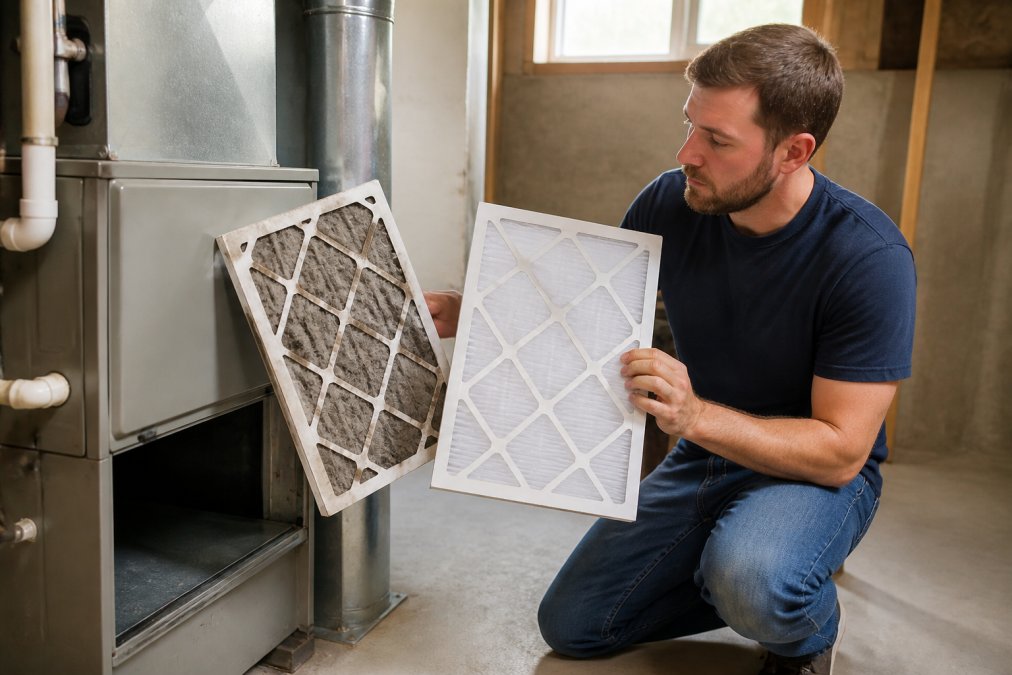
What you cannot do yourself: charging refrigerant, diagnosing electrical faults, replacing compressors, or servicing sealed systems. These require EPA 608 certification and specialized equipment. The maintenance above, the work that actually prevents most emergencies, is entirely in your wheelhouse.
Home Warranty Plans vs. Service Contracts: Key Differences
A home warranty plan and an HVAC service contract sound similar but are fundamentally different products.
HVAC Service Contract:
- Sold directly by your HVAC company
- Covers annual maintenance (tune-ups, inspections) plus discounted or free repairs
- You choose your technician
- Cost: $150-300 per year, plus service call fees for repairs not included
Home Warranty Plan:
- Sold by a third-party warranty company (American Home Shield, 2-10 Home Buyers Warranty, First Premier)
- Covers repair or replacement of major systems when they fail, but does NOT include routine maintenance
- You call the warranty company, and they dispatch a technician from their network
- Cost: $47-82 per month (roughly $564-984 per year), plus service call fees ($75-150 per call)
The key difference: a service contract prevents problems through maintenance. A home warranty responds to problems after they occur. If your system is relatively new (under 10 years old) and you're doing basic maintenance yourself, a home warranty is often the better choice. If your system is older (15+ years) or you want guaranteed priority service, a service contract makes more sense.
Home warranty plans have strict coverage limits. American Home Shield caps HVAC coverage at $5,000 per claim, which might not cover a full system replacement. Additionally, home warranties exclude systems that were already failing before you purchased the plan.
| Protection Type | Coverage Focus | Cost Range | Best For |
|---|---|---|---|
| Service Contract | Preventative maintenance + discounted repairs | $150-300/year | Older systems, priority service preference |
| Home Warranty Plan | Emergency repairs/replacement only | $564-984/year | Newer systems, protection against catastrophic failure |
| DIY Maintenance Only | Self-managed preventative care | $50-100/year | Disciplined homeowners, newer systems |
| Combination (Warranty + DIY) | DIY maintenance + warranty safety net | $564-984/year | Balanced protection with lower risk |
Signs Your AC Needs Refrigerant and When to Call a Professional
Your air conditioner doesn't "use up" refrigerant like a car uses gasoline. If your system is low on refrigerant, it has a leak. Topping it off without fixing the leak is temporary and wasteful.
Visual and Performance Signs:
- AC is running but not cooling effectively; air feels cool but not cold.
- Ice buildup on refrigerant lines or outdoor condenser unit.
- Hissing or bubbling sounds from the outdoor unit or indoor evaporator coil.
- Higher-than-normal utility bills despite normal usage.
- System cycles on and off more frequently than usual (short-cycling).
What You Should NOT Do:
- Don't attempt to add refrigerant yourself. It requires EPA 608 certification and specialized equipment.
- Don't ignore the problem. Low refrigerant forces your compressor to work harder and can lead to complete system failure.
- Don't assume a one-time recharge will fix it. A professional needs to locate and repair the leak, then recharge properly.
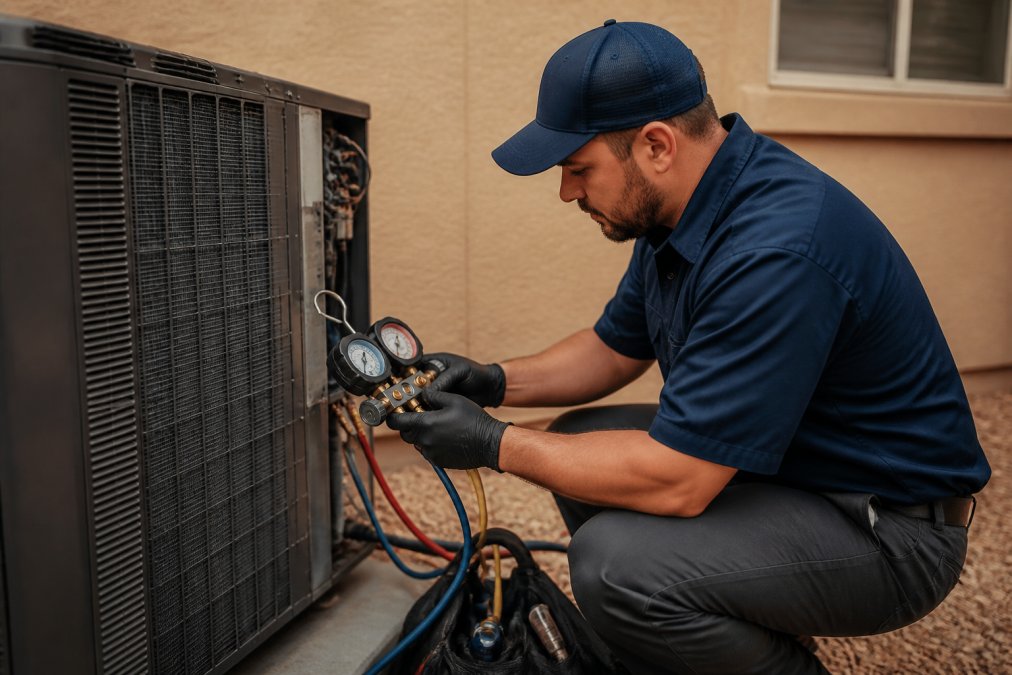
When to Call a Professional: If you notice any of the signs above, call immediately. Refrigerant issues worsen quickly, and a system running low can fail completely within weeks. Most refrigerant-related repairs run between $300-800 depending on leak location and severity. This is precisely where a home warranty plan or service contract adds value.
Average Cost of HVAC Repair Without a Contract
Understanding what repairs actually cost helps you decide whether paying for a contract is worth it.
Common HVAC Repairs (without a contract or warranty):
- Service call fee (diagnostics only): $75-150
- Air filter replacement: $10-30 (DIY) or $50-100 (professional)
- Capacitor replacement: $150-300
- Blower motor replacement: $300-600
- Refrigerant recharge with leak repair: $300-800
- Compressor replacement: $1,500-3,000
- Full system replacement: $5,000-12,000
The real cost isn't the individual repair, it's the unpredictability. A service call fee of $100 is manageable. A $2,000 compressor replacement is a financial shock. A home warranty plan that costs $600-1,000 per year caps your risk with a predictable annual cost and per-call service fee.
However, this protection only makes sense if you're actually likely to need it. A system less than 5 years old with no history of problems is unlikely to fail. A system 15+ years old is much more likely to need major work.
Comparison of Alternatives: Which Option Saves You the Most Money
The decision depends on your system's age, budget, and tolerance for uncertainty.
For Systems Under 5 Years Old: Best approach: DIY maintenance only, plus a home warranty plan if you want emergency protection.
- Annual cost: $50-100 (filters and tools) + $564-984 (warranty) = $614-1,084
- Your system is reliable and unlikely to need major repairs. Skip the service contract.
For Systems 5-10 Years Old: Best approach: DIY maintenance plus a home warranty, or a service contract if you prefer priority service.
- DIY + warranty cost: $614-1,084 per year
- Service contract cost: $150-300 per year
- Your system is entering the zone where repairs become more common.
For Systems 10-15 Years Old: Best approach: Service contract or home warranty, plus consistent DIY maintenance.
- Service contract cost: $150-300 per year
- Home warranty cost: $564-984 per year
- Your system is aging and repairs are increasingly likely.
For Systems 15+ Years Old: Best approach: Service contract, home warranty, or plan for replacement within 2-3 years.
- Service contract cost: $150-300 per year
- Home warranty cost: $564-984 per year
- Protection is valuable, but replacement is inevitable.
The lowest-cost alternative for most homeowners is consistent DIY maintenance combined with a home warranty plan. This approach typically costs $600-1,000 per year and provides both preventative care and emergency protection.
Hidden Limitations in Service Contracts and Warranty Plans
Before committing to any protection plan, understand what's not covered.
Service Contract Exclusions:
- Refrigerant charges are often not included, only the repair of the leak.
- Damage from improper installation, lack of maintenance, or user error is excluded.
- Upgrades or replacements are rarely covered; only repairs.
- Some contracts exclude systems over a certain age (often 15-20 years).
- Priority service doesn't mean same-day service; you may still wait 3-5 days during peak season.
Home Warranty Plan Exclusions:
- Pre-existing conditions (systems already failing before purchase) are excluded.
- Coverage caps limit what you'll receive. A full system replacement can exceed the cap.
- Service call fees ($75-150) apply to every visit.
- Certain refrigerant types may have limited availability and higher costs.
- Systems with a history of repeated failures may be excluded at renewal.
What Both Miss:
- Neither covers damage from natural disasters, accidents, or misuse.
- Neither covers preventative upgrades or ductwork repairs.
- Neither covers issues caused by inadequate insulation or air sealing.
The most common surprise is the coverage cap. A homeowner with a $5,000 cap discovers their system needs an $8,000 replacement and realizes they're only getting $5,000 of help. Reading the fine print before you buy prevents costly misunderstandings.
Conclusion: Building Your Own HVAC Protection Strategy
The best alternatives to expensive HVAC service contracts are built on your system's age, your willingness to do basic maintenance, and your financial tolerance for unexpected repairs.
Most homeowners save money by combining DIY maintenance (filter replacement, clearing debris, checking for leaks) with a home warranty plan that covers emergency repairs. This approach costs roughly $600-1,000 annually, provides both preventative care and catastrophic protection, and eliminates the service contract's recurring fees. For systems over 10 years old, adding a service contract's tune-ups becomes more defensible because maintenance directly extends system life.
The key is consistency. The right protection aligns with how you actually use it.
Home Tech is here to help you navigate this decision. Whether you need a one-time diagnostic to understand your system's condition, help interpreting a warranty plan's coverage, or guidance on what maintenance you can handle yourself, our EPA 608-certified technicians can assess your situation and recommend a strategy that fits your budget and risk tolerance. Call (602) 486-1901 or visit hometechappliancerepair.com to book an appointment.
Frequently Asked Questions
Are HVAC service contracts worth the cost?
Service contracts make sense if your system is aging or you want predictable monthly costs. However, if your HVAC system is under 10 years old and well-maintained, paying for repairs as they occur often costs less. Calculate your annual contract fee against historical repair expenses. Many homeowners save money by combining DIY preventative maintenance with occasional professional service calls rather than signing a contract.
What basic HVAC maintenance can I do myself?
You can replace air filters every 1-3 months, clean condenser coils with a brush, check thermostat settings, and inspect ductwork for visible leaks. You can also clear debris around outdoor units and ensure vents aren't blocked. However, tasks like refrigerant charging, electrical diagnostics, and heat exchanger inspection require EPA 608 certification and professional tools. Know your limits, improper repairs can damage your system and void warranties.
What are the signs your AC needs refrigerant?
Your AC needs refrigerant if it's blowing warm air despite running, has ice buildup on the outdoor unit, produces hissing sounds, or shows reduced cooling performance. Rising utility bills without increased usage can also signal low refrigerant. However, low refrigerant usually indicates a leak, not just depletion. A licensed technician must locate and repair the leak, then recharge the system, this cannot be done safely as a DIY task.
How much does HVAC repair typically cost without a service contract?
HVAC repair costs depend on the problem and your location. Service call fees typically range from $100-$200, while repairs vary widely: a refrigerant recharge might cost $200-$400, a capacitor replacement $300-$500, or a compressor replacement $1,500-$3,000. Emergency or after-hours calls cost more. Without a contract, you pay full price per visit, but you only pay when repairs are needed, making this option cheaper for systems that rarely break down.
Should I choose a home warranty or a service contract instead?
Home warranties typically cost $47-$82 monthly and cover repair or replacement with a service fee per claim. Service contracts are usually offered directly by HVAC companies and focus on preventative maintenance plus discounted repairs. Warranties work better if you want broad coverage across multiple home systems; service contracts suit homeowners who want relationship-based service with one trusted company. Compare coverage limits, exclusions, and total annual costs before deciding.
Protecting your HVAC system doesn't require expensive service contracts. By understanding your system's age, learning which maintenance tasks you can handle yourself, and choosing the right warranty or service plan for your situation, you can build protection that's both effective and affordable. The goal isn't the lowest cost, it's the right cost for the protection you actually need.