 how-to
Refrigerant Phase-Down: Commercial Freezer Maintenance in 2026
Table of Contents
- What the Refrigerant Phase-Down Means for Your Commercial Freezer
- HFC Regulations and Timeline: What's Changing and When
- Refrigerants Affected and Low-GWP Alternatives Available Now
- Commercial Refrigeration Preventive Maintenance Checklist for Phase-Down Compliance
- Commercial Freezer Refrigerant Leak Detection: Early Action Saves Money
- Repair, Retrofit, or Replace: A Decision Framework for Your Freezer
- EPA Section 608 Certification: Why Your Technician Must Be Qualified
- Preparing Your Business for Refrigerant Transition
- Frequently Asked Questions
Last Updated: October 14, 2026
What the Refrigerant Phase-Down Means for Your Commercial Freezer
The refrigerant phase-down commercial freezer mandate is a federal rule that eliminates hydrofluorocarbon (HFC) refrigerants from production and import by specific deadlines.
HFCs are being phased out because of their high global warming potential (GWP).
At Home Tech, we help restaurant owners, grocery stores, and food service operators navigate the refrigerant phase-down commercial freezer transition.
The key takeaway: act now.
HFC Regulations and Timeline: What's Changing and When
The EPA's phased approach started years ago, but 2026 marks a critical turning point: production and import limits are tightening further, affecting what's available to technicians and what it costs.
Here's the timeline:
- 2024-2025: Production caps reduced to 15% of baseline
- 2026 onward: Further reductions to 10% of baseline, then lower still
- Older HFC refrigerants become increasingly scarce and expensive
What this means for you: if your freezer uses R-404A or R-507, refrigerant charges will cost more each year.
The regulation doesn't ban servicing existing equipment yet, you can still maintain and repair freezers with HFC refrigerants.
Refrigerants Affected and Low-GWP Alternatives Available Now
Understanding which refrigerants are being phased out helps you evaluate your options.
HFCs being phased down:
- R-404A (most common in commercial freezers)
- R-507
- R-502
Low-GWP alternatives available today:
- R-448A and R-449A (drop-in replacements for R-404A in many systems)
- R-454B (used in newer equipment)
- R-290 (propane-based, highly efficient but requires special handling)
Low-GWP refrigerants have significantly lower global warming potential, making them compliant with current and future regulations. Some are "drop-in" replacements, meaning they work in existing equipment with minimal modification.
The challenge: not all freezers can accept all low-GWP alternatives. Equipment design, compressor type, and pressure ratings matter, so a technician must evaluate your unit.
Commercial Refrigeration Preventive Maintenance Checklist for Phase-Down Compliance
A generic cleaning schedule won't protect you from phase-down economics. What matters now is catching refrigerant loss early, documenting it correctly, and timing service so you aren't buying scarce HFCs at spot prices during a breakdown.
Why the phase-down changes what "preventive" means
Under EPA regulations implementing the American Innovation and Manufacturing (AIM) Act, HFC production and import allowances step down to an 85% reduction from baseline by 2036 (the EPA). The practical effect is not a ban on servicing, it's a shrinking supply of R-404A and R-507, rising per-pound cost, and longer lead times. Every pound you leak is a pound you buy back later at a worse price, which reframes leak prevention as line-item cost control.
Monthly walk-through (10-15 minutes, no tools)
- Log the box temperature at the same time each day from a calibrated thermometer, not the panel display. A drift of 2-3°F over a week is an early leak signal.
- Check door gaskets by closing a dollar bill in the door and tugging. If it slides out with no resistance, the seal is failing.
- Inspect the evaporator for uneven frost patterns. A patchy frost line often means low charge, not a defrost problem.
Quarterly service (technician or trained in-house)
- Clean condenser coils and fan blades. A fouled condenser raises head pressure and compressor amp draw, shortening compressor life, the most expensive component in the box.
- Verify superheat and subcooling against the manufacturer's target. These readings tell you more about charge health than pressure alone.
- Inspect electrical connections at the contactor and compressor terminals for pitting or heat discoloration.
Annual professional service, the compliance-critical visit
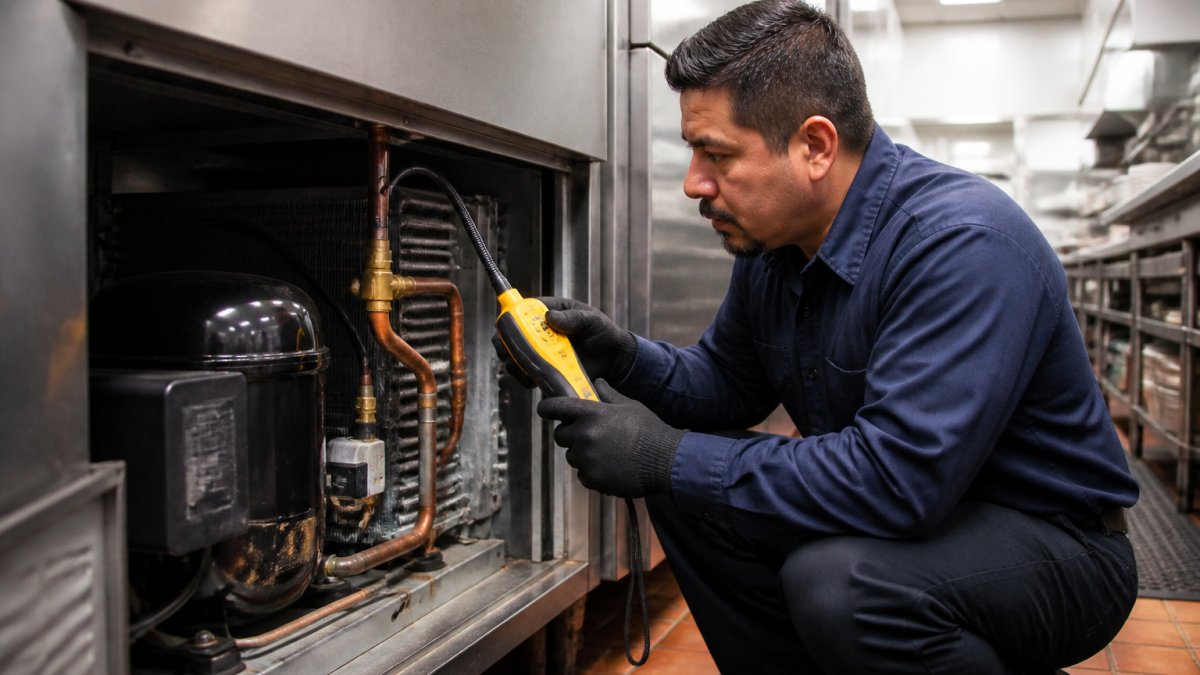
- Electronic leak detection on all accessible joints, Schrader ports, and the shaft seal.
- Record the refrigerant charge and compare to the equipment nameplate. A system that needs topping off every year has a leak, whether or not you found it.
- Oil condition and acid test if the system has a history of moisture ingress or burnout.
Recordkeeping: the part most operators skip
EPA regulations require tracking refrigerant purchases, recoveries, and additions, and technicians servicing appliances containing 5 to 50 pounds of refrigerant must follow specific leak-repair timelines. Commercial freezers frequently fall in that charge range:
- Keep a refrigerant log per unit: date, type, amount added, amount recovered, technician name and certification number.
- Keep purchase receipts for cylinders. If an inspector asks where the refrigerant went, receipts plus the log are your defense.
- Note leak-repair deadlines triggered when a system exceeds its applicable leak rate. Missing those deadlines can carry civil penalties.
Seasonal timing that saves money
Schedule annual service before peak cooling season. Technicians are more available and less likely to charge emergency rates, and you find problems while you still have time to source refrigerant or plan a retrofit instead of paying whatever the market demands during a July breakdown.
EPA AIM Act HFC allowance allocation and leak-repair requirements
A freezer that holds its charge and runs clean is the cheapest freezer you will ever own during a phase-down. The checklist above is how you keep it that way.
Commercial Freezer Refrigerant Leak Detection: Early Action Saves Money
Leaks are the most common reason commercial freezers fail. A small leak today becomes a catastrophic loss tomorrow, spoiled inventory and lost revenue.
Signs of a refrigerant leak:
- Temperature rising above normal settings
- Frost buildup on compressor or lines
- Hissing or bubbling sounds
What to do if you suspect a leak:
Call a certified technician immediately and do not attempt to recharge the system yourself.
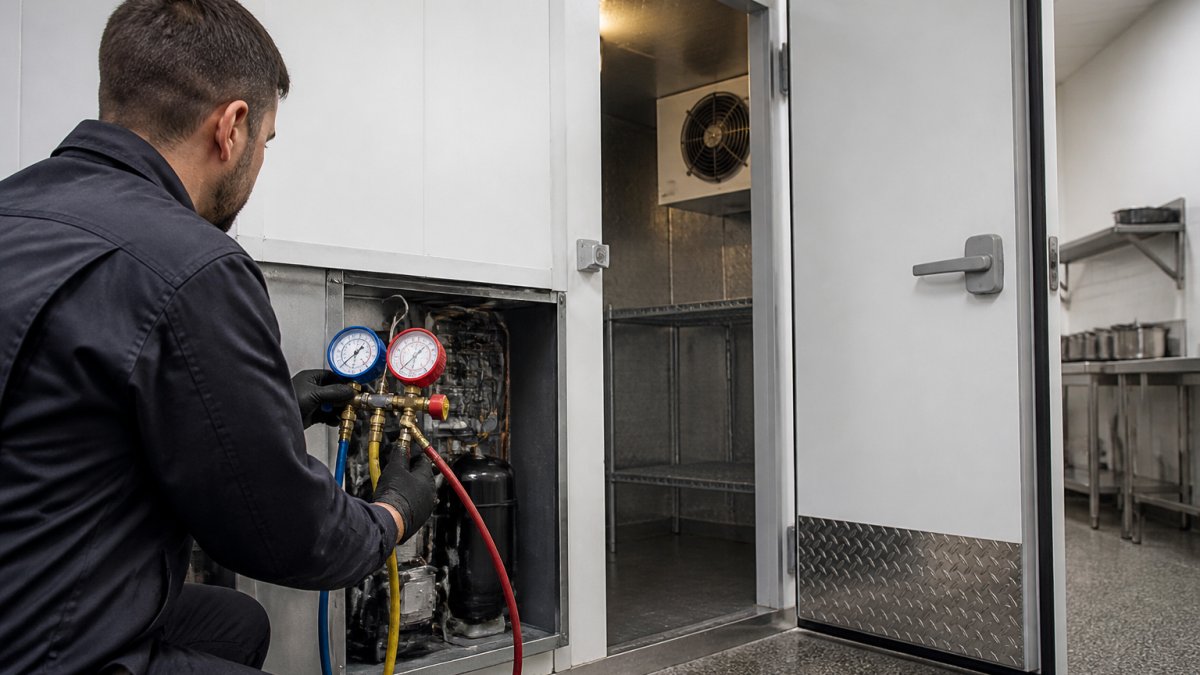
A technician will use electronic leak detection equipment to locate the problem. Common leak locations include solder joints, valve connections, and shaft seals.
Repair, Retrofit, or Replace: A Decision Framework for Your Freezer
Age alone is a poor decision variable. A 12-year-old freezer with a clean service history and compatible refrigerant can be a good retrofit candidate, while a 7-year-old unit with two compressor replacements should probably be replaced. The framework below weighs refrigerant compatibility, remaining useful life, total cost of ownership, and the risk of unplanned failure during a supply-constrained period.
Step 1: Identify what is actually in the system
Before any decision, confirm the refrigerant on the nameplate and in the service log. Common freezer refrigerants and their phase-down status:
| Refrigerant | Typical use | Phase-down status | Notes |
|---|---|---|---|
| R-404A | Low- and medium-temp commercial freezers | High GWP, supply tightening | Most common retrofit candidate |
| R-507 | Low-temp freezers | High GWP, supply tightening | Chemically similar to R-404A |
| R-22 | Older freezers | Phased out earlier under the Montreal Protocol | Reclaimed supply only; expensive |
| R-448A / R-449A | R-404A replacement | Lower GWP | Often marketed as near-drop-in |
| R-290 (propane) | Small self-contained units | Low GWP | Flammable; charge-size limits apply |
| R-454A / R-454C | Low-temp alternatives | Lower GWP | May require component changes |
If the nameplate is illegible or missing, a technician can identify the refrigerant by pressure-temperature behavior and oil type. Don't guess, the wrong refrigerant causes compressor failure.
Step 2: Assess retrofit feasibility, not just refrigerant availability
A "drop-in" replacement is rarely truly drop-in on a freezer. Feasibility depends on:
- Compressor. Some lower-GWP blends run at different pressures and mass flows than R-404A. A compressor rated for R-404A may not be approved by its manufacturer for a substitute. Check the compressor OEM's approved refrigerant list before committing.
- Lubricant. R-404A systems typically use POE oil, generally compatible with many HFC replacements, but mineral-oil systems (common with R-22) require a full oil change and possibly a flush.
- Expansion device. A thermostatic expansion valve sized for R-404A may not meter a substitute correctly. Many retrofits require a new TXV or an adjustable valve.
Step 3: Run the lifecycle math
Compare three numbers over a five-year horizon:
- Repair path: current refrigerant cost per pound × expected annual loss + repair labor + rising refrigerant price trend.
- Retrofit path: one-time retrofit cost (evacuation, flush, TXV, seals, oil, new charge, labor) + lower ongoing refrigerant cost + any efficiency change.
- Replace path: equipment purchase + installation + disposal/recovery of old charge + expected energy savings from a newer, more efficient unit.
A common pattern: a retrofit on a 10-12 year old freezer pencils out when the unit has no compressor history and the quote is well under half the cost of a comparable new box. Once repair history includes a compressor replacement, replacement usually wins because the remaining life is too short to amortize the retrofit.
Step 4: Weight the risk of doing nothing
During a supply-constrained period, the cost of an unplanned failure isn't just the repair, it's:
- Emergency labor rates at nights and weekends.
- Refrigerant sourced at spot prices when your normal supplier is out of stock.
- Product loss if the box is down long enough to break the cold chain.
For a walk-in freezer holding high-value inventory, that risk alone can justify replacing a marginal unit before it fails rather than nursing it through another season.
A quick decision matrix
| Situation | Recommended path |
|---|---|
| Under 8 years old, clean history, refrigerant still available | Repair and maintain |
| 8-12 years old, no compressor history, OEM-approved substitute exists | Retrofit |
| 8-12 years old, compressor replaced once, refrigerant scarce | Replace |
| Over 12 years old, any major repair needed | Replace |
| Any age, refrigerant unavailable at any reasonable price | Retrofit or replace |
| Self-contained unit under charge limit, R-290 approved | Consider R-290 replacement |
What to ask your service provider
- Which refrigerants are approved by the compressor OEM for my model?
- What is the total installed cost of the retrofit versus a comparable new unit?
- What efficiency change should I expect after retrofit?
EPA regulatory framework for HFC management and reclamation
EPA Section 608 Certification: Why Your Technician Must Be Qualified
Any technician who handles refrigerants must hold EPA Section 608 certification. This is not optional, it's federal law.
Why it matters for you: An uncertified technician puts your business at risk. They may cause leaks, violate EPA regulations, or damage equipment.
When you call for service, ask for proof of certification. A legitimate repair company will provide it without hesitation.
Certification is also a sign of professionalism.
Preparing Your Business for Refrigerant Transition
Here's how to prepare now:
Step 1: Get a professional assessment. Have a certified technician evaluate your freezer and ask specifically about refrigerant phase-down risks and low-GWP compatibility.
Step 3: Plan your timeline. Decide whether you'll repair, retrofit, or replace, and when, don't wait until equipment fails.
Step 4: Budget for rising costs. If you're staying with current refrigerant, expect higher recharge costs each year.
Step 5: Schedule preventive maintenance. Regular service catches problems early and extends equipment life, your best defense against emergency failures and expensive surprises.
Home Tech offers same-day and next-day service for commercial refrigeration emergencies.
The refrigerant phase-down is reshaping commercial refrigeration maintenance.
Frequently Asked Questions
How does the refrigerant phase-down affect commercial freezer maintenance?
The phase-down requires businesses to transition from high-GWP HFC refrigerants to low-GWP alternatives, which changes service procedures, parts availability, and equipment compatibility. Existing freezers can continue operating with their current refrigerant through 2030, but preventive maintenance becomes critical to avoid leaks that trigger mandatory recovery and replacement. Technicians must follow EPA Section 608 protocols for all servicing work, and maintenance schedules may need adjustment based on your refrigerant type and equipment age.
Which refrigerants are being phased down in commercial refrigeration?
HFCs (hydrofluorocarbons) like R-404A, R-507, and R-407A are being phased down under EPA regulations due to their high global warming potential. Production and import limits began in 2022 and continue through 2030. Low-GWP alternatives include R-449A, R-448A, R-452A, and R-513A for existing equipment retrofits, plus newer HFO and HFO-blended options for new installations. Your equipment's refrigerant type determines whether retrofit is an option or replacement is necessary.
Can a commercial freezer still be serviced if its refrigerant is being phased down?
Yes. The EPA allows servicing of existing equipment with phased-down refrigerants through 2030. However, supply constraints and rising prices make preventive maintenance essential. Any leaks must be documented and the refrigerant recovered by an EPA 608-certified technician. If repairs exceed 25% of replacement cost or your equipment is near end-of-life, replacement with a low-GWP system becomes the practical choice. Delaying decisions increases risk of emergency downtime.
What maintenance practices help reduce refrigerant leaks in commercial freezers?
Implement quarterly leak inspections using EPA-approved detection methods, check all connection points and seals monthly, maintain proper system charge and pressure levels, and keep condenser coils clean to reduce strain on seals. Document all service visits and refrigerant top-ups. Install vibration isolation mounts to reduce mechanical stress on components. Train staff to recognize signs of leaks: unusual noise, reduced cooling, or ice buildup. Early detection prevents catastrophic leaks and keeps your equipment operational during the supply-constrained transition period.