 how-to
Is a Refrigerator Refrigerant Leak Dangerous to Health?
Last Updated: November 1, 2026
Quick Summary
Yes, a refrigerant leak can be dangerous to health, but the real risk depends on how much refrigerant escapes and how small the space is. A refrigerant leak in a normal kitchen rarely reaches harmful levels, though in a tight, closed room the gas can push oxygen down and cause headache, dizziness, or worse.
- Most modern refrigerants have no smell at all, so a sweetish or chemical odor may be the lubricating oil.
- The main danger is oxygen displacement because the gas is heavier than air and pools low.
- If you do not know the refrigerant, assume it could be flammable and do not unplug the fridge.
- A basement or utility-room fridge is the highest-risk placement because gas pools low and airflow is poor.
- Sealed-system work requires EPA Section 608 certification, so call a pro for any suspected leak.
Table of Contents
- Is a Refrigerator Refrigerant Leak Dangerous to Health?
- Refrigerant Leak Symptoms: What You Might Notice
- Refrigerant Poisoning Symptoms and Health Effects
- What to Do If Your Refrigerator Is Leaking Freon
- How Long Does Refrigerant Stay in the Air?
- Leak Size, Room Size, and Your Real Exposure Risk
- Food Safety After a Suspected Refrigerant Leak
- When to Call a Professional for Refrigerant Repair
- Frequently Asked Questions
Is a Refrigerator Refrigerant Leak Dangerous to Health?
Yes, a refrigerant leak can be dangerous to health, but the real risk depends on how much refrigerant escapes and how small the space is. A refrigerator refrigerant leak in a normal kitchen rarely reaches harmful levels. In a tight, closed room, though, the gas can push oxygen down and cause headache, dizziness, or worse.
Below, we explain what a leak does to your body, what to do in the first five minutes, and when to call a pro.
How Refrigerators Use Refrigerant and Why Leaks Happen
Refrigerant is the fluid inside a sealed loop that absorbs heat from the fridge and dumps it outside. It cycles between liquid and gas, and it never gets used up. If the charge drops, it escaped somewhere.
So why do leaks happen? The usual suspects:
- Vibration cracks at joints and welds after years of the compressor kicking on
- Corroded coils on older units, especially in humid rooms
- Factory defects or damage from moving the fridge
- Compressor seal failures, which are common on aging units
Watch out: a slow leak can run for months before you notice weak cooling. By then, the compressor may be running nonstop and overheating.
EPA refrigerant management requirements
Refrigerant Leak Symptoms: What You Might Notice
The first sign is usually not a health symptom. It is a fridge that stops cooling well. Then come the physical clues.
Look for these refrigerant leak symptoms:
- The fridge or freezer feels warm, but the motor runs constantly
- Frost or ice buildup in odd spots, or none at all
- A faint chemical or sweetish smell near the back or bottom
- Hissing or bubbling sounds at the rear
- Oily residue or corrosion on coils and lines
- Headache or nausea that fades when you leave the kitchen
One important note: most modern refrigerants have no smell at all. If you smell something, it may be the lubricating oil, not the gas itself.
Refrigerant Poisoning Symptoms and Health Effects
Refrigerant poisoning happens when you breathe in enough gas to affect your body. The main danger is oxygen displacement: the gas is heavier than air, so it pools low and pushes breathable air out of the way.
Refrigerant poisoning symptoms to watch for:
- Headache and lightheadedness
- Nausea or stomach upset
- Dizziness and trouble concentrating
- Shortness of breath or a tight chest
- Eye, nose, and throat irritation
- Skin irritation or frostbite if liquid touches skin
At very high concentrations, exposure can cause irregular heartbeat, confusion, or loss of consciousness. That is rare in a home kitchen, but it is why you never ignore a strong smell or a hissing line.
Watch out: symptoms can mimic a cold, a migraine, or food poisoning. If several people in the home feel off at the same time, suspect the fridge.
What to Do If Your Refrigerator Is Leaking Freon
If you think your fridge is leaking Freon, act in this order. Do not wait to confirm it.
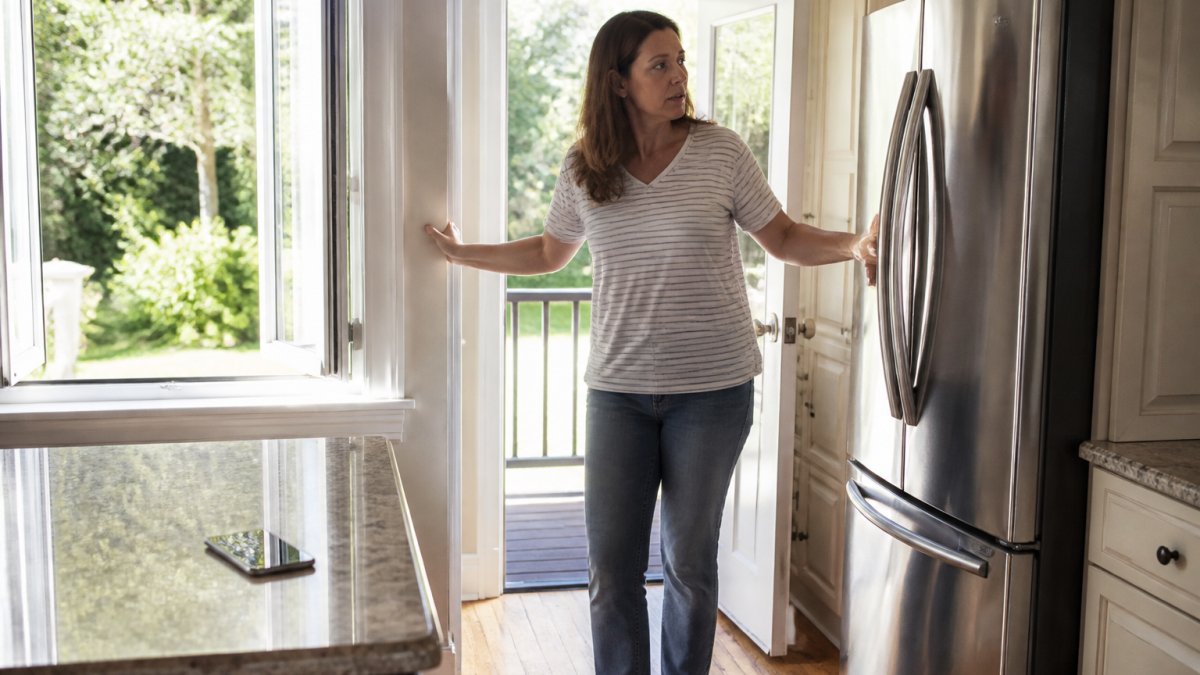
Step 1: Get people out first. Move children, pets, and anyone with asthma, COPD, or heart conditions out of the kitchen and into fresh air. Do not stop to gather belongings or finish cooking.
Step 2: Ventilate only when it is safe to reach the windows. Open windows and doors to create cross-flow.
Step 3: Treat ignition sources differently by refrigerant type. This is where most guides give unsafe blanket advice.
- If you do not know the refrigerant: assume it could be flammable. Do not flip light switches, unplug the fridge, or use a phone inside the room. Leave the breaker alone and call from another room.
- If the unit uses R600a (isobutane) or R290 (propane): these are flammable hydrocarbons (the EPA). A spark from a switch, plug, or vacuum can ignite a concentrated pocket of gas. Do not unplug the fridge, do not run a fan, and do not use any device that could arc.
- If the unit uses R134a, R410A, or R454B: these are not classified as flammable under normal household conditions, but they can still displace oxygen. Unplugging the fridge is generally safe if the smell is mild and you can reach the cord without entering a gas pocket.
Step 4: Call for help based on symptoms, not smell.
- No symptoms, faint odor, fridge still cooling: ventilate, leave the area, and schedule a technician visit. This is not an emergency.
- Headache, dizziness, nausea, or eye/throat irritation that improves in fresh air: call your healthcare provider or a poison control center for guidance. Do not drive yourself if you feel lightheaded.
- Chest pain, trouble breathing, confusion, fainting, or a person who cannot be woken: call 911. Tell the dispatcher you suspect refrigerant exposure and give the refrigerant type if you know it.
Step 5: Do not attempt repairs. Puncturing a line or loosening a fitting can release the remaining charge into the room and turn a slow leak into a fast one.
If the leak is active and you need help fast, our team handles emergency refrigerator repair in Chandler to stop food spoilage and limit exposure.
How Long Does Refrigerant Stay in the Air?
Refrigerant gas dissipates faster in a well-ventilated room than in a closed one. In a closed space with no airflow, it can linger much longer because it is heavier than air and settles near the floor.
How long does refrigerant stay in the air depends on three things:
- Ventilation: open windows and doors clear it fast
- Leak rate: a fast leak keeps feeding the room
- Room size and airflow: a small, sealed room traps it
Here is the practical takeaway. Open the windows, leave the room, and let the space air out before you go back in. Do not rely on a fan alone to fix it.
Leak Size, Room Size, and Your Real Exposure Risk
A refrigerator holds a small charge of refrigerant compared with a central AC system. That is the good news. The bad news is that room size and refrigerant type change everything, and most guides treat all refrigerants as if they behave the same way.
Start with the charge. Refrigerator refrigerant charges are small compared with those in central air conditioners. A full release of a refrigerator charge into a normal kitchen is a small event in absolute terms. The risk comes from concentration, not total volume.
Then do the room math. Oxygen displacement is about concentration. Picture a tiny galley kitchen with the door shut and no airflow.
Here is how we think about the risk:
- Large, open kitchen with airflow: low risk from a slow leak
- Small, closed room: higher risk, especially overnight while people sleep
- Basement or utility room fridge: highest risk, since gas pools low and airflow is poor
- Flammable refrigerants (R600a, R290): added fire risk if a spark is nearby, independent of oxygen displacement
Refrigerant type matters more than most articles admit. Older refrigerants such as R134a and R22 are not classified as flammable under normal household conditions, but they can still displace oxygen in a sealed space.
This is the angle most guides skip. If you do not know which refrigerant your fridge uses, check the nameplate inside the refrigerator compartment or on the back of the unit before you decide how cautious to be.
Food Safety After a Suspected Refrigerant Leak
Refrigerant gas does not contaminate food the way bacteria does. The bigger issue is temperature. Once the fridge stops cooling, food starts to spoil.
Use this checklist:
- Check the fridge and freezer temperature with a thermometer
- Discard meat, dairy, and cooked leftovers that sat warm for hours
- Keep sealed, unopened items only if the fridge stayed cold
- Throw out anything with an odd smell or texture
- Wash and sanitize shelves and drawers before restocking
- Do not taste food to "check" it
Watch out: a fridge that is cooling again is not proof the food is safe. Temperature is the test, not the motor.
When to Call a Professional for Refrigerant Repair
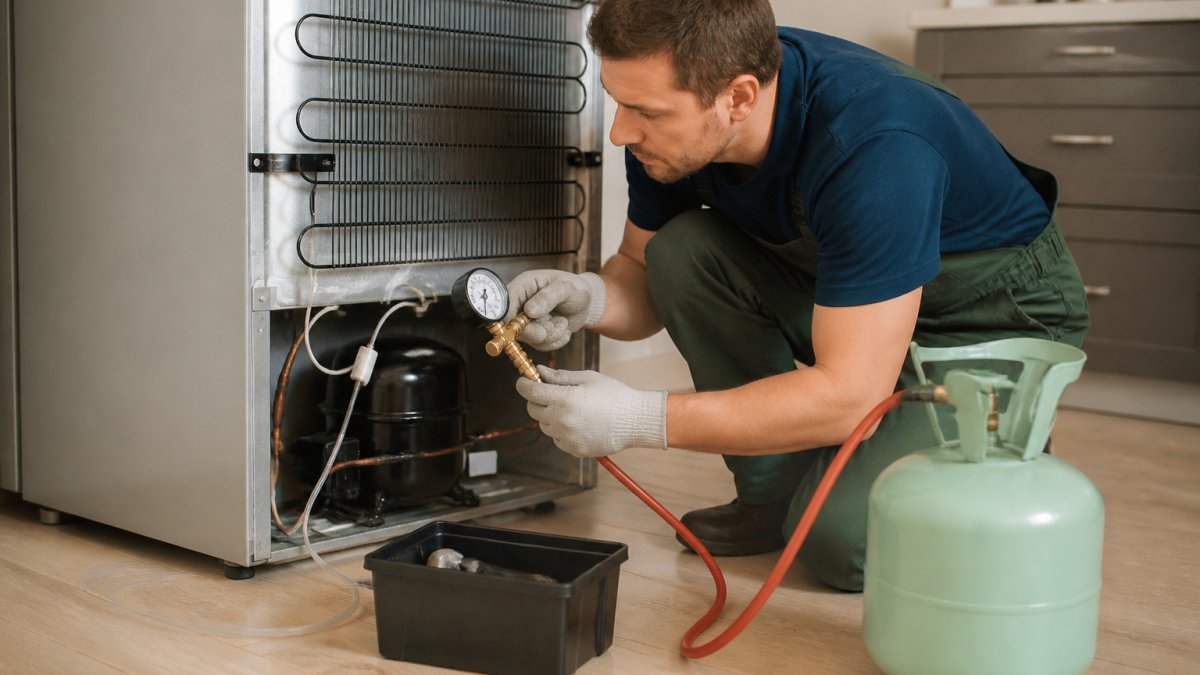
Call a pro for any confirmed or suspected refrigerant leak. This is not a DIY fix. Sealed-system work requires EPA Section 608 certification, and handling refrigerant without it is both unsafe and against the rules.
EPA Section 608 technician certification
Our EPA 608-certified technicians can handle sealed-system refrigerant work. We also handle refrigerator compressor repair when the leak traces back to a failing compressor.
If you are ready to book, you can request refrigerator repair or browse our refrigerator repair service. And if you are nearby, we also offer professional refrigerator repair in Glendale.
| Situation | Action | Who Handles It |
|---|---|---|
| Faint smell, fridge still cold | Ventilate, monitor, schedule a visit | Technician |
| Fridge warm, hissing at rear | Leave area, ventilate, call for repair | Technician |
| Strong odor, dizziness, chest tightness | Evacuate, call emergency services | Emergency services |
| Food sat warm for hours | Check temps, discard unsafe items | You |
| Leak confirmed on coils or lines | Sealed-system repair and recharge | EPA 608 technician |
A refrigerant leak is one problem you should not sit on. The gas can affect your health, and a slow leak quietly damages the compressor until the whole unit fails. At Home Tech, we are family-owned, EPA 608-certified, and we offer same-day and next-day appointments with no hidden fees and a 100% satisfaction guarantee. We repair all major brands, including Samsung Bespoke and LG systems.
Frequently Asked Questions
Is leaking Freon a health hazard?
Yes, in certain conditions. Modern refrigerants are generally low in toxicity, but they displace oxygen in enclosed spaces. A small, slow leak in a well-ventilated kitchen is unlikely to cause serious harm. A larger leak in a small, sealed room can cause dizziness, headaches, nausea, and breathing difficulty. High concentrations also create frostbite risk from cold gas and, with some refrigerant types, flammability concerns. Treat any suspected refrigerant leak as a reason to ventilate the area and call an EPA 608-certified technician.
How can you tell if your refrigerator is leaking refrigerant?
Common refrigerator refrigerant leak symptoms include the fridge not cooling properly while the compressor runs constantly, frost buildup in unusual places, a faint chemical or sweetish smell near the unit, and hissing or bubbling sounds. You may also notice oily residue on coils or tubing. Because refrigerant is colorless, a qualified technician uses leak detection tools to confirm the source before any repair. Do not attempt to add refrigerant yourself; sealed-system work requires EPA 608 certification.
How long does it take for Freon poisoning to go away?
For mild exposure, symptoms like headache and dizziness often ease within hours once you move to fresh air. Recovery depends on concentration, exposure duration, and your general health. If symptoms persist, worsen, or include chest pain or difficulty breathing, seek medical attention promptly. A doctor can assess whether oxygen therapy or further monitoring is needed. Never assume symptoms will pass if you were exposed in an enclosed space.
Can a refrigerator refrigerant leak cause a fire or explosion?
Some refrigerants, including R600a (isobutane) and R290 (propane), are flammable. They are used in small charges in many modern fridges, but a leak near an ignition source in a poorly ventilated space can create a fire risk. Older refrigerants like R12 and R22 are not flammable but carry other hazards. If you smell gas or suspect a leak from a flammable-refrigerant appliance, ventilate the area, avoid switches and flames, and call for professional help.