 how-to
HVAC Refrigerant Recharge: What It Is and When You Need It
Table of Contents
- What Is an HVAC Refrigerant Recharge?
- Signs Your AC Needs Refrigerant
- Why Refrigerant Levels Drop: The Leak Problem
- How to Find an AC Refrigerant Leak
- Is Refrigerant Recharge a DIY Project?
- Cost of AC Refrigerant Recharge and Timeline
- Refrigerant Types and EPA Regulations
- What to Do After Your AC Recharge
- Frequently Asked Questions
Last Updated: August 21, 2026
What Is an HVAC Refrigerant Recharge?
An HVAC refrigerant recharge is the process of adding refrigerant to your air conditioning system to restore its cooling capacity. Refrigerant is the chemical compound that circulates through your AC system, absorbing heat from inside your home and releasing it outside. When refrigerant levels drop below the manufacturer's specification, your system loses cooling power, and a recharge restores it.
Here's the critical distinction most homeowners miss: a recharge is a symptom treatment, not a cure. If your refrigerant is low, something is wrong. In a properly sealed HVAC system, refrigerant should never need topping off. The fact that you need one means your system is leaking.
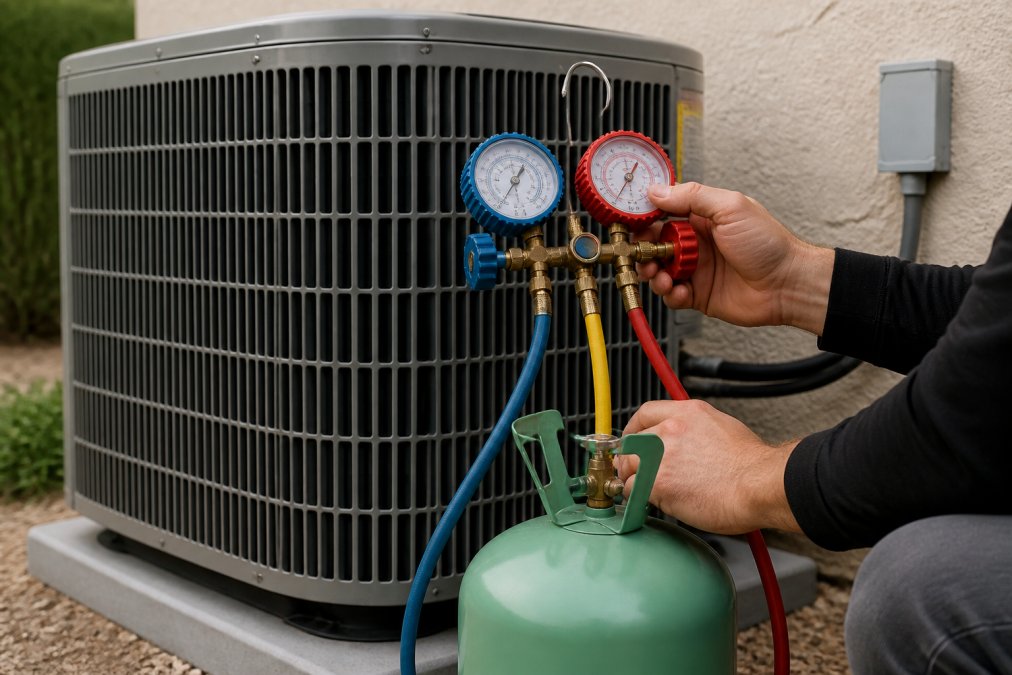
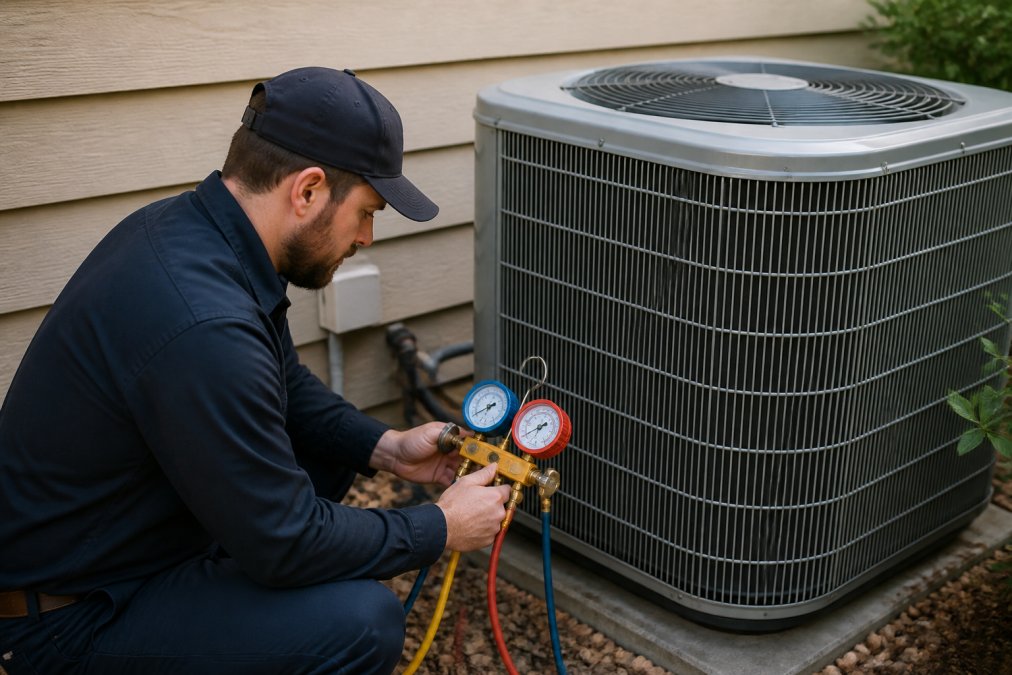
The recharge process involves connecting manifold gauges to the low-pressure and high-pressure sides of your AC system, measuring current refrigerant levels, and adding the correct type and amount of refrigerant to bring the system back to factory specifications. At Home Tech, our EPA 608-certified technicians don't just add refrigerant and send you on your way. We diagnose why the level dropped in the first place, because addressing the root cause prevents you from calling us again in three weeks.
Signs Your AC Needs Refrigerant
Your air conditioning system sends clear signals when refrigerant levels are low. Recognizing these signs early prevents your home from becoming unbearably hot and saves you from compressor damage, which is far more expensive to repair than a simple recharge.
Weak or warm air output is the most obvious symptom. If your AC is running but the air coming from your vents feels lukewarm instead of cold, low refrigerant is a leading suspect. The evaporator coil can't absorb enough heat from the indoor air without adequate refrigerant.
Hissing sounds near your outdoor condenser unit or indoor air handler often indicate a refrigerant leak. A small leak creates a distinctive hissing noise as pressurized refrigerant escapes.
Ice buildup on refrigerant lines or the evaporator coil is another red flag. Low refrigerant causes the evaporator coil temperature to drop below freezing, and moisture in the system condenses and freezes on the coil, restricting airflow.
Higher than normal electricity bills without a change in your thermostat settings can signal that your compressor is working overtime to compensate for low refrigerant. The system runs longer and harder to achieve the temperature you've set.
The air conditioner cycles on and off frequently (short-cycling) when refrigerant is low. Your compressor starts, runs briefly, and shuts off without reaching the thermostat setpoint, stressing the compressor.
Why Refrigerant Levels Drop: The Leak Problem
Refrigerant doesn't evaporate or get "used up" like gasoline in a car. Your HVAC system is a closed-loop system, meaning the same refrigerant circulates indefinitely without being consumed. If your refrigerant level is dropping, your system is leaking.
This is the fundamental principle that separates a temporary fix from a permanent solution. A car engine consumes coolant because it's an open system. Your AC is sealed. Refrigerant loss always means a breach in the system.
Leaks occur at connection points where refrigerant lines join the compressor, condenser, or evaporator coil. Vibration and thermal cycling gradually loosen these connections over years. Corrosion inside copper refrigerant lines is another culprit, moisture that enters the system during installation or repair reacts with refrigerant to form acids that eat through the copper tubing. Physical damage to refrigerant lines from branches, landscaping equipment, or weather also causes leaks. The thermal expansion valve, condenser coils, and compressor seals can all develop leaks from manufacturing defects, mechanical stress, or corrosion.
:::pro-tip If you've had a recharge and symptoms return within weeks, the leak is still there. Don't keep paying for repeated recharges. Invest in leak detection to find and repair the source. Home Tech uses both UV dye methods and electronic leak detectors to pinpoint even tiny leaks. :::
How to Find an AC Refrigerant Leak
Finding a refrigerant leak requires specialized equipment and training. This is not a DIY task. Refrigerant is pressurized, and improper handling creates safety hazards.
Visual inspection is the first step. A technician examines all visible refrigerant lines, connections, and components for obvious damage, corrosion, or oil residue. An oily film around a connection point signals a leak. Frost or ice buildup on lines also indicates the leak location.
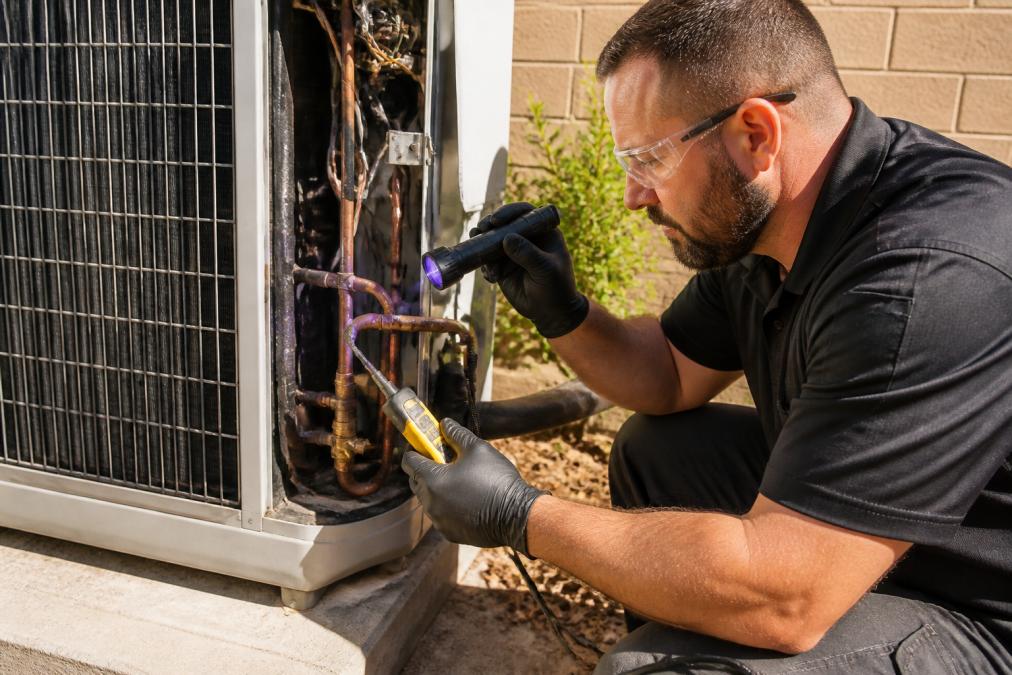
UV dye detection involves adding a fluorescent dye to the refrigerant, then running the system for 15-30 minutes to circulate the dye throughout. The technician uses a UV flashlight to inspect all components. The dye glows bright under UV light, making even pinhole leaks visible.
Electronic leak detectors are the most sensitive method. These handheld devices detect the presence of refrigerant vapor in the air. The technician moves the probe slowly around all connections, lines, and components. Electronic detectors can find leaks as small as 0.5 ounces per year (the EPA).
Nitrogen pressure testing is used when no leak is immediately obvious. The technician pressurizes the system with inert nitrogen gas. If pressure drops overnight, a leak exists, and electronic detection or dye locates it.
The location of the leak determines repair options. Small leaks at connection points can be fixed by tightening or replacing the connection. Leaks in refrigerant lines require soldering or line replacement. Leaks in the compressor or evaporator coil typically mean the component must be replaced, which is expensive.
Is Refrigerant Recharge a DIY Project?
No. Refrigerant recharge is not a DIY project, and attempting it creates legal, safety, and technical problems.
The legal barrier is absolute. The Environmental Protection Agency (EPA) regulates refrigerant handling under the Clean Air Act. Only certified technicians, those holding EPA Section 608 certification, are legally permitted to handle, recover, recycle, or dispose of refrigerant (the EPA). Homeowners cannot legally purchase refrigerant or perform recharge work themselves.
Safety hazards are serious. Refrigerant is pressurized and can cause frostbite or chemical burns if it contacts skin. Incorrect handling can rupture lines or damage the compressor. Overfilling the system can cause liquid refrigerant to enter the compressor, requiring a replacement.
Technical barriers are real. Determining the correct refrigerant type for your system is critical. Older systems use R-22, some use R-12 (banned), and newer systems use R-410A, R-32, R-407A, or R-454B. Mixing refrigerant types ruins the system. Interpreting manifold gauge readings requires understanding your system's design, ambient temperature, and the relationship between pressure and refrigerant charge level.
A professional recharge costs significantly less than a compressor replacement. Home Tech technicians have the right tools, training, and legal authority to do the job correctly.
Cost of AC Refrigerant Recharge and Timeline
The cost of an AC recharge depends on your system's refrigerant type, the amount needed, your location, and whether leak detection is required. Contact Home Tech directly for a quote specific to your system. When you call, provide your AC system's model number (found on the outdoor condenser unit) so the technician can prepare the correct refrigerant type.
How Long Does an AC Recharge Take?
A straightforward AC recharge typically takes 1-2 hours from arrival to completion. The technician connects manifold gauges, measures current pressure, calculates the amount of refrigerant needed, and adds it slowly while monitoring pressure readings.
If leak detection is required, add 30-60 minutes. UV dye detection requires the system to run for 15-30 minutes after dye is added, then another 15-30 minutes for inspection. Electronic detection is faster, 15-30 minutes typically.
If a leak is found and requires repair, the timeline extends. A simple connection tightening adds 15 minutes. Soldering a refrigerant line adds 45 minutes to an hour. Replacing an evaporator coil or compressor turns the job into a half-day or full-day project.
Home Tech prioritizes same-day and next-day appointments. Emergency calls are handled with priority dispatch.
Refrigerant Types and EPA Regulations
Your AC system uses one of several refrigerant types, each with different properties and regulatory status. Mixing types damages your system, and using a banned refrigerant is illegal.
R-22 (Chlorodifluoromethane) was the standard refrigerant for decades. The EPA began phasing out R-22 in 2010 because it damages the ozone layer (the EPA). Production ended in 2020, though existing supplies can still be used. If your system is older than 15 years, it likely uses R-22. Recharging is legal, but supplies are limited and pricing is higher.
R-410A (Difluoromethane and Pentafluoroethane blend) became the standard replacement for R-22 starting in the mid-2000s. It has zero ozone depletion potential and is approved indefinitely. Most AC systems installed in the last 15-20 years use R-410A.
R-32 is a newer refrigerant gaining adoption in residential systems. It has lower global warming potential than R-410A and better energy efficiency.
R-454B is a low-GWP refrigerant used in high-efficiency systems and some commercial applications.
R-404A and R-407A are used in commercial refrigeration and industrial AC systems, not common in residential applications.
The EPA requires that technicians handling refrigerant be certified and that recovered refrigerant be recycled or disposed of properly, not vented into the atmosphere. When your system needs a recharge, the technician verifies your refrigerant type from the nameplate on your AC unit. Adding the wrong type requires a complete system flush and recharge, a costly repair.
What to Do After Your AC Recharge
After your system is recharged and cooling properly, address the underlying cause. If a leak was found and repaired, your system should remain stable. If no leak was found but refrigerant was low, a leak still exists, it's just small enough that detection equipment didn't find it immediately. Monitor your system closely for recurring symptoms.
Schedule preventative maintenance. Most HVAC professionals recommend annual AC maintenance before the cooling season begins. During a maintenance visit, the technician inspects refrigerant pressure, checks for leaks, cleans the condenser coil, verifies thermostat operation, and ensures all electrical connections are secure.
Keep your condenser unit clear. The outdoor condenser releases heat from your refrigerant. If surrounded by vegetation, debris, or blocked by fencing, airflow is restricted and efficiency drops. Maintain at least 2-3 feet of clear space around all sides.
Don't ignore warning signs. If you notice weak cooling, hissing sounds, or ice buildup again within weeks of a recharge, call immediately. Recurring symptoms mean the leak wasn't fully repaired or a new leak has developed.
Verify the work. Ask your technician to explain what they found, what they repaired, and what refrigerant type and amount they added. A good technician provides documentation of the work performed.
Home Tech provides a 100% satisfaction guarantee on every repair. If your AC doesn't cool properly after our service, we return at no additional charge to diagnose and fix the problem. We also stand behind our leak repairs, if a leak we fixed reappears within the warranty period, we address it again.
An AC system that won't cool is more than an inconvenience, it's a health and safety concern during hot months and a financial threat if you operate a temperature-sensitive business. A refrigerant recharge restores cooling quickly, but it's always a signal that something is wrong. Finding and fixing the leak is the only permanent solution. Home Tech's EPA 608-certified technicians diagnose the root cause, perform the recharge correctly, and repair leaks to keep your system running reliably. Call (602) 486-1901 or visit hometechappliancerepair.com to schedule same-day or next-day service in the Phoenix metro area.
Frequently Asked Questions
How much does an AC refrigerant recharge usually cost?
The cost of an AC refrigerant recharge varies based on your system's size, refrigerant type, and whether a leak repair is needed. Pricing depends on the specific conditions of your HVAC system and local service rates. Contact Home Tech for a quote, we provide transparent pricing with no hidden fees and can give you an estimate after inspecting your unit.
How can I tell if my home AC needs a refrigerant recharge?
Common signs include warm air blowing from vents, longer cooling times, hissing or bubbling sounds from the unit, and ice buildup on the evaporator coil. Your thermostat may show the system running but not reaching your set temperature. A professional HVAC technician can confirm low refrigerant levels using a manifold gauge and check for leaks before recommending a recharge.
Is recharging my AC the same as adding Freon?
Freon is a brand name for R-12 refrigerant, which was phased out decades ago due to EPA regulations. Modern systems use R-410A, R-407A, or other approved refrigerants. When a technician recharges your AC, they're adding the correct refrigerant type for your specific HVAC system, not necessarily Freon. Using the wrong refrigerant can damage your compressor and void warranties.
Can I recharge my home AC unit myself?
No. EPA regulations require anyone handling refrigerant to hold EPA 608 certification. DIY recharge kits are available online but are illegal to use without certification and can cause serious harm, improper charging damages the compressor, creates safety hazards, and violates federal law. Professional technicians have the tools and training to charge your system correctly and identify the underlying leak causing low refrigerant.