 how-to
How to Tell If Your Refrigerator Compressor Is Failing
Table of Contents
- Common Signs Your Refrigerator Compressor Is Failing
- Signs of a Bad Refrigerator Start Relay
- How to Test Your Refrigerator Compressor With a Multimeter
- Repair vs. Replace: Understanding Refrigerator Compressor Replacement Cost
- Preventative Maintenance to Extend Compressor Life
- When to Call a Professional vs. DIY Diagnostics
- Frequently Asked Questions
Last Updated: September 30, 2026
Common Signs Your Refrigerator Compressor Is Failing
Your refrigerator compressor is the heart of your cooling system. When it fails, food spoils, energy bills spike, and repairs become expensive. Learning the signs of a refrigerator compressor failing helps you catch problems early. This guide covers common symptoms, how to test your compressor, and when to call a professional.
Temperature Fluctuations and Food Spoilage
Your fridge should hold a steady 37-40°F. When the compressor fails, temperatures swing wildly. Food spoils faster, milk goes bad in days instead of weeks, vegetables wilt, and meat develops an off smell.
Check temperature with a thermometer on a shelf after a few hours. If readings jump around or stay above 40°F, your compressor may be struggling. Uneven ice buildup in the freezer is another sign, thick ice on one wall but bare spots elsewhere indicates inconsistent cooling.
Unusual Compressor Sounds and Vibration
A healthy compressor hums quietly. A failing compressor makes distinct noises: rattling (housing vibrating), clicking (relay struggling), loud humming (insufficient pressure), or grinding/squealing (worn bearings). Feel the back of your fridge, it should vibrate smoothly. Excessive vibration signals mechanical problems.
The Compressor Runs Continuously
A normal compressor cycles on and off throughout the day. When the refrigerator compressor is failing, it runs almost constantly because it can't reach the target temperature. This continuous running burns extra electricity and overheats the compressor. If it's running more than 80% of the time, something's wrong.
Signs of a Bad Refrigerator Start Relay
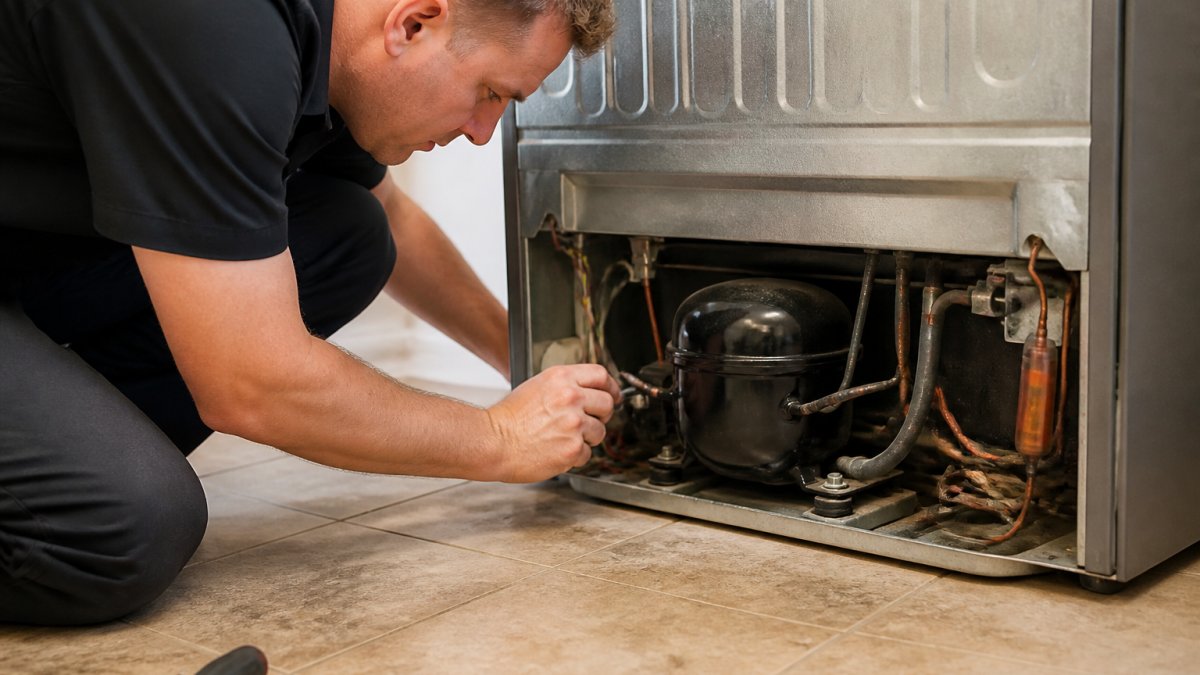
The start relay helps the compressor motor start. A bad relay prevents the compressor from starting, causing humming without engagement, clicking sounds, or intermittent cooling. The relay sits near the compressor at the back, a small device about lighter-sized. If it's burnt or smells like burned plastic, it's failed. Relays are cheaper to replace than compressors, so early diagnosis saves money.
How to Test Your Refrigerator Compressor With a Multimeter
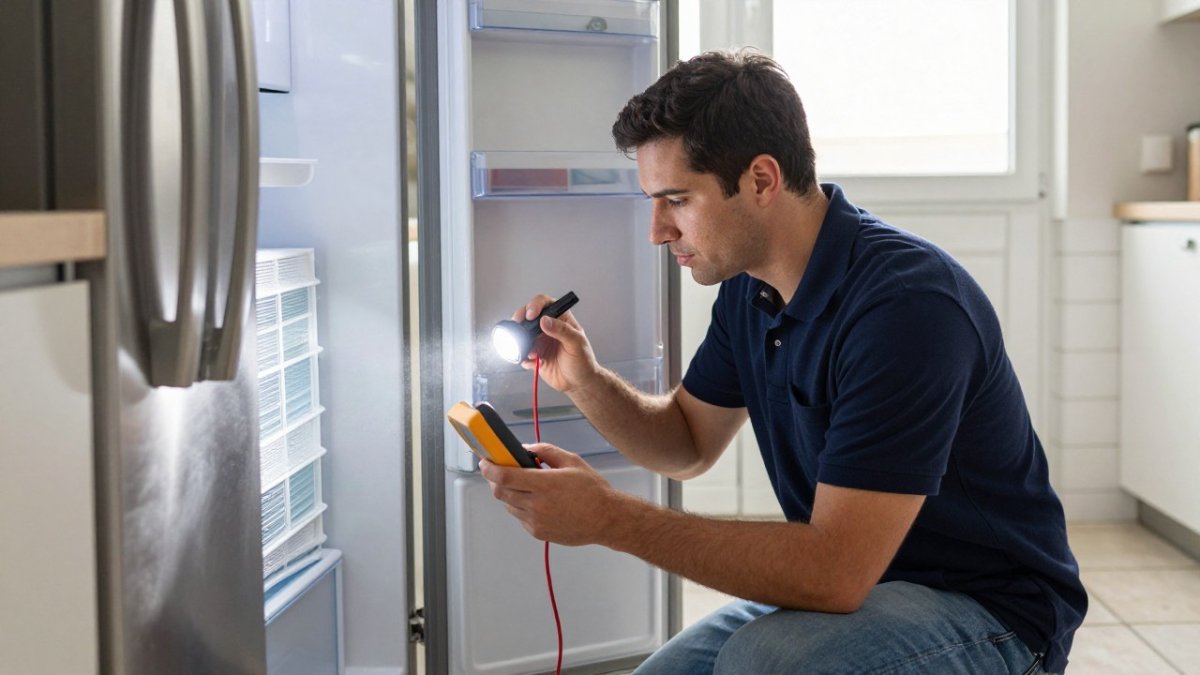
Testing the refrigerator compressor with multimeter requires basic electrical knowledge. If you're not comfortable working with electrical components, skip this section and call a professional.
Step-by-Step Electrical Testing
Step 1: Unplug the refrigerator to prevent shock. Step 2: Locate the compressor at the back or bottom, a large cylindrical metal housing. Step 3: Find the three terminals (common, run, start) labeled on the housing or color-coded.
Step 4: Set your multimeter to resistance mode (ohms). Step 5: Test common-to-run (normal: 2-10 ohms). Step 6: Test common-to-start (normal: 5-20 ohms). Step 7: Test run-to-start (should equal the sum of steps 5 and 6; if not, windings are damaged).
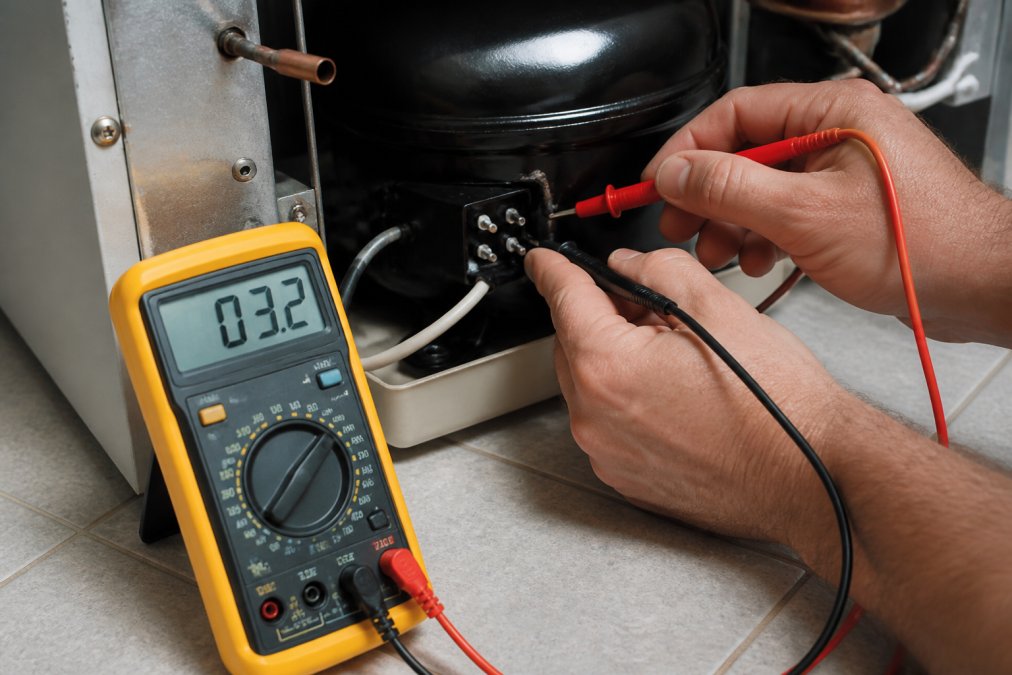
What Normal Readings Look Like
Healthy compressors show consistent readings. Infinite resistance means broken windings (must replace). Erratic readings indicate internal damage (will fail soon). Zero resistance suggests a dangerous short circuit (call a professional immediately).
Repair vs. Replace: Understanding Refrigerator Compressor Replacement Cost
The decision to repair or replace your refrigerator hinges on a straightforward financial calculation: repair cost plus expected remaining lifespan versus replacement cost and energy savings. Most homeowners skip this analysis and default to whichever option feels less painful in the moment, a mistake that can cost hundreds of dollars.
The Real Cost Breakdown
Compressor repair: $400-$800. Start relay replacement: $150-$300 (much cheaper, so professional diagnosis matters). Full compressor replacement: $600-$1,200. New refrigerator: $600-$3,000+ depending on model.
The Age-Based Decision Tree
Under 7 years old: Repair almost always makes sense. A $700 repair extends the unit another 5-10 years, beating replacement cost.
7-12 years old: Compare repair cost to 50% of a new unit's price. If repair is less, repair. If more, replace. Example: $800 repair vs. $1,400 new fridge = repair wins. But $800 repair vs. $1,200 new fridge = replacement wins (warranty + efficiency).
Over 12 years old: Replacement is usually better. Compressors rarely last beyond 12-15 years, and other components are likely failing too. A new unit's warranty protects you from surprise failures.
The Energy Efficiency Multiplier
Older fridges use 600-800 kWh/year; modern ENERGY STAR models use 400-500 kWh/year. At $0.14/kWh, that's $28-$56/year savings, or $280-$560 over 10 years, a 19-37% reduction in true ownership cost.
The Hidden Repair Risk
Repairing an older unit bets the rest stays healthy. If the door gasket, ice maker, or control board fails within 12 months of your $800 repair, you've spent $1,200+ on a 12+ year-old unit. A new refrigerator eliminates this risk.
When to Repair Despite the Math
Repair makes sense on older units if: the model is specialty (replacement costs $3,000+), your technician offers a 1-year warranty, the compressor is the only problem, or you need 2-3 more years before affording replacement.
Preventative Maintenance to Extend Compressor Life
A compressor typically lasts 8-15 years. Maintenance can extend it to 15+ years; neglect shortens it to 5-8 years. Focus on airflow, temperature stability, and mechanical strain.
Condenser Coil Cleaning (Every 6 Months)
Why it matters: Blocked condenser coils prevent heat release, forcing the compressor to run 30-50% more frequently. This extra runtime degrades motor windings and bearings. Compressor failures in homes with pets or dusty environments occur 2-3 years earlier.
How to do it: Unplug the fridge and use a coil brush or vacuum to remove dust from the condenser coils (back or bottom). Clean every 6 months, or every 3 months with pets. What to watch for: Caked lint means the compressor is working 40-60% harder, clean immediately.
Door Seal Inspection (Monthly)
Why it matters: A leaky door gasket allows cold air to escape continuously. The thermostat detects the temperature rise and signals the compressor to run more often. A compromised seal can increase compressor runtime by 20-40%.
Over a year, this extra runtime adds up to hundreds of extra hours of compressor operation. The motor heats up more, bearings wear faster, and electrical contacts degrade. Homeowners often blame a "failing compressor" when the real culprit is a $50 door gasket that's been leaking for months.
How to do it: Close the door on a dollar bill or thin piece of paper. Try to pull it out. If it slides out easily, the seal is compromised. Check all four sides of the door. A good seal should grip the paper firmly.
What to watch for: Visible cracks, hardening, or gaps in the rubber gasket. Gaskets typically last 8-12 years before becoming brittle. Replacement gaskets cost $50-$150 and take 15-30 minutes to install.
Temperature Setting Optimization
Why it matters: Every degree colder than necessary forces the compressor to work harder. Setting your fridge to 35°F instead of the recommended 37-40°F increases compressor runtime by roughly 10-15% per degree.
The USDA recommends 40°F or below to prevent bacterial growth. Going colder than 35°F provides no food safety benefit but significantly stresses the compressor. Many homeowners set their fridges to 32°F or lower thinking "colder is safer," not realizing they're shortening compressor life by years.
How to do it: Place a thermometer on the middle shelf and check the temperature after 4 hours.
Airflow and Loading Patterns
Why it matters: Overstuffed refrigerators block air circulation. Cold air cannot reach all shelves evenly, creating warm spots. The thermostat senses these warm areas and signals the compressor to run longer.
Defrost Cycle Management (If Applicable)
Why it matters: Refrigerators with automatic defrost cycles use a heating element to melt frost from the evaporator coils periodically. If frost builds up excessively between cycles, the compressor must work harder to cool through the ice layer.
Location and Environmental Factors
Why it matters: Compressors work harder when the ambient temperature around the refrigerator is high. Placing a fridge next to an oven, in direct sunlight, or near a heating vent increases the temperature difference the compressor must overcome.
The Maintenance ROI
Spending 30 minutes every 6 months on coil cleaning and seal inspection costs almost nothing but can extend compressor life by 3-5 years. That's a $400-$800 value (the cost of a compressor repair) for minimal effort. Neglecting these tasks is the single biggest reason compressors fail prematurely.
When to Call a Professional vs. DIY Diagnostics
Some tests you can do yourself. Others require professional equipment and certification.
But you should call a professional if:
- You smell burned plastic or see scorch marks on the compressor
- The compressor is visibly leaking oil
- You're not confident testing electrical components
- You need to recover refrigerant from the sealed system
- You need to replace the compressor itself
Frequently Asked Questions
What is the most common cause of refrigerator compressor failure?
Sealed-system refrigerant leaks and thermal overload from a faulty start relay are the two most frequent culprits. A refrigerant leak forces the compressor to work harder with less cooling capacity, causing it to overheat. Start relay failures prevent the compressor from cycling off properly, leading to continuous running and eventual burnout. Regular maintenance of condenser coils and prompt attention to clicking or humming sounds can catch these issues early.
Is it worth fixing a compressor on a refrigerator?
The answer depends on the refrigerator's age and the repair cost relative to replacement. If your refrigerator is under 7 years old and the repair is less than 40-50% of a new unit's price, repair is usually the right move. Older units with multiple failing components or those requiring refrigerant recharge may be better replaced. A professional technician can assess whether the sealed system is still sound or if leaks make long-term repair unlikely.
What are the signs of a bad start relay on a fridge?
A failing start relay typically causes the compressor to click repeatedly without starting, or it may hum loudly without cycling off. You might also notice the fridge running continuously, temperature not dropping, or the compressor getting hot to the touch. The start relay is a small component that sends power to the compressor windings at startup; when it fails, the compressor cannot start or cannot stop. Testing with a multimeter can confirm continuity problems in the relay's electrical circuit.
Can a refrigerator run without a compressor?
No. The compressor is the heart of the cooling system, it circulates refrigerant through the sealed system to create the temperature drop that cools your fridge and freezer compartments. Without it, the evaporator fan and condenser coils cannot function, and no cooling occurs. Food will spoil quickly. A refrigerator cannot operate as a refrigerator without a working compressor, though it can serve as an insulated cabinet for ambient-temperature storage.