 how-to
How to Fix Dishwasher Smells: 7 Steps to Eliminate Odors
Table of Contents
- Why Your Dishwasher Develops Odors
- What You'll Need to Fix Dishwasher Smells
- Step 1: Clean the Dishwasher Filter Properly
- Step 2: Run a Vinegar Wash Cycle to Deodorize
- Step 3: Inspect and Clean the Drain Hose
- Step 4: Wipe Door Seals and Spray Arms
- Diagnosing Sewage Smells: When It's More Than Odor
- Best Dishwasher Cleaner Products and Eco-Friendly Alternatives
- Frequently Asked Questions
Last Updated: July 11, 2026
Why Your Dishwasher Develops Odors
Dishwasher odors stem from trapped food particles, grease buildup, and bacterial growth in hard-to-reach places. Small debris gets stuck in the filter, spray arms, and drain hose, where it decomposes in the warm, moist environment, ideal conditions for microbial growth. Hard water areas experience faster odor development because mineral deposits accumulate alongside food residue, creating thicker buildup that's harder to clean.
The good news: most smells don't require expensive repairs. A systematic cleaning approach targeting the filter, drain hose, and interior surfaces will eliminate odors and prevent them from returning.
What You'll Need to Fix Dishwasher Smells
Gather these supplies before starting:
Essential cleaning supplies:
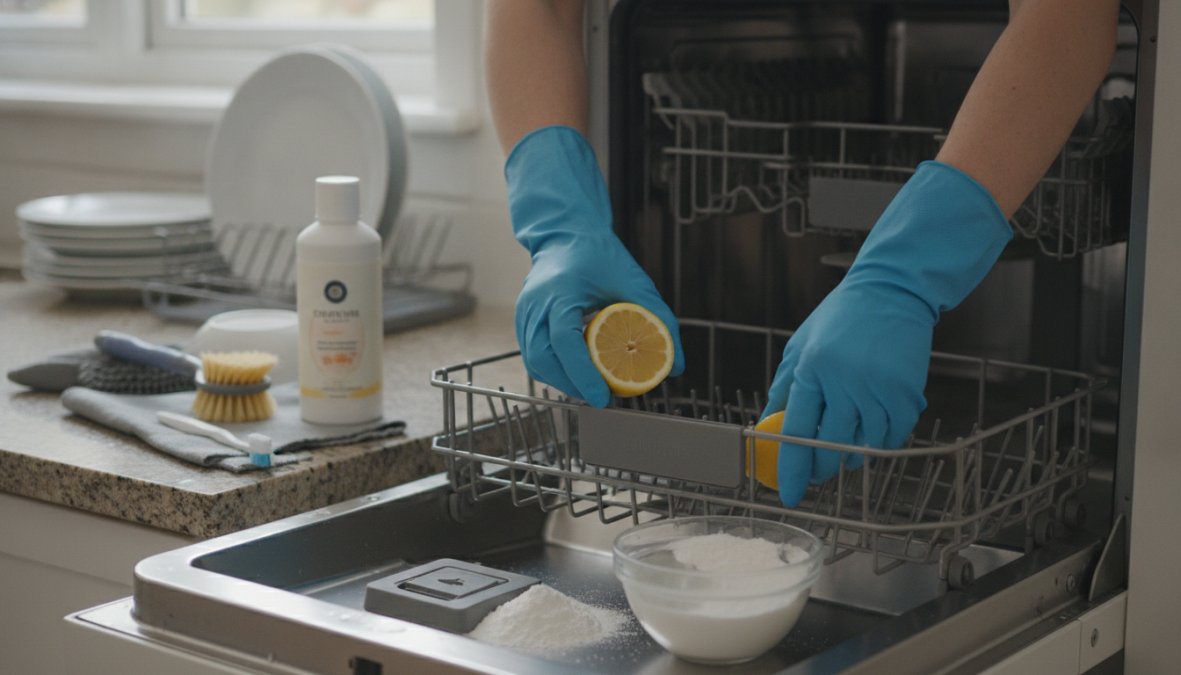
- White vinegar (5% acidity)
- Baking soda
- A soft brush or old toothbrush
- Rubber gloves
- A sponge or microfiber cloth
- Flashlight (optional)
Optional but recommended:
- Citric acid (for hard water areas)
- Pipe cleaner or flexible wire (for drain hose inspection)
White vinegar and baking soda are your primary weapons. Vinegar cuts through grease and kills bacteria, while baking soda neutralizes odors and acts as a mild abrasive. Together, they're more effective than most commercial cleaners and cost significantly less.
| Supply | Purpose | When to Use |
|---|---|---|
| White vinegar | Deodorize, dissolve grease, kill bacteria | Vinegar wash cycle, spot cleaning |
| Baking soda | Neutralize odors, gentle scrubbing | Filter cleaning, seal wiping |
| Soft brush | Scrub filter and spray arms | After soaking in vinegar |
| Rubber gloves | Hand protection | Throughout entire process |
| Citric acid | Remove hard water deposits, deodorize | Alternative to vinegar in hard water areas |
Step 1: Clean the Dishwasher Filter Properly
The filter is where most odor originates. Food particles accumulate here because the filter traps them before they reach the drain pump.
Locating and removing the filter: Open your dishwasher door and look at the floor. You'll see a cylindrical or rectangular cage-like structure at the bottom center or back, that's your filter. Twist it counterclockwise (or pull straight up, depending on your model) to remove it. Some filters have a secondary fine mesh filter above them; remove that too if present.
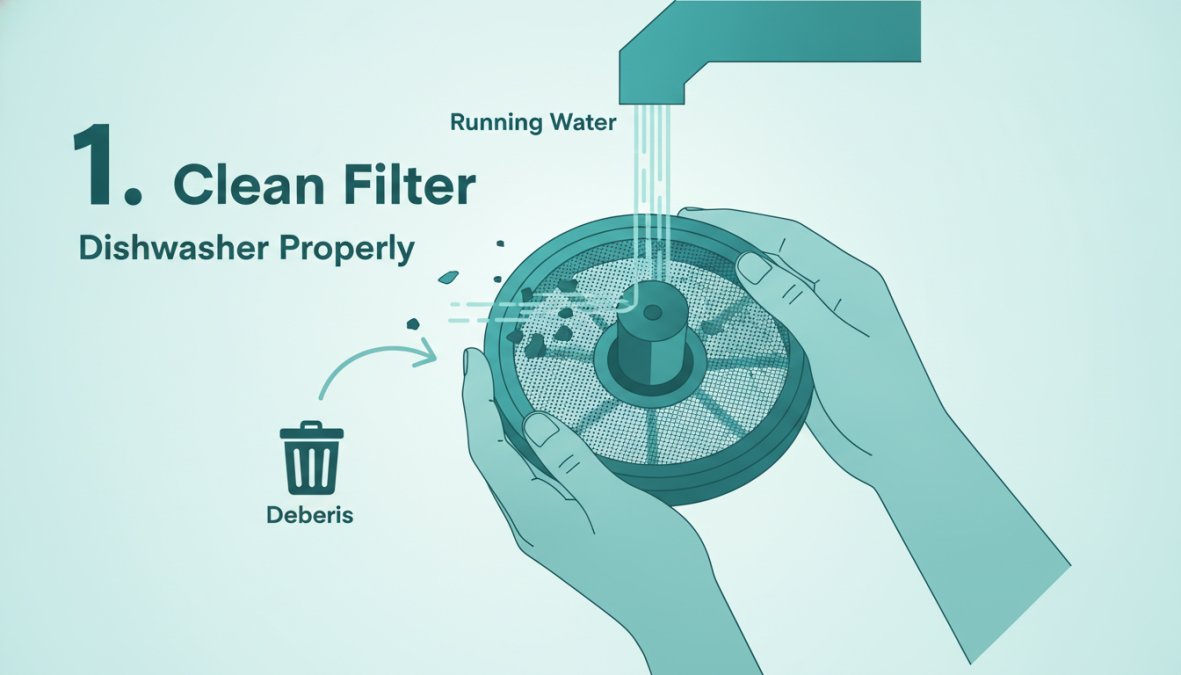
Removing food debris and buildup: Rinse the filter under hot running water to dislodge loose particles. Use your soft brush to scrub the mesh, getting into every groove. For stubborn buildup, soak the filter in a bowl of equal parts white vinegar and hot water for 15 minutes, then scrub again. Pay special attention to the underside where debris accumulates. Dry the filter with a clean cloth before reinstalling.
Step 2: Run a Vinegar Wash Cycle to Deodorize
After cleaning the filter, run a full vinegar wash cycle to deep clean the interior and kill odor-causing bacteria.
Using white vinegar for deep cleaning: Place a bowl filled with white vinegar on the top rack of your empty dishwasher. Run a hot water cycle (or the hottest cycle your machine offers). The heat and vinegar combination will circulate through the spray arms, dissolve grease from the walls, and kill bacteria in the drain. After the cycle completes, the dishwasher should smell noticeably better.
Alternative: Citric acid for hard water areas: If you live in an area with hard water, citric acid works better than vinegar because it specifically targets mineral deposits. Use 2 cups of citric acid in a bowl on the top rack and run the same hot cycle. For extremely hard water, run the vinegar cycle first, then follow with a citric acid cycle a few days later.
Step 3: Inspect and Clean the Drain Hose
The drain hose is a common source of odors because water can stagnate inside it, especially if the hose has kinks or low spots.
Checking for clogs and water stagnation: The drain hose connects your dishwasher to either your garbage disposal or directly to your home's drain line. Look for visible kinks or bends. If the hose dips below the water line of your sink drain, water can back up into the dishwasher, creating stagnation and odors. The hose should ideally have a slight upward slope toward the drain.
If you suspect a clog, disconnect the hose (place a towel underneath first) and run hot water through it. If water flows freely, the clog is minor. If it backs up, use a pipe cleaner or flexible wire to break up the blockage. Reattach the hose securely.
Air gap and garbage disposal connection issues: Many dishwashers connect through an air gap, a small cylindrical device mounted on the sink or countertop. If your dishwasher smells like sewage or rotten food, a clogged air gap is often the culprit. Unscrew the cap on top and look inside. Use a small brush or pipe cleaner to clear the interior and rinse thoroughly with hot water.
If your dishwasher drains directly into your garbage disposal, ensure the disposal is clean and functioning properly. A clogged or malfunctioning disposal can cause odors to back up into the dishwasher.
Step 4: Wipe Door Seals and Spray Arms
The rubber gasket around the dishwasher door and the spray arms are prime locations for mold and mildew growth.
Removing mold and mildew from rubber gaskets: Open your dishwasher door and inspect the rubber seal. You may see black spots, pink residue, or visible slime. Dampen a cloth with equal parts white vinegar and water, then wipe the entire gasket, paying special attention to corners and crevices. For stubborn mold, make a paste of baking soda and water, apply it to affected areas, let sit for 10 minutes, then scrub gently. After cleaning, leave the dishwasher door open for 15 minutes to allow the gasket to dry completely.
Cleaning spray arms for better water circulation: The spray arms are the rotating parts that spray water during the wash cycle. Remove them (most pop out or unscrew from the bottom and top of the tub). Soak them in hot vinegar for 15 minutes, then use a small brush or toothpick to clear each spray hole. Run hot water through them to flush out loosened debris. Reinstall them securely.
Diagnosing Sewage Smells: When It's More Than Odor
If your dishwasher smells like sewage or rotten eggs despite following the steps above, you may have a mechanical issue.
Drain pump and clogged drain troubleshooting: A failing drain pump can't evacuate water completely, leaving standing water at the bottom of the tub. This becomes a breeding ground for anaerobic bacteria, which produce rotten-egg or sewage smells. If you notice water pooling at the bottom after a cycle completes, the drain pump may be failing.
A clogged drain line will cause water to back up into the dishwasher. You may notice slow draining from your kitchen sink as well, a sign that the problem is in the main drain line, not the dishwasher itself.
When to call a professional repair technician: If you've completed all cleaning steps and the smell persists, or if you notice water pooling or slow draining, it's time to call a professional. A drain pump replacement requires disassembling the dishwasher, which is beyond a DIY cleaning project. Home Tech provides same-day and next-day dishwasher repair appointments across the Phoenix metro area. Call (602) 486-1901 to schedule an inspection.
Best Dishwasher Cleaner Products and Eco-Friendly Alternatives
While vinegar and baking soda handle most odor problems, commercial cleaners and alternative approaches exist.
Commercial cleaners versus natural solutions: Commercial dishwasher cleaners like Finish Dishwasher Cleaner and Affresh are formulated to dissolve grease and mineral deposits. They work faster than vinegar but cost more and introduce chemical residues. For most homeowners, white vinegar and baking soda deliver equivalent results at a fraction of the cost.
Detergent residue buildup and rinse aid impact: Excess detergent doesn't rinse away completely and leaves a film that traps food particles and bacteria. Using rinse aid (like Jet-Dry) helps water sheet off dishes and interior surfaces, reducing residue buildup. Check your rinse aid dispenser and refill if empty. A common mistake is using too much detergent, modern detergents are highly concentrated, and most dishwashers need only 1-2 tablespoons per load.
| Product Type | Cost | Effectiveness | Best For |
|---|---|---|---|
| White vinegar | $3-5/bottle | High for grease and bacteria | Budget-conscious, eco-friendly approach |
| Baking soda | $2-3/box | High for odor neutralization | Combining with vinegar, general maintenance |
| Commercial cleaners | $5-8/bottle | High for mineral deposits | Hard water areas, convenience preference |
| Rinse aid | $4-6/bottle | High for preventing residue | Hard water areas, improving drying |
| Citric acid | $6-10/container | Very high for hard water | Mineral-heavy water, limescale removal |
Dishwasher odors are preventable and fixable with the right approach. Most smells come from trapped food, grease, and bacteria, issues that respond well to vinegar, baking soda, and regular filter cleaning. If you've followed these steps and the odor persists, or if you notice water pooling or slow draining, the problem may be mechanical. Home Tech specializes in dishwasher repair and can diagnose drain pump failures and clogged drain lines. Our technicians service all major brands including GE, Whirlpool, LG, Samsung, and Bosch, with same-day appointments available across Chandler, Gilbert, Tempe, Scottsdale, and Phoenix. Call (602) 486-1901 or visit hometechappliancerepair.com to book your appointment today.
Frequently Asked Questions
Why does my dishwasher smell like rotten eggs or sewage?
Rotten egg smells typically indicate bacteria growth and food particle decomposition trapped in the drain hose, filter, or food trap. This occurs when water stagnates or food debris isn't properly removed. Check your drain hose for clogs, clean the dishwasher filter thoroughly, and inspect the garbage disposal connection. If the smell persists after cleaning, the drain pump may be failing, contact a repair technician to diagnose mechanical issues.
How often should I clean my dishwasher filter to prevent odors?
Clean your dishwasher filter monthly as part of preventative maintenance, and more frequently if you notice odors developing. Remove visible food particles after each load by rinsing the filter under hot water. Hard water areas may require more frequent cleaning due to limescale and mineral buildup. A consistent cleaning schedule prevents mold and mildew growth and keeps bacteria from accumulating in the food trap.
Can I use bleach to remove dishwasher odors?
No, avoid bleach in your dishwasher. Bleach can damage rubber seals and gaskets, leading to leaks and mechanical failure. Instead, use white vinegar or baking soda for natural deodorizing. Run an empty cycle with vinegar on the hot water setting to sanitize and eliminate odors safely. For hard water areas, citric acid is an effective alternative that won't harm your appliance.
What's the best way to fix how to fix dishwasher smells naturally?
The most effective natural method combines white vinegar and baking soda. First, clean the filter and spray arms to remove food particles. Run an empty hot water cycle with a bowl of white vinegar on the top rack to dissolve limescale and deodorize. Sprinkle baking soda on the bottom rack and run another cycle to eliminate remaining odors. This eco-friendly approach is safer than commercial chemicals and prevents detergent residue buildup.