 how-to
Common Causes of Refrigerator Electrical Failures
Table of Contents
- Why Refrigerators Fail Electrically: 7 Common Causes
- Refrigerator Keeps Tripping Circuit Breaker: What It Means
- Refrigerator Outlet Problems: When the Wall Is the Culprit
- Refrigerator Has No Power: Safe Step-by-Step Checks
- Refrigerator Reset Troubleshooting: What to Try First
- Prevention and Electrical Maintenance for Your Refrigerator
- When to Call a Professional for Refrigerator Electrical Repair
- Frequently Asked Questions
Last Updated: October 12, 2026
Why Refrigerators Fail Electrically: 7 Common Causes
A refrigerator electrical failure is any fault in the power path or control system that stops the appliance from running, cooling, or holding temperature. The most common causes: a tripped circuit breaker, a dead wall outlet, a loose or damaged power cord, a faulty control board, a failing compressor, a bad condenser fan motor, and worn internal wiring.
At Home Tech, we run these calls across the Phoenix metro every week. Most homeowners assume the fridge is dead. Usually, one link in the electrical chain has failed, and the fix is smaller than they fear.
Here are the seven causes we see most often:
- Tripped circuit breaker at the panel
- Dead or overloaded wall outlet
- Damaged power cord or plug
- Loose electrical connections at the terminal block
- Faulty control board or wiring harness
- Compressor malfunction or failed start relay
- Condenser fan motor failure causing overheating
The U.S. Fire Administration home electrical safety guidance notes that electrical faults remain a leading source of home fires, which is why we treat every fridge power issue as a safety check, not just a repair.
Refrigerator Keeps Tripping Circuit Breaker: What It Means
A refrigerator that keeps tripping the breaker is drawing more current than the circuit allows, or it has a short circuit or ground fault in its wiring. The breaker is doing its job; the question is whether the fault lives in the fridge or your home's wiring.
Appliance Fault vs. Household Circuit Fault
This split changes who you call.
Appliance fault: The refrigerator itself is pulling too much current or has a shorted component.
Household circuit fault: The circuit is overloaded or the wiring is old. Signs include the breaker tripping when other appliances run at the same time, or multiple outlets on the same circuit losing power.
| Symptom | Likely Fault | First Step |
|---|---|---|
| Breaker trips only when fridge kicks on | Appliance fault | Test compressor and start relay |
| Breaker trips when other appliances run | Household circuit fault | Move fridge to a dedicated circuit |
| Breaker trips immediately on reset | Short circuit | Stop and call a technician |
| Breaker trips after 10-20 minutes | Overheating or overload | Check condenser coils and fan |
A refrigerator should run on a dedicated circuit. Sharing one with a microwave or space heater causes nuisance trips, a wiring fix, not a fridge fix.
Refrigerator Outlet Problems: When the Wall Is the Culprit
A refrigerator outlet problem shows up as no power at the plug even though the breaker looks fine. Outlets wear out from heat, loose wiring, and moisture. What we check:
- Test the outlet with a small lamp or phone charger
- Look for scorch marks or a melted faceplate
- Check for a GFCI outlet that has tripped and needs a reset
If a lamp works in the outlet but the fridge does not, the problem is in the fridge. If nothing works, the outlet or circuit is the issue. Never run a fridge on an extension cord or power strip, they add resistance, heat up, and fail under the constant load a compressor pulls. Plug the fridge directly into its own wall outlet.
Refrigerator Has No Power: Safe Step-by-Step Checks
A refrigerator with no power needs an ordered check before anyone touches a wire. Work from the wall inward, and stop the moment you smell burning or see damage.
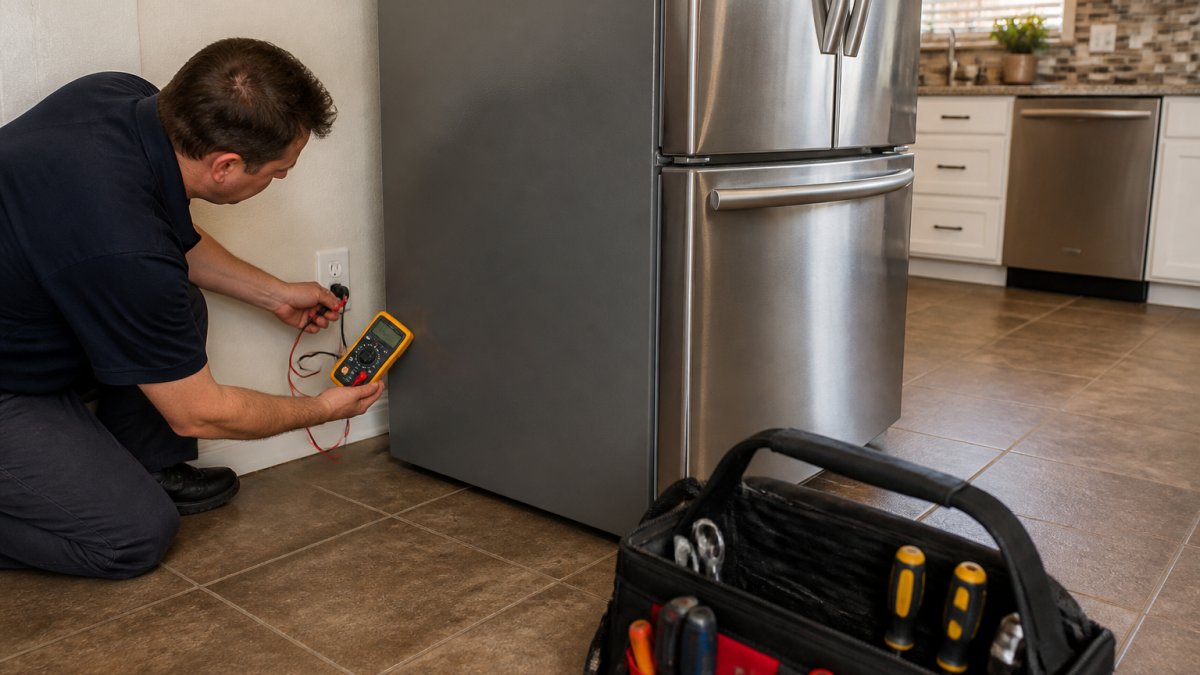
Total time: 15-20 minutes Difficulty: Beginner (visual checks only)
Follow these steps in order:
- Confirm the fridge is truly off. Check that the interior light does not come on.
- Check the breaker. Look for a tripped switch and reset it once. If it trips again, stop.
- Test the outlet with a lamp or charger.
- Inspect the power cord for cuts, kinks, or a scorched plug.
- Check the terminal block at the back of the fridge for loose or burnt wires (unplug first).
- Listen for the compressor. A hum with no cooling points to the start relay or compressor.
If all six checks pass and the fridge still will not run, the fault is inside the appliance.
Diagnostic Measurements That Narrow the Cause
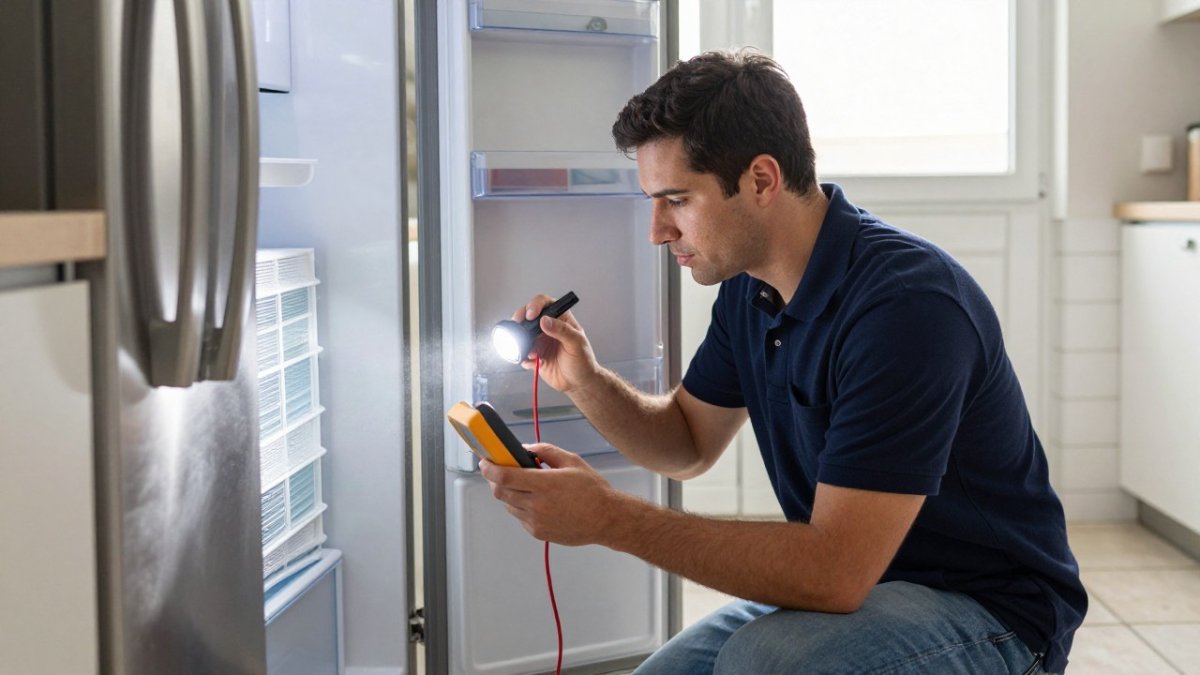
A multimeter turns guesswork into answers. We measure three things: voltage at the outlet, continuity through the cord and wiring, and current draw at the compressor.
- Voltage: A healthy outlet reads close to its rated voltage. Low voltage points to a supply problem.
- Continuity: With the fridge unplugged, a good cord and wire show continuity. No reading means a break.
- Current draw: A compressor pulling far more than its rating is failing.
These readings separate a household supply fault from an appliance fault fast, the difference between an electrician and an appliance tech.
Refrigerator Reset Troubleshooting: What to Try First
Refrigerator reset troubleshooting starts with a hard reset: unplug the fridge, wait one full minute, then plug it back in. This clears many control board glitches and costs nothing, but it only tells you whether the fault is transient or hard-wired. To know what you are dealing with, connect the symptom to the electrical mechanism behind it.
What Each Electrical Failure Mechanism Looks Like
Most guides list symptoms. The mechanism tells you whether the fault is in the fridge or the circuit, and whether it is safe to keep troubleshooting.
- Short circuit: A hot conductor touches a neutral or ground path where it should not. Current spikes instantly. The breaker trips the moment the fridge is plugged in or the compressor tries to start, and it will not hold on reset. This is the one failure mode where repeated resets are genuinely dangerous.
- Ground fault: Current leaks from the hot conductor to the metal chassis instead of returning on the neutral. You may feel a tingle when touching the fridge, or a GFCI outlet on the same circuit trips. A ground fault can exist without tripping a standard breaker, so never ignore a tingle.
- Failing start relay or start capacitor: The compressor tries to start, hums, and clicks off. The relay or capacitor that gives the compressor its initial torque is weak, so the compressor draws locked-rotor current, several times its running current, until the overload protector opens. This trips breakers after a delay, not instantly, and is one of the most misdiagnosed refrigerator electrical faults.
Matching the Symptom to the Mechanism
| What You Observe | Most Likely Mechanism | Safe Next Step |
|---|---|---|
| Breaker trips instantly on plug-in or reset | Short circuit | Stop. Do not reset again. Call a technician. |
| Breaker trips 10-30 minutes after the fridge starts | Overload, failing start component, or overheating | Check coils and condenser fan; test start relay |
| Fridge works intermittently, no breaker trip | Loose connection or damaged insulation | Unplug and inspect cord, plug, and terminal block |
| Tingle when touching the fridge | Ground fault | Stop using the outlet. Have the circuit checked. |
| Compressor hums, clicks, no cooling | Failed start relay or capacitor | Test or replace start components |
| Fridge powers on after reset but will not cool | Control board or sealed-system fault | Reset once; if it recurs, call a technician |
A reset that works for a day then fails again points to a failing component, the control board, start relay, or compressor. A reset that never works at all points to a hard fault, a short, an open wire, or a dead board, and no amount of resetting will change it.
Prevention and Electrical Maintenance for Your Refrigerator
Preventing refrigerator electrical failures comes down to three things: clean power, airflow, and catching small symptoms before they become component failures.
Protect the Power Path
- Keep the fridge on a dedicated circuit. A refrigerator's compressor draws a large inrush current every time it starts. When that circuit also feeds a microwave, space heater, or air fryer, the combined load pushes the breaker toward its trip threshold. Nuisance trips are the early warning; sustained overload heats the wiring behind the wall.
- Never use an extension cord or power strip. A compressor's starting current can exceed what a light-duty cord is rated to carry. The cord's resistance converts that current into heat at the plug and along the cord, which is how cord fires start. Plug the fridge directly into its own wall outlet.
- Confirm the outlet is not switched and not a GFCI that nuisance-trips. A fridge on a GFCI-protected circuit can trip the GFCI when the compressor's start winding leaks a small amount of current, even though nothing is wrong with the fridge. If it trips repeatedly, that is a circuit design question for an electrician, not a fridge repair.
Keep Heat Away From Electrical Components
- Clean the condenser coils every 6-12 months. Dust and pet hair insulate the coils, so the compressor runs longer and hotter to reject the same amount of heat. Longer run times mean higher current draw and more thermal stress on the start relay, capacitor, and compressor windings. In a hot, dusty climate, coils can clog in three months.
- Leave a few inches of clearance behind and beside the unit. Restricted airflow raises the temperature inside the compressor compartment, and heat ages every electrical component in that space.
- Check the condenser fan. With the fridge running, the fan behind or beneath the unit should spin and move air across the coils. A stopped fan turns the compressor compartment into an oven and is a common precursor to start-component failure.
Watch for Early Warning Signs
A refrigerator rarely fails electrically without warning. The signals worth acting on:
- The fridge runs constantly instead of cycling on and off. This points to a heat-rejection problem, dirty coils, a weak fan, or a failing compressor, and raises current draw on every component in the power path.
- The sides or back feel unusually hot. Some warmth is normal; hot to the touch means it is working too hard.
- The plug or outlet faceplate feels warm. That is resistance in the connection, a fire risk, not a nuisance.
A fridge that runs constantly, feels hot on the sides, or makes unusual noise is telling you something. Catch it early and you avoid a compressor replacement.
When to Call a Professional for Refrigerator Electrical Repair
Call a professional when the fault is inside the sealed system or control board, when the breaker will not hold, or when you smell burning.
Occupational Safety and Health Administration electrical safety guidance is clear that live electrical work carries real risk. Sealed-system and refrigerant work also requires EPA 608 certification.
Call us if you see any of these:
- Breaker trips every time the fridge runs
- Burning smell or scorch marks
- Compressor hums but never starts
Home Tech is a family-owned, Google Guaranteed company with EPA 608-certified technicians.
Our customers notice the difference.
Frequently Asked Questions
Can a faulty outlet cause a refrigerator to stop working?
Yes. A wall outlet with a loose connection, worn contacts, or a tripped GFCI can cut power to the refrigerator entirely. Test the outlet with a small appliance or lamp first. If the outlet works but the refrigerator does not, the problem is likely inside the appliance. If the outlet itself is dead, check the breaker panel before assuming the refrigerator needs repair.
Why does my refrigerator keep tripping the circuit breaker?
A refrigerator that repeatedly trips its breaker usually points to one of three things: a compressor drawing too much current, a short in the internal wiring or defrost system, or too many appliances sharing one circuit. Refrigerators should run on a dedicated circuit. If the breaker trips within seconds of plugging in, stop resetting it and call a technician to test the compressor and wiring.
How do I reset a refrigerator that is not cooling?
Unplug the refrigerator from the wall outlet and wait at least five minutes. Plug it back in and listen for the compressor to start within a few minutes. If the refrigerator has a control board, you can also try pressing the power or reset button if your model has one. If cooling does not return within an hour, the issue is likely electrical or mechanical rather than a simple reset.
What should I do if my refrigerator has no power at all?
Start at the wall: confirm the outlet has power by testing it with another device. Check the circuit breaker panel for a tripped switch and reset it once. Inspect the power cord for visible damage. If the outlet works and the cord is intact but the refrigerator stays dark, the fault is inside the appliance, likely the control board or main wiring harness, and it needs professional diagnosis.
A fridge that loses power, trips a breaker, or will not cool puts your food and your schedule at risk. Home Tech offers same-day and next-day appointments, no hidden fees, and a 100% satisfaction guarantee on every repair. Our technicians diagnose the real cause, fix it right, and clean up after themselves. Get started with Home Tech and get your refrigerator running safely again.